





























World War I Centennial News
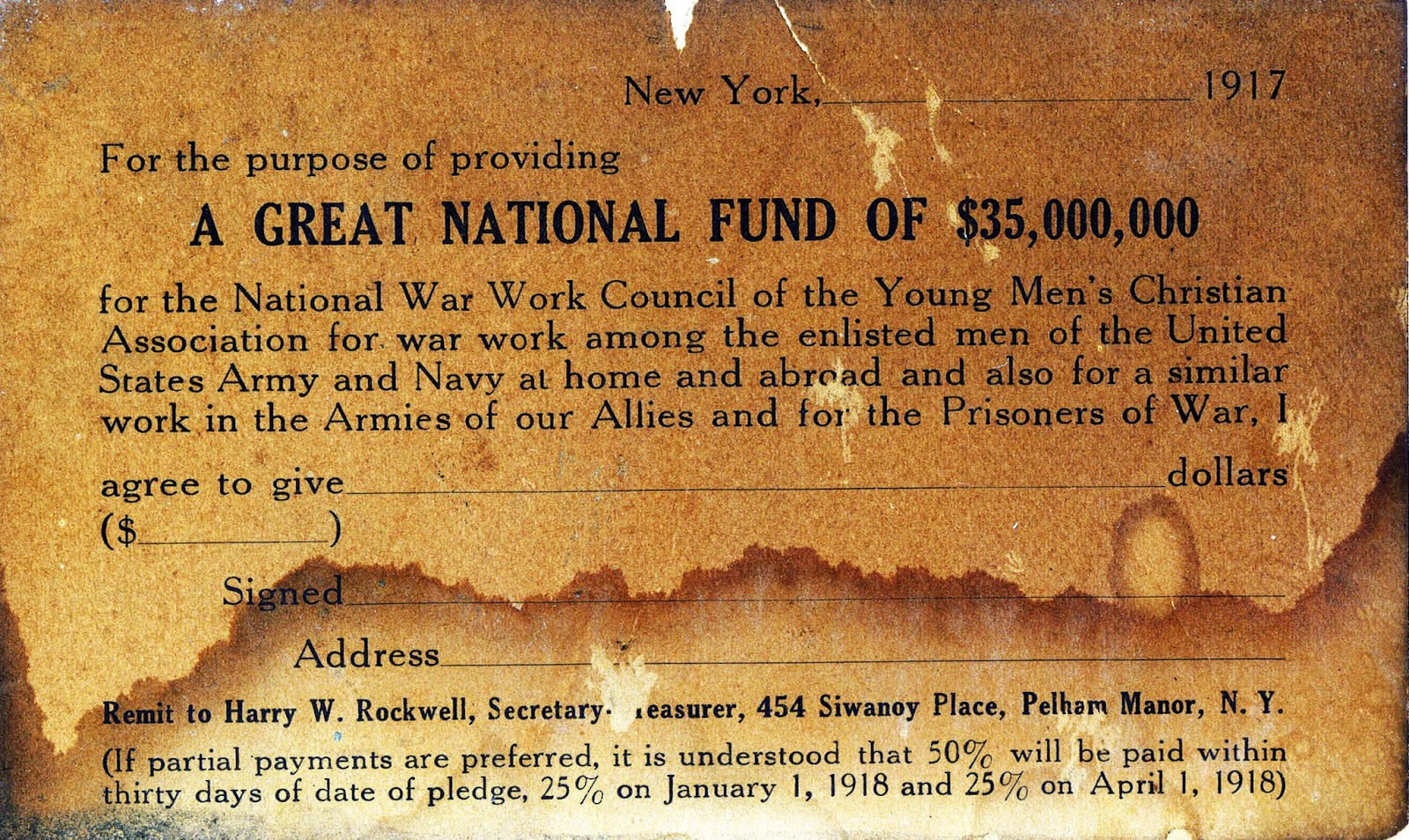 Obverse of Blank 1917 Local Pledge Card for National Campaign to Raise $35,000,000 for the Y.M.C.A.'s National War Work Council Via Pelham Campaign Committee. Source: Gift to the Office of the Historian of the Town of Pelham from Ms. Michele Egan.
Pelhamite Finds Important Local WWI National War Work Council Pledge Card Inside Walls of House
By Blake A. Bell
via the Historic Pelham (NY) web site
Pelham mobilized during World War I -- and again during World War II -- to defend the home front and to support the many young men who fought the war in Europe. Part of that mobilization was to provide monetary support to a national campaign to raise $35,000,000 for the Y.M.C.A.'s National War Work Council that funded efforts to provide comfort and support to American troops, Allied troops, and prisoners of war.
Recently, Pelhamite Michele Egan of Young Avenue discovered an unused pledge card issued by the local Pelham Committee in late 1917 to raise money locally for the National War Work Council inside the walls of her home. Ms. Egan has donated the pledge card to the Office of the Historian of the Town of Pelham. Today's Historic Pelham article presents images of the front and back of the card and places its history in context of the trying times faced by Pelham, the United States, and the World in late 1917 as World War I raged.
The Pledge Card
Images of the front and back of the recently-discovered pledge card appear immediately below. Each is followed by a transcription of its text to facilitate search.
Read more: Pelhamite Finds Important Local WWI National War Work Council Pledge Card
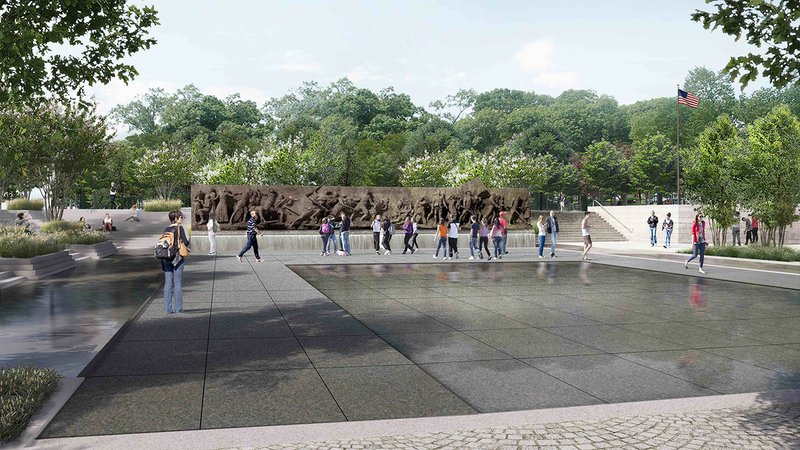 Image courtesy UA "The design has always been relatively simple and straightforward, even through its many iterations," architect Joe Weishaar says of the World War I Memorial he's designing in Washington, D.C. "Everything in the design needed to look and feel timeless to help the memorial feel relevant even in 200 years, so we've gone with materials that are very timeless themselves: bronze, granite, water, etc."
Victory in design contest led to elation, despair for WWI project, UA grad says
National WWI Memorial winner tells of fits, starts
By Jaime Adame
via the Arkansas Democrat Gazette newspaper Arkansas Online web site
FAYETTEVILLE -- The elation of winning a design competition for a national World War I memorial at age 25 turned at times to cynicism as unexpected obstacles emerged in the months after, architect Joe Weishaar said Wednesday.
"There were times I thought about leaving this project entirely," said Weishaar, a 2013 graduate of the University of Arkansas, Fayetteville.
The team of Weishaar and sculptor Sabin Howard was selected from more than 350 entries to design the privately funded National World War I Memorial.
In what is sometimes known as the Great War, 116,516 U.S. soldiers died, a total that includes 53,402 battle deaths, according to data published by the Congressional Research Service. The World War I Centennial Commission offered the design competition.
Weishaar talked at UA about the trials that followed the January 2016 design competition win, including an unanticipated push to preserve Pershing Park in Washington, D.C., where the memorial is expected to be built. Backers hope to have the project complete by November 2021.
About 70 people in attendance saw Weishaar present images of 16 designs that he said were worked up and presented to agencies as part of the lengthy approval process. Ultimately, the updated design was approved in July, Weishaar said.
"From time to time, this design process leaves you sort of incredibly cynical and maybe even a little bit feeling snarky" Weishaar said.
In meetings, groups would "nitpick" aspects of the memorial, Weishaar said. Comments led him to redo the work.
But the result ended up being a kind of "wonderful sort of experimentation process," Weishaar said.
Veterans History Project Updates Collections Policy and Scope, Includes Gold Star Voices
By Chris Isleib
Director of Public Affairs, United States World War One Centennial Commission
 Our friends at the Library of Congress have a special Congressional program called the Veterans History Project.
The mission of the Veterans History Project is to collect, preserve, and make accessible, the personal accounts of American veterans so that future generations may hear directly from veterans and better understand the realities of war.
They do this by working with organizations and individuals to obtain the first person narratives, in the forms of original unedited audio/video recorded interviews, photographs, letters, diaries, journals, military documents, two-dimensional artwork, maps and unpublished memoirs from U.S. veterans who professionally supported war/conflict efforts.
This past year, the Veterans History Project has made special effort to collect and preserve the stories of World War I - and they have found remarkable success in the form of donated WWI diaries, journals, and letters home.
This effort was so successful, that they have further expanded their materials acceptance policy. In a partnership with our friends at Gold Star Families, the VHP will now also collect, preserve, and make available, the important stories of America’s Gold Star veteran family members.
Read more: Veterans History Project Updates Collections Policy and Scope, Includes Gold Star Voices
Ceremony in advance of Fleet Week New York 2019
Public Invited to Special Wreath Ceremony at Cypress Hills National Cemetery, NYC
By Chris Isleib
Director of Public Affairs, United States World War One Centennial Commission
NEW YORK, NY — The upcoming Navy Fleet Week New York 2019 will come to New York beginning Thursday, May 22nd, and this year, the event will have a theme of ‘Remembering America’s World War I Veterans’.
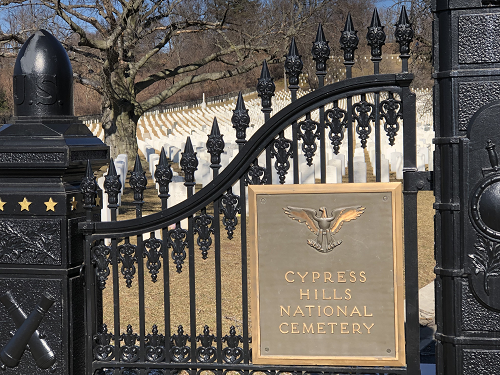 Gate to Cypress Hills National Cemetery, in New York CityAs Fleet Week approaches, the United States World War I Centennial Commission will host a commemorative event on May 2nd at historic Cypress Hills National Cemetery. There, we will take a moment to remember some heroes, who remain New Yorkers forever.
These heroes specifically include:
- Marine Sergeant Major Dan Daly, World War I hero and Double Recipient of the Medal of Honor
- Navy Coxswain John Cooper, Civil War hero and Double Recipient of the Medal of Honor
- Twenty-One World War I-era sailors of the French Navy, who passed away in New York during the influenza pandemic in 1918
- Three World War I-era sailors of the Royal British Navy, who also passed away in New York during the influenza pandemic in 1918
The public is invited to attend. The Cemetery is located at 625 Jamaica Avenue, Brooklyn, NY. Event will take place on Thursday, May 2nd, 2019 at 10:00am.
Ceremonial Color Guards will be provided from the Navy and Marine Corps Honor Guard in Washington DC. Music will be provided courtesy of the Navy Headquarters Ceremonial Band.
Featured guests for this commemoration will include representatives from the United States Navy, the United States Marine Corps, the Consulate of France, and the Consulate of the United Kingdom.
Other special guests will include members of the New York City Mayor's Office of Veteran Affairs, the New York City World War I Centennial Committee, the United War Veterans Council, professional historians, and many others.
Read more: Public Invited to Special Wreath Ceremony at Cypress Hills National Cemetery, NYC
Five Questions for Lucie Aubert, of the Yonne Historical Association
Remembering the Doughboys of Yonne, France
By Chris Isleib
Director of Public Affairs, United States World War One Centennial Commission
During the course of World War I, the entire nation of France was affected by the arrival of the two million American men and women serving with the American Expeditionary Force. These people not only manned the front lines of the war -- but, very importantly, they also built & operated hospitals, railway lines, roads, training facilities, port facilities, headquarters areas, and many other activities -- some of which remain to this day. Despite the hundred years that has passed, the impacts of these efforts are not forgotten. One place where the memories remain alive is in the Yonne Valley, to the southeast of Paris. Named after the river Yonne, it is one of the eight constituent departments of Bourgogne-Franche-Comté and was the site of the AEF's 16th Training Region. The Doughboys who trained there are well remembered. We were very lucky to speak to one of the leaders of the historical efforts in the region, Lucie Aubert. In addition to their various commemorative efforts, Lucie and her friends have created a website that tells the story of every single one of the 175 American service member who lost their lives in the Yonne, one hundred years ago.
This is remarkable vision. Tell us about your organization, and your activities to tell the story of the American Doughboys 100 years ago.
 Lucie Aubert, with the flags of the U.S. and of the Yonne Region of FranceWe are a non-profit organization since the March 9, 2019 named Yonne Doughboys. We commemorate and make known the American presence in the department of Yonne (France) during World War 1 we also pay tribute to the 175 Americans who died here. We do this with a website and memorial page for each soldier which contain personal data, military data and pictures (graves and when we have it a portrait).
You have incredible depth to your remembrance -- with stories on every single Sammy who passed away in Yonne. Tell us about your research, and how you got started. Who helped you, who have been your partners?
All start with my WW1 collection and each time I had an item, I tried to discover the story and more specifically the story of the man who had it. That’s why I wanted to know more about the US soldiers who were in my “state”. I asked the city of Tonnerre (city which hosted the 16th training area) and the archivist told me she had a list of soldiers which were buried in the city’s cemetery. I tried to know more about it and that’s the beginning of an incredible adventure. It was the November 30, 2017.
I found other lists in Yonne’s archives and I had the number of deaths with a document from American Battle Commission Monument which told me that we had 175 soldiers. I found a lot of them but few are not on my listing, 45, all buried in Saint Mihiel cemetery. I made a lot of research in France but found nothing. I asked a researcher in NARA to help me. As a student without money, I made a deal with him, we helped each other in our respective researches. Thank to him I had Access to all the documents I needed to have all the soldiers and even an unknown soldier.
Writing Lucky’s Way
"It was important for me to let people know what it was like during the year 1918."
By Gina Hooten Popp
Special to the United States World War One Centennial Commission web site
As an author, I don’t plan a story, but rather let the story come to and through me. So when Lucky’s Way—my historical fiction novel about a young World War One fighter pilot from Houston, Texas started to take shape in my imagination, I totally immersed myself in research about The Great War. From non-fiction books and documentaries containing historical facts and timelines to soldier’s diary entries and letters sent back home, I learned about the nuances of this fascinating era. But before I go into more detail about my research for Lucky’s Way let me back up and tell you a little bit about the book itself.
 Gina Hooten PoppLucky’s Way is the second book in my three-book historical fiction Texas series titled Winds of Change. (Don’t worry, you don’t have to read the entire series as each book stands alone. In fact, many readers have told me they read the series in reverse and enjoyed it just as much.) In The Storm After, the first book of the series, four survivors of the 1900 Galveston Hurricane come together to form a family of sorts as they recover from inconceivable loss. Seventeen years later in 1918, the historical fiction saga picks up in Lucky’s Way, following the same cast of characters (and a few new ones) all the way from war-torn France to the Gulf Coast of Texas.
In the opening chapter of Lucky’s Way, it is the month of September and The Great War is starting to show signs of a possible end. Lieutenant Lucky McLaren, a battle-weary U.S. fighter pilot, is headed home to Houston, Texas on an extended reprieve. But destiny has other plans for him when Antonia, an Italian beauty, suffragette and ex-Allied spy, seeks refuge in the same train car he is traveling on—changing not only his homeward bound direction, but also the course of both of their lives. Soon the young Lieutenant finds himself back overseas, fighting for his country and his life. Filled with history and passion, Lucky’s Way is an inspirational tale of healing and redemption—a stirring testament to the power of belief and self-discovery, to hopes lost and found again.
Yes, Lucky’s Way is a World War One love story. But as one of my readers told me, it is not a goopy love story, but rather one along the lines of Larry McMurtry’s Lonesome Dove. “Don’t worry,” the reader went on to say, “In addition to the romance there’s a lot of interesting information about the war and the time period.”
Which brings us back to what it was like to research a book set in World War One. So much has been printed about the war, but I wanted to give a glimpse of what it was like for the individual. So I started my research by reading diary entries. Before too long, the people who wrote them started to bring the time period alive for me. I was interested in what their everyday concerns were about, as well as what other events (beside the war) were happening globally.
From the World War I Centennial News Podcast
Remembering Veterans: Ken Buckles
In March 29th's edition of the World War I Centennial News Podcast, Episode 116, host Theo Mayer spoke with Ken Buckles, relative of the last surviving American WWI veteran, Frank Woodruff Buckles. Ken is the Executive Director of Remembering America's Heroes, an organization dedicated to the memory of the men and women who have served this country. The following is a transcript of the interview, edited for clarity: 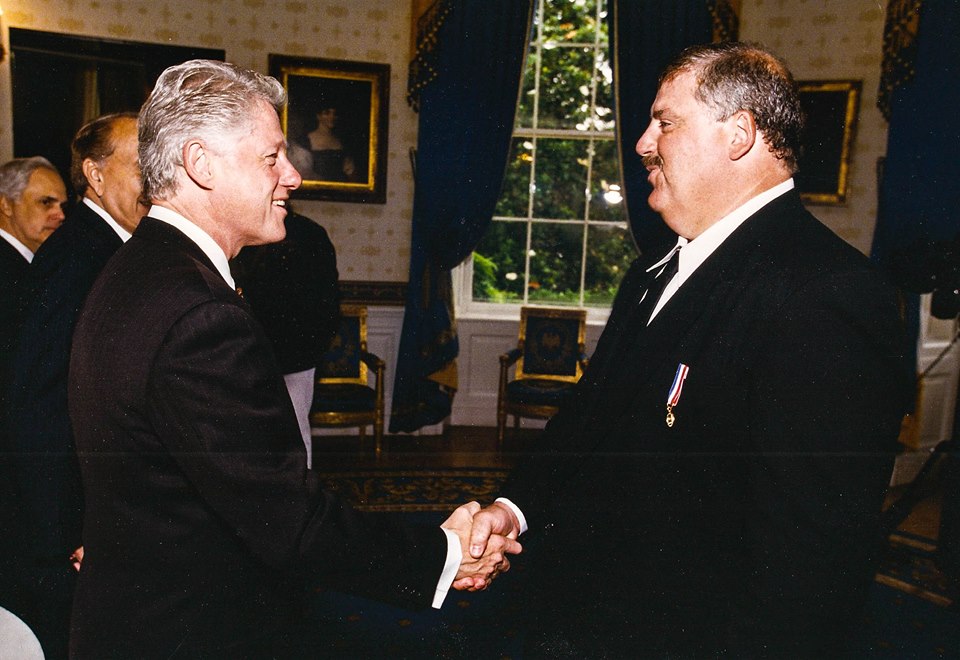 Ken Buckles, pictured here with President Bill Clinton
Theo Mayer: This week for Remembering Veterans, Frank Woodruff Buckles was a United States Army corporal and the last surviving American military veteran of World War 1. Frank enlisted in the US Army in 1917 at the age of only 16 and served with a detachment at Fort Riley driving ambulances and motorcycles near the front lines in Europe. Frank Buckles left us on February 27, 2011 at the age of 110. Many Americans have family traditions of service and so it is here. With us today is Frank's descendant Ken Buckles, who has been an educator for the Living History Day event since 1996 and is the Executive Director of Remembering American Heroes, an organization founded in 2002. Ken, welcome to the podcast.
Ken Buckles: Thank you.
Theo Mayer: Well it's nice to have you here. Let me start with a couple of questions about you personally. How are you related to Frank Buckles?
Ken Buckles: Well it's 1992, I was curious about family genealogy and my parents had given me a list of names that had eight names on it and I recognized my great-grandfather and my grandfather and of course my father, but nobody knew what the heck it was. So I found it and bam, it went to a genealogy center and found out with Robert Buckles descended from him and they had settled in West Virginia, Harpers Ferry. So I called information to see if there were any Buckles living in the area, and in those days they connected you and he answered the phone and that started about a nine-year relationship over the phone. Just an amazing, incredible man who lived a fascinating life. I could talk about him for hours, and he kept saying "when you're going to come out, when you're going to come out?" So I came out when he was 99 and then I visited him every year on his farm in West Virginia until he passed. And then of course his funeral was at Arlington National Cemetery.
From the World War I Centennial News Podcast
Post-War Transatlantic Flight
In March 29th's edition of the World War I Centennial News Podcast, Episode 116, host Theo Mayer told the story of the first flight across the Atlantic Ocean; a tremendous feat made possible by innovations in the flight technology that resulted from The War That Changed the World.
Theo Mayer: We've been spending a lot of time looking at the political ramifications in aftermath of World War 1, some progressive and some not much so. But the aftermath of World War 1 also had profound effects on technology and new technology driven industries- take aerospace, for example. Throughout the history of powered flight there have been a host of prizes for achieving major milestones.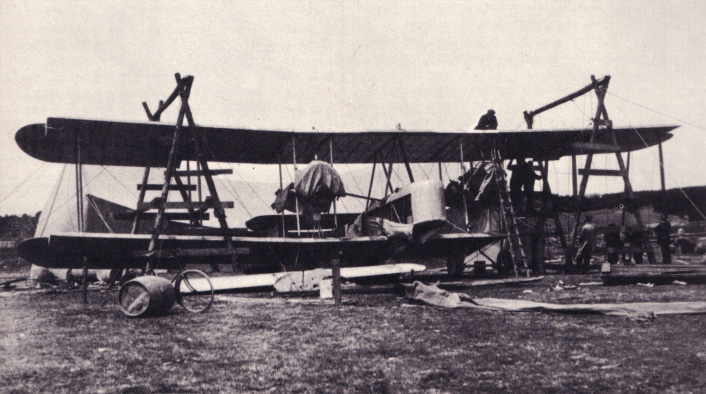 The modified Vickers Vimy bomber that carried Alcock and Brown across the Atlantic Ocean in 1919
One of the biggest ever was offered to the first pilot to cross the Atlantic in a single jump. It was a British newspaper, The Daily Mail, who as early as 1913 offered a ten thousand pound sterling prize to accomplish this feat, the equivalent of a little more than a million dollars today.
Driven by World War 1, airplane technology progressed substantially so that by 1919 a whole bunch of adventuring sky pioneers were aiming for the prize. The shortest distance between North America and Europe is the route between Ireland and Newfoundland, but that requires flying into the predominant headwinds so the adventurers all shipped their planes to Newfoundland to fly the other way. The region got so crowded with aviators that when John Alcock and Arthur Brown, the guys who eventually won the prize, shipped their airplane to Newfoundland they couldn't find an open pasture to work in, at least not until one of the other teams failed.
It's interesting to remember that in 1919, all planes were open cockpit. That means cold, miserable and really uncomfortable conditions. It also means you had to fly low under the weather- yuck. These two pioneers converted a Vickers Vimy bomber, which had twin engines, and replaced the bomb-carrying capacity with extra fuel tanks.
From the World War I Centennial News Podcast
WWI Remembered: Alan Axelrod on George Creel, America's Chief Propagandist- Part 1
In April 5th's edition of the World War I Centennial News Podcast, Episode 117, author Alan Axelrod joined the show to speak at length about George Creel, the publisher of the government's Official Bulletin and one of the most powerful war-time Americans. The following is a transcript of the interview, edited for clarity:
 Alan Axelrod is the author of over 150 books on topics such as history, management, and businessTheo Mayer: With us today is Alan Axelrod, the author of more than 150 books on leadership, history, military history, and business, among others. And one of those books that Alan wrote is called Selling the Great War: The Making of American Propaganda. It's the bio of George Creel. We got together to talk about George, and it turned into such an interesting conversation, we're going to have to break this out into two parts. Here's part one of George Creel, the man who sold America on World War I. Alan, welcome.
Alan Axelrod: Great to be with you.
Theo Mayer: Alan, you and I have talked about George Creel quite a bit, but let's maybe introduce him in a broad context first.
Alan Axelrod: Well, he was a young man from rural Missouri, who was the son of a doting mother and an alcoholic father, and not very well educated. But he had a quick mind, and he was intensely curious, and he became a journalist, sort of through the back door. He worked for some small town papers and then moved to New York, and found work as a joke writer. He eked out a living writing jokes that were just stuck in newspapers to fill space.
But eventually, he linked up with a few influential people, and he became a muckraker, he became a very socially high-minded journalist. And in this job, he became acquainted with Woodrow Wilson during his first run at the presidency, and he just fell in love with the man, he fell in love with progressivism. By the time Wilson stood for reelection in 1916, Creel had ingratiated himself with Wilson, and became the writer of Wilson's campaign, biography, and became a leading exponent of Wilson—particularly Wilson's opposition to any American involvement in World War I. And, of course, Wilson won by a very narrow margin, reelected largely on the campaign slogan "He kept us out of war."
Then, of course, he takes the oath of office, back in those days, in March of 1917. And on April 6 of that year, he asked Congress for a declaration of war so that the United States could join the war that he had kept the country out of during this first administration. And this put Creel in the position of having to turn the American public around, 180 degrees, from this orientation of pacifism, of absolute neutrality, to total commitment to a war in Europe.
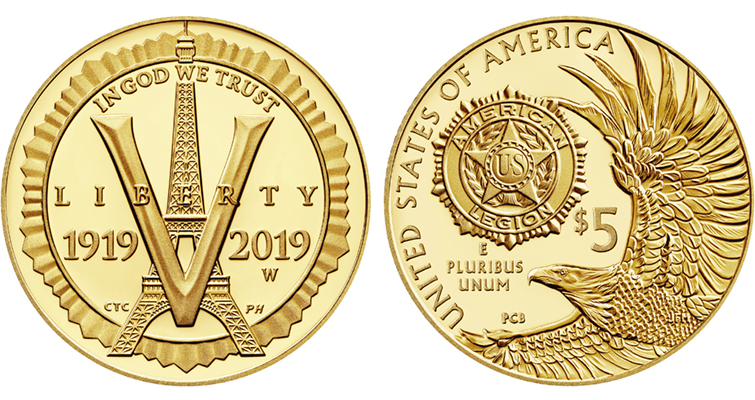 The U.S. Mint's American Legion commemoratives mark the centennial anniversary of the founding of the veterans organization in Paris in 1919 at the end of World War I. The program's Proof $5 half eagle is shown.
U.S. Mint releases images of struck 2019 American Legion Centennial coins
By Paul Gilkes
via the Coin World magazine web site
The United States Mint has released images of struck examples of the three 2019 American Legion 100th Anniversary commemoratives to be issued to the public at noon Eastern Time March 14.
The Mint will be offering Proof and Uncirculated versions of the program’s gold $5 half eagle, silver dollar and copper-nickel clad half dollar. The gold coin has a maximum authorized mintage of 50,000 coins, the silver dollar 400,000 coins, and the half dollar, 750,000 coins, across all product options.
The adopted designs approved by Treasury Secretary Steven Mnuchin were unveiled during an Aug. 29, 2018, event held in Minneapolis during the Legion’s 100th national convention.
The gold coins are being struck at the West Point Mint with the W Mint mark while the silver dollars will bear the P Mint mark of the Philadelphia Mint where they are being produced. The Proof half dollar will bear the S Mint mark of the San Francisco Mint and the Uncirculated half dollar the D Mint mark of the Denver Mint.
The half eagle obverse, designed by U.S. Mint Artistic Infusion Program artist Chris Costello and sculptured by U.S. Mint Sculptor-Engraver Phebe Hemphill, commemorates the inception of the American Legion and its mission to serve America and its war veterans. The outer geometric rim design from the American Legion emblem, the Eiffel Tower, and V for victory represent the formation of the organization in Paris in 1919 at the end of World War I.
Read more: U.S. Mint releases images of struck 2019 American Legion Centennial coins
From the World War I Centennial News Podcast
Commission News: Valor Medal Review Task Force, Part II
In March 29th's edition of the World War I Centennial News Podcast, Episode 116, host Theo Mayer spoke with Park University's Dr. Timothy Wescott and Ashlyn Weber, a history student, about their work with the Commission's Valor Medal Review Task Force. The following is a transcript of the interview, edited for clarity:
Theo Mayer: This week we want to introduce you to another one of our Valor Medal Task Force partners, the George S. Robb Centre for the Study of the Great War at Park University, a private school in Parkville, Missouri. Joining us today to talk about their part of the program are Dr. Timothy Wescott, Associate Professor of History and the Director of the George S. Robb Centre.
Joining him is Ashlyn Weber, a hi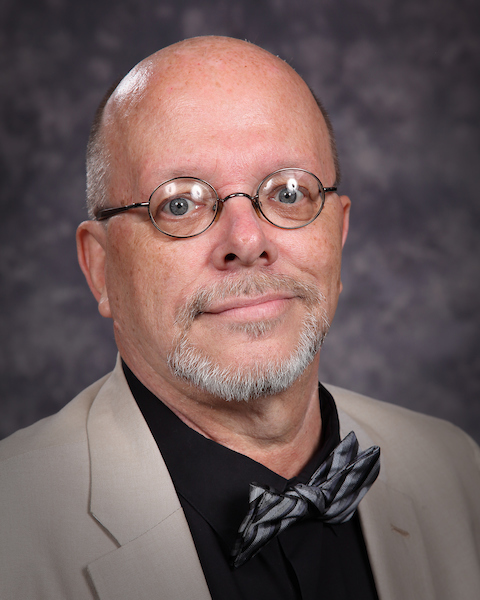 Dr. Timothy Wescott is the Director of Park University's George S. Robb Centre for the Study of the Great Warstory major at the University who's also working on the program. Both of you, welcome to the show.
Timothy Wescott: Thank you Theo, it's a pleasure to be with you today.
Ashlyn Weber: Thank you very much for having us.
Theo Mayer: So Tim, I'd like to start with you and ask you about the University's efforts on behalf of the Valor Medals Review Task Force. What role are you playing and what kind of activities you guys undertaking?
Timothy Wescott: Well the Centere is researching, we are drafting narratives and performing genealogical outreach with the actual descendants of the service members that we're researching.
Theo Mayer: About how many are there?
Timothy Wescott: Between the five groups that we are researching, which include Asian Americans, African Americans, Jewish Americans, Hispanic Americans, and Native Americans, we are estimating that will probably be 125 to 150 actual individual service members that we will review within the focus of the task force.
Read more: Podcast Article - Timothy Wescott and Ashlyn Weber Interview
Barrier Island Center Exhibit of African-American WWI Servicemen Includes Shore Soldiers
via the Eastern Shore Post newspaper (VA) web site
 Herbert Lee Byrd was an African-American World War I serviceman from the Eastern Shore of Virginia. The Barrier Islands Center in Machipongo is hosting a temporary exhibit on loan from the Library of Virginia, “True Sons of Freedom.”
To commemorate World War I, “True Sons of Freedom” uses photographs of African-American soldiers from Virginia who fought overseas to defend freedoms they were denied at home. African-Americans from all parts of the Commonwealth served in the army and navy during World War I. The soldiers highlighted in “True Sons of Freedom” came from locations across Virginia and most worked as farmers or laborers before the conflict.
Reflecting the pride and determination of African-American World War I servicemen, the images were submitted by these veterans with their responses to military service questionnaires created by the Virginia War History Commission as part of an effort to capture the scope of Virginians’ participation in the Great War. The series of questions about the veterans’ experiences provides invaluable genealogical information about the soldiers, their families, and their service records.
World War I recruitment efforts aimed at African-Americans brought new soldiers into the armed services, providing them with opportunities to travel, to work, and, in many cases for the first time, to face cameras—all outside the restrictions of the Jim Crow South. These pocket-size portraits, made outdoors or in makeshift studios, became mementos for families and sweethearts.
More importantly, these photographs challenge the crude and demoralizing cultural products of an era that often reduced African-Americans to stereotypes and denied them full participation as citizens of the United States. They posed in uniform, some in casual stances, others with a rifle to show their combat readiness. Here were African-Americans presented as they wanted themselves seen.
Read more: Barrier Island Center Exhibit of African-American WWI Servicemen
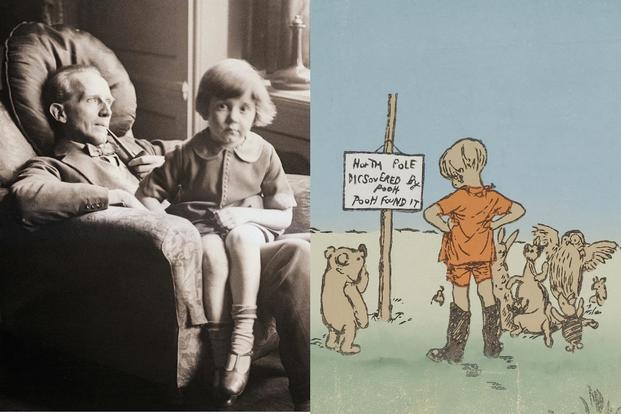 (Left) Alan Alexander Milne and his son Christopher Robin. (Right) Illustration from Winnie the Poo.
'Winnie the Pooh' Was Created by a Vet Explaining WWI to His Boy
By Eric Milzarski
via the Military.com web site
There is nothing more heart-wrenching to veterans with families than having to explain why daddy hasn't been the same ever since he returned from the war. A reasonable adult can grasp the idea that war is hell and that it can change a person forever, but an innocent kid — one who was sheltered from such grim concepts by that very veteran — cannot.
A. A. Milne, an English author and veteran of both World Wars, was struggling to explain this harsh reality to his own child when he penned the 1926 children's classic, "Winnie-the-Pooh."
As a young man, Alan Alexander Milne stood up for King and Country when it was announced that the United Kingdom had entered World War I. He was commissioned as an officer into the 4th Battalion, Royal Warwickshire Regiment, as a member of the Royal Corps of Signals on February 1, 1915. Soon after, he was sent to France to fight in the Battle of the Somme.
The description, "Hell on Earth" is apt, but doesn't come close to fully describing the carnage of what became the bloodiest battle in human history. More than three million men fought and one million men were wounded or killed — many of Milne's closest friends were among the numerous casualties. Bodies were stacked in the flooded-out trenches where other men lived, fought, and died.
On August 10, 1915, Milne and his men were sent to enable communications by laying telephone line dangerously close to an enemy position. He tried warning his command of the foolishness of the action to no avail. Two days later, he and his battalion were attacked, just as he had foreseen. Sixty British men perished in an instant. Milne was one of the hundred or so badly wounded in the ambush. He was sent home for his wounds suffered that day.
Milne returned to his wife, Daphne de Selincourt, and spent many years recovering physically. His light finally came to him on August 21, 1920, when his son, Christopher Robin Milne, was born. He put his writings on hold — it was his therapeutic outlet for handling his shell shock (now known as post-traumatic stress) — so he could be the best possible father to his baby boy.
Read more: 'Winnie the Pooh' Was Created by a Vet Explaining WWI to His Boy