






























World War I Centennial News
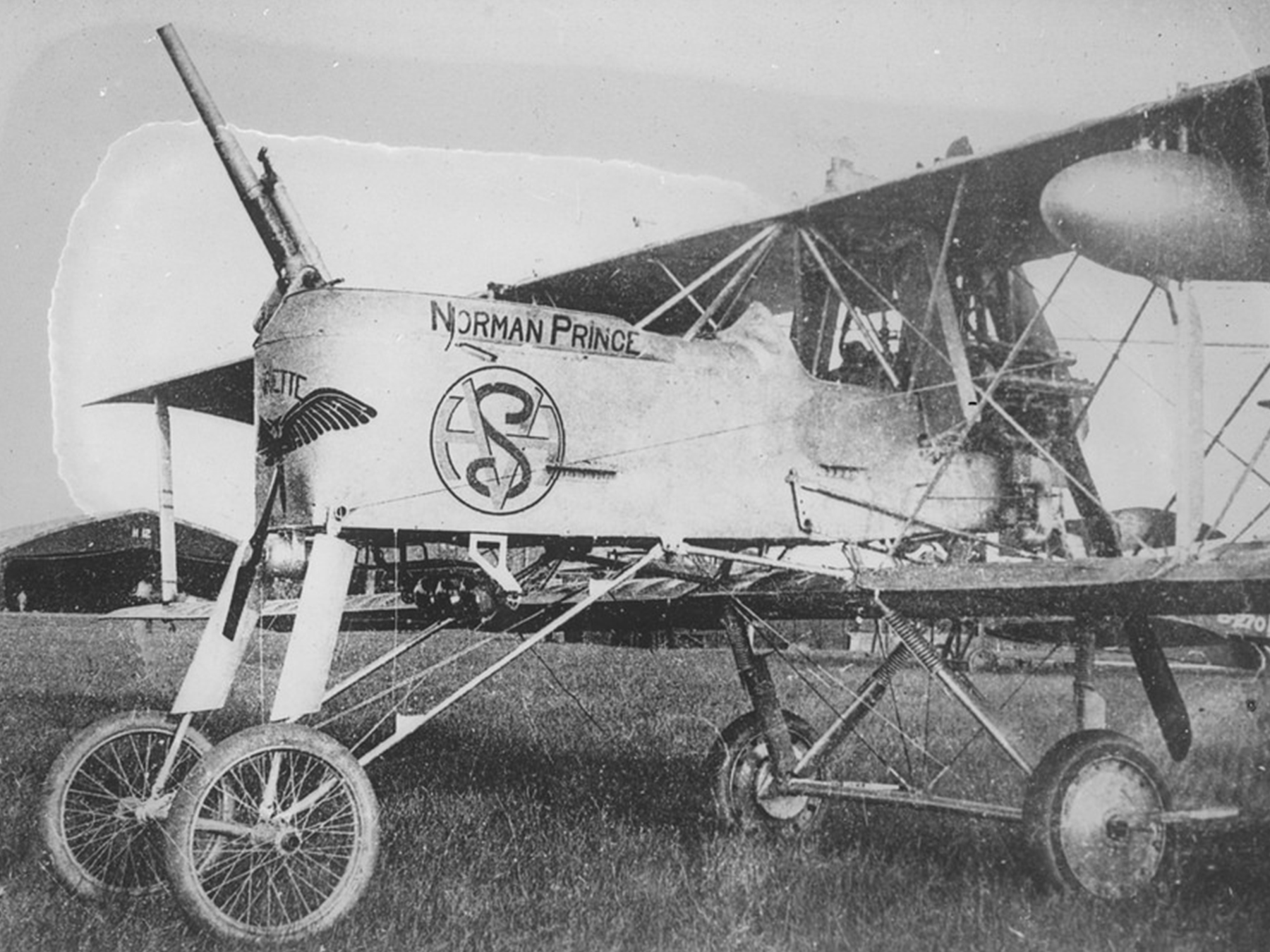 Voisin Type 8 Voisin 8 / Voisin VIII) pusher equipped with what appears to be a 37mm cannon. The Voisin Type 8, in particular the cannon armed type, was used frequently on night attack and bombing missions by the French air services during the First World War. Norman Prince was an American aviator and pilot who was a founding member of the Lafayette Escadrille. Prince would perish from head injuries sustained in October 1916 when his Nieuport 17 tangled with telegraph cables and crashed. This aircraft was named "Norman Prince" in his honor. (Provincial Archives of Alberta.)
"A Prince In Sky-Blue Uniform" pays tribute to WWI American aviator Norman Prince
via the French Cultural Center of Boston web site
On April 19, 2019 the French Cultural Center of Boston will present a live theatre play entitled " A Prince In Sky-Blue Uniform: Paying Tribute to War Hero Norman Prince" at 6:30 p.m. at the Center.
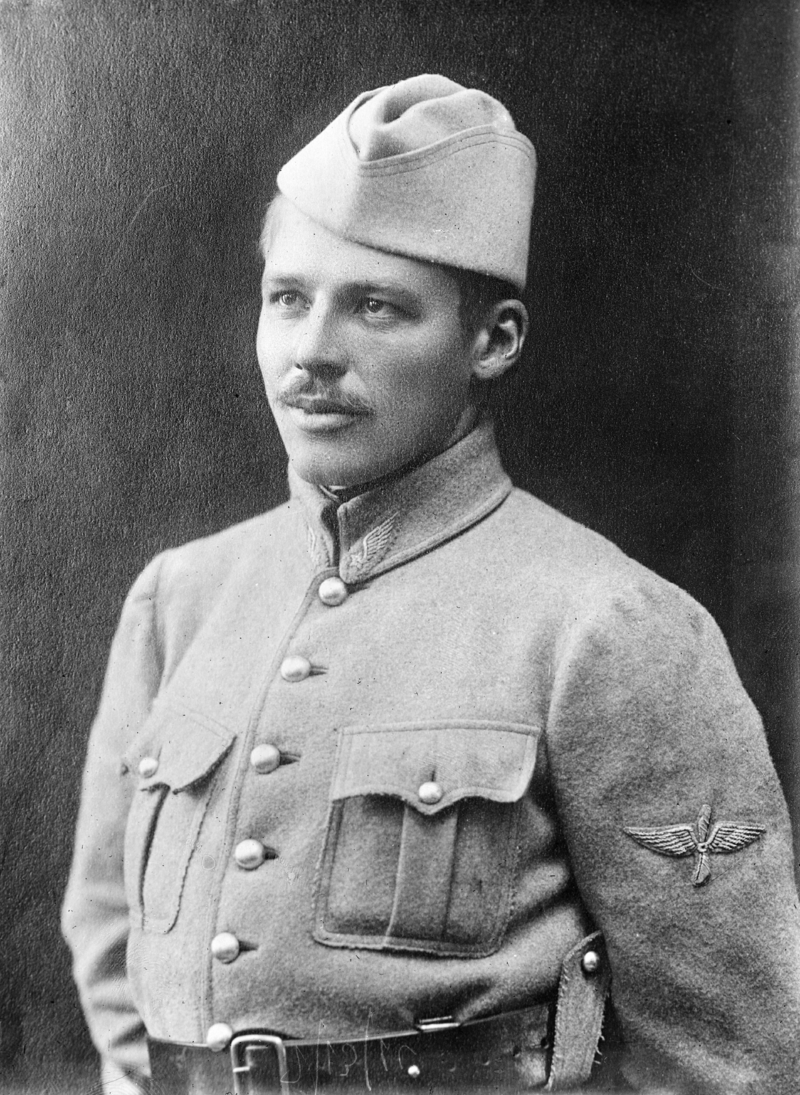 Sous Lieutenant Norman Prince in the summer 1916.The emotional play, written by Jean-Claude Redonnet and directed by Richard Sewell, pays tribute to Massachusetts-born war hero Norman Prince, portrayed by David Bliss. Norman is one of the many Americans who fought and perished for the freedom of France and the World during World War I.
The 40-minute play will be introduced by Jean-Claude Redonnet. A complimentary wine reception will follow the performance. RSVP is required; tickets will not be sold at the door. Click here for more information & reservations.
In October 1916, American aviator Norman Prince (1887-1916) succumbed to wounds inflicted during the crash of his Nieuport combat aircraft during WWI. This imaginary monologue represents Norman in the hospital during his last three days and evokes his commitment as an American volunteer in the service of France. Its objective is to deepen our understanding of the fallen hero and his relationship with his environment, comrades of the air squadron (Escadrille Lafayette) he helped create, and fellow citizens whose country is in the last days of its WWI neutrality.
Prince was born on August 31, 1887 in Beverly, Massachusetts and graduated from Harvard Law School in 1911. In January 1915, Norman, who spoke fluent French, sailed to France, and persuaded the French to allow the founding of the American Escadrille (squadron) in April 1916. Norman Prince was involved in 122 aerial combat engagements in which he was officially credited with five victories.
Prince was awarded the French Legion of Honor, Médaille Militaire, and Croix de Guerre. Prince was severely injured and died on October 15, 1916. His body was returned to the United States and buried in an elaborate tomb at the National Cathedral in Washington, D.C.
Read more: "A Prince In Sky-Blue Uniform" pays tribute to WWI aviator Norman Prince
Dayton photographer part of World War I documentary
By Ty Greenlees
via the Dayton Daily News (Ohio) newspaper web site
DAYTON, OHIO — Last year, 2018 marked the 100th year since the end of World War I. The War to End All Wars was not only historic for the immense loss of life and more powerful weapons, but it was the first use of powered aircraft in warfare.
Volunteer pilots from the United States formed the Lafayette Escadrille under French command in 1916 to fly and fight for the French, and eventually move the U.S. to join their Allies in the war.
The flying was dangerous, even without the war. The rudimentary biplane designs made from wood and fabric had barely progressed past the Wright’s first flight a short 13 years before.
In celebration of this 100th anniversary of WWI, four collaborators from across the U.S. — including one from Dayton — released a documentary about the Lafayette Escadrille.
Dayton Connection
Local aviation photographer, historian and author Dan Patterson is one of the producers and the art director of a 20-minute documentary version for The United States World War One Centennial Commission titled “The Lafayette Escadrille.”
The film makers collected original film footage, photographs and historical records and conducted interviews with descendants of the pilots. Film of replica WWI aircraft in dogfights over the Pennsylvania countryside is used to give a pilot’s perspective of the close combat between the fragile airplanes.
Read more: Dayton photographer part of World War I documentary
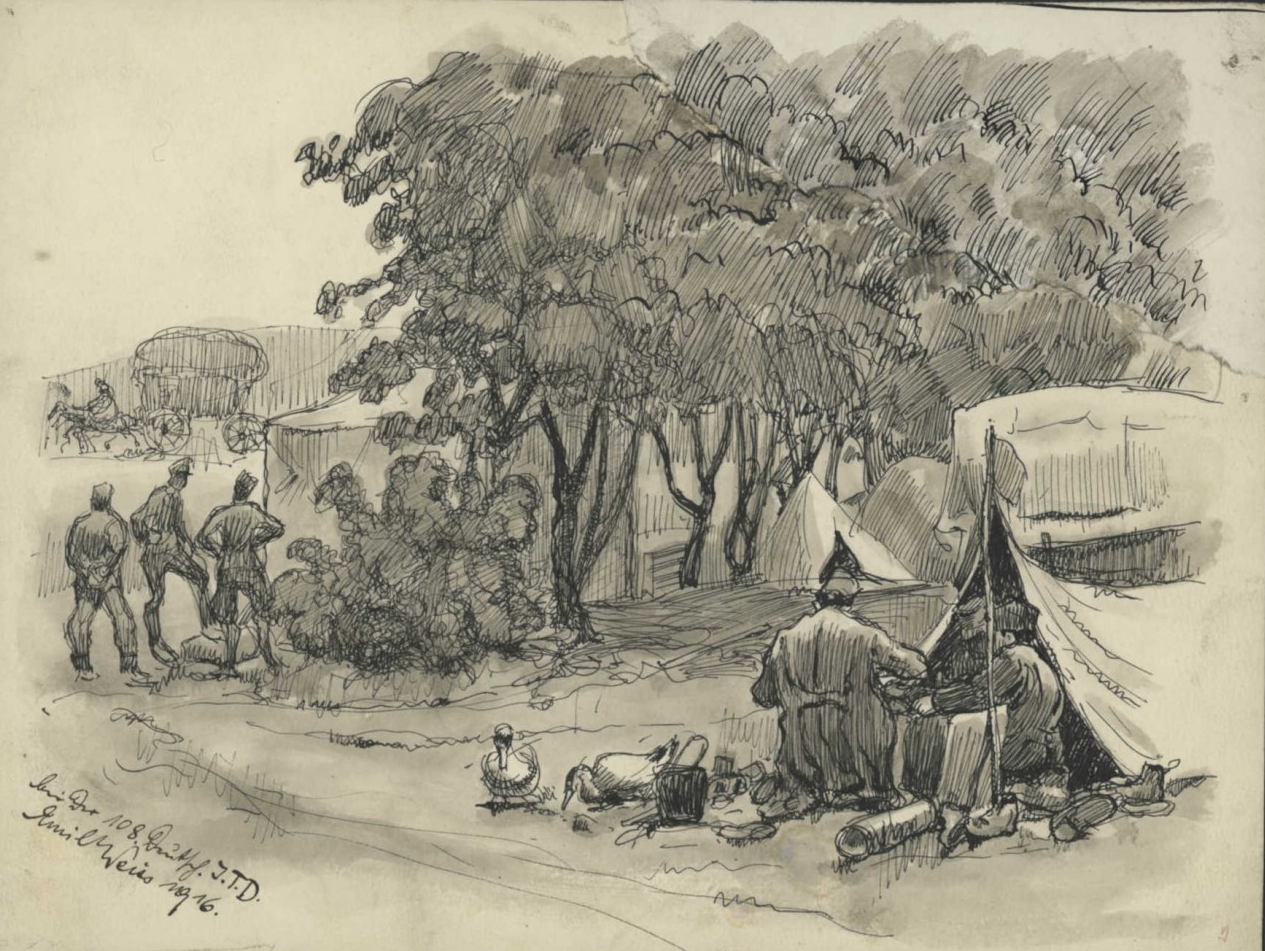 A sketch by Emil Weiss, who was one the official Austro-Hungarian war artists who documented the war through art and emigrated to the US in 1948. His grandson brought a collection of sketches, posters and drawings from his war time service. Photo courtesy of Connecticut State Library.
NEH Grant Helps Connecticut to Remember WWI
By Christine Pittsley
Connecticut WWI Centennial Committee
With the help of an NEH grant, the Connecticut State Library has documented more than 450 men’s and women’s experiences in World War I. Over the course of four years, the Remembering World War One project collected nearly 5,000 images and artifacts illustrating these individuals’ stories. This extensive and deeply personal collection was amassed through 47 public digitization events hosted by partner institutions throughout the state. Remembering World War One stands out as an exceptionally comprehensive state-wide commemoration of the war’s centennial; it garnered two nationally-syndicated AP stories and numerous local television and radio spots.
NEH funding enabled the Connecticut State Library and its diverse partner institutions to sponsor public programming in advance of these digitization events. They gathered communities to remember the war, raised awareness about the project, and prompted Connecticut residents to consolidate and prepare their family heirlooms for the public archive. Participants contributed a range of objects, including a box of personal effects that had been shipped to one man’s family when he was wounded in the Battle of the Marne. Preservationists helped a woman identify medals that recognized her grandmother’s courageous service in the Slovakian Red Cross. “We were able to tell not only the story of Connecticut during the war,” says project director Christine Pittsley, “but of Connecticut after the war: the people that came to our state and make up our state today.”
The program’s impressive impact continues to expand. Connecticut residents are still contributing to the growing archive through an online portal, and local historical societies are able to easily contribute to the Connecticut Digital Archive using a system developed by the library. The program also facilitated state-wide digitization events for Rhode Island and Maine—the Maine State Library will soon adapt the training they received to commemorate their state bicentennial. And for three years now, journalism students at Southern Connecticut State University have participated in the project as part of their capstone course, recording oral histories from those who contributed particularly interesting items.
For the full display of what is available, go to https://nehforall.org/projects/remembering-world-war-one-connecticut
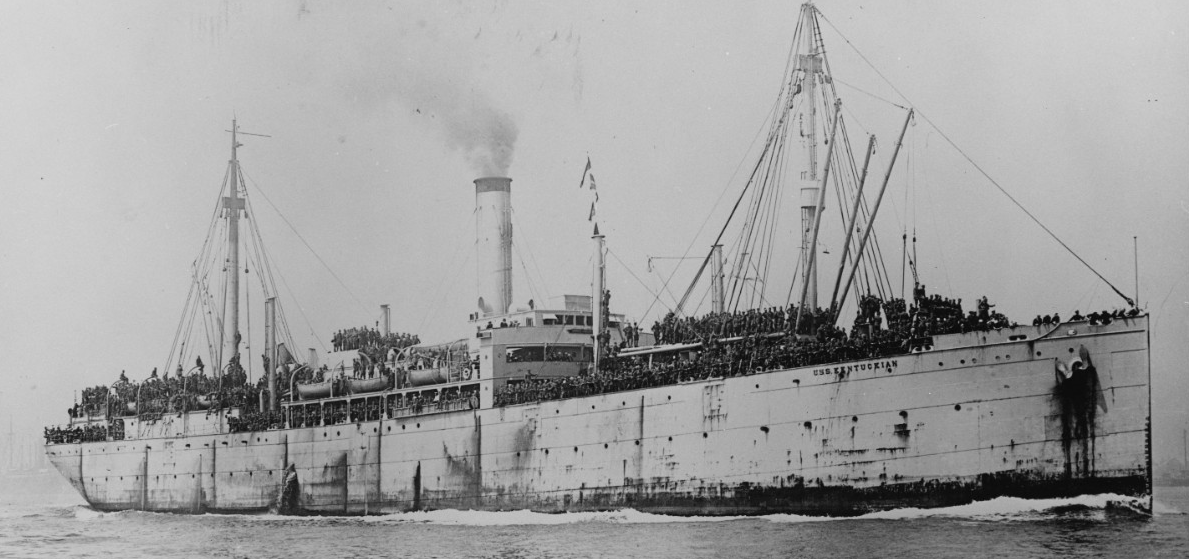 This picture of the USS Kentuckian returning to the United States with troops from France in 1919, taken by Enrique Muller, Jr., is one of over one million photos in the photo archives of the Naval History and Heritage Command.
A Century of Service with the U.S. Navy Photo Archive
via the Naval History and Heritage Command's The Sextant web site
From Naval History and Heritage Command, Histories and Archives Division
January 2019 marked the 100-year anniversary of the creation of the U.S. Navy’s Photo Archive, currently held at the Naval History and Heritage Command at the Washington Navy Yard. The Navy’s collection of historical records predates the National Archives (established in 1934) and originally began in the Office of Naval Records and Library (NR&L). The first expansion of the activities of the Historical Section had been the establishment on Jan. 1, 1919 of a Pictorial Branch whose purpose was to collect and file under proper references photographs illustrating activities of U.S. and foreign navies. A follow-up in the form of an ALNAV 86 dated March 14, 1919 requested that copies of photographs and motion pictures of naval activities, ships, bases, personnel, and incidents taken during the war be forwarded to the Historical Section. Subsequently a letter over the signature of the Secretary of the Navy addressed to all Bureaus stated:
“A photographic Division of the Historical Section has been established, in which will be gathered and filed all the photographs of historic interest taken of Naval activities during the war. As the issuance of a Pictorial History of the War is contemplated, it is desirable for the Historical Section to have copies of all Navy photographs of interest; and it is requested that each Bureau furnish to the Historical Section, Room 1732, Navy Department, two copies of all such photographs it has, and that each contractor who was engaged in Navy work be requested to furnish such photographs.”
The Photo Archive, in its current state, is part of the Histories and Archives Division of the Naval History and Heritage Command. The Photo Archive’s collections are related to the U.S. Navy (or other navies when specifically associated with U.S. involvement or historical events) with specific emphasis on ships, aviation, places, wars/events, activities, and significant individuals associated with naval history. Photographs in the collection reflect both official and unofficial naval viewpoints and consist of mostly private donations by the general public. The general date range of the collection is from the mid-19th century to the 1990s, with particular focus on the World War II era. Our entire holdings consist of approximately one million photographs dating as early as pre Civil War. Formats include daguerreotype, ambrotype, carte de visite, cyanotype, glass plate negatives, prints, transparencies, slides, and negatives.
Read more: A Century of Service with the U.S. Navy Photo Archive
From the World War I Centennial News Podcast
The Great War and the Great Depression: Exploring the Connection with Professor Maury Klein
In March 15th's edition of the World War I Centennial News Podcast, Episode 114, host Theo Mayer spoke with history professor and author Maury Klein about the often forgotten connection between two of the most catastrophic events of the 20th century. The following is a transcript of the interview, edited for clarity:
Theo Mayer: For our listeners who have been with us for a while, you know that a core theme for the podcast is highlighting how the once-named "forgotten war" is in truth the war that changed the world. How we can trace so much of the foundation of the 20th and even 21st century to this founding event. Our regular listeners also know that I'm not a historian, I'm just a very curious guy who's discovering all of this with you. Well, for months, especially as we started to look forward being the Armistice, I've been captivated by the connection between this once obscure World War I and the pretty well known and even famous follow up events like the women's right to vote, prohibition, the roaring 20s, and one that I've been really interested in connecting the dots to, the giant crash of 1929 and the following depression. That's why I was so excited to come across an article that drew the lines between the Great War and the Great Depression. With us today is a Professor Emeritus of history, from the University of Rhode Island, an author who's written about this, Professor Maury Klein. Maury, welcome to the podcast.
 Puget Sound Navy Yard, Bremerton, Washington. Yeoman (F) boat crew, wearing N (for Navy) sweaters, 1918. Chief Boatswain’s Mate Philip Andrew Carey, the crew coach, is seated in front.
A U.S. Navy with Women: Stronger, More Efficient and More Capable
By Dr. Regina T. Akers
via the Naval History and Heritage Command web site
Editor’s note: ‘Why We Do What We Do’ is an initiative CNO Richardson asked the Naval History and Heritage Command to help share with the fleet. Each month, our historians will dissect a seminal moment in our Navy’s past and then highlight the lessons we learned. The purpose, is to ground today’s Sailors in their history and heritage by explaining the reasons behind some of today’s seemingly mundane or routine activities and actions.
The Navy’s First Enlisted Women, 1917-1918
Secretary of the Navy Josephus Daniels began preparing for the United States’ entry into World War I before Congress declared war in April 1917. While assessing the administrative, material, personnel, strategic other requirements, Daniels discovered that the Civil Service Department could not provide an adequate number of workers. He was delighted to learn, however, that there were no legal barriers to recruiting women, as the Naval Reserve Act of 1916 permitted any U.S. citizen to serve. Rear Admiral Leigh C. Palmer, Chief of the Bureau of Navigation, announced via his 19 March 1917 memo that the Navy was enlisting women for primarily clerical duties. Loretta Perfectus Walsh of Olyphant, PA distinguished herself as the first female enlistee.
The recruitment of women began soon afterwards without thorough planning, leaving the Bureau of Navigation with administrative hurdles. For the first time the Navy had to designate gender, give a large number of women physical exams, and provide women with uniforms and housing. The bureau identified female yeomen as Yeoman (F.), the “F” indicating gender. Since they did not attend basic training, the Navy taught female recruits how to drill, how the Navy operated, and the requirements for enlisted personnel in the evenings after their work day. Insufficient housing and no access to mess halls led the Navy to pay the women stipends to supplement those expenses.
Read more: A U.S. Navy with Women: Stronger, More Efficient and More Capable
The East Coast Doughboys march in NYC St. Patrick’s Day Parade
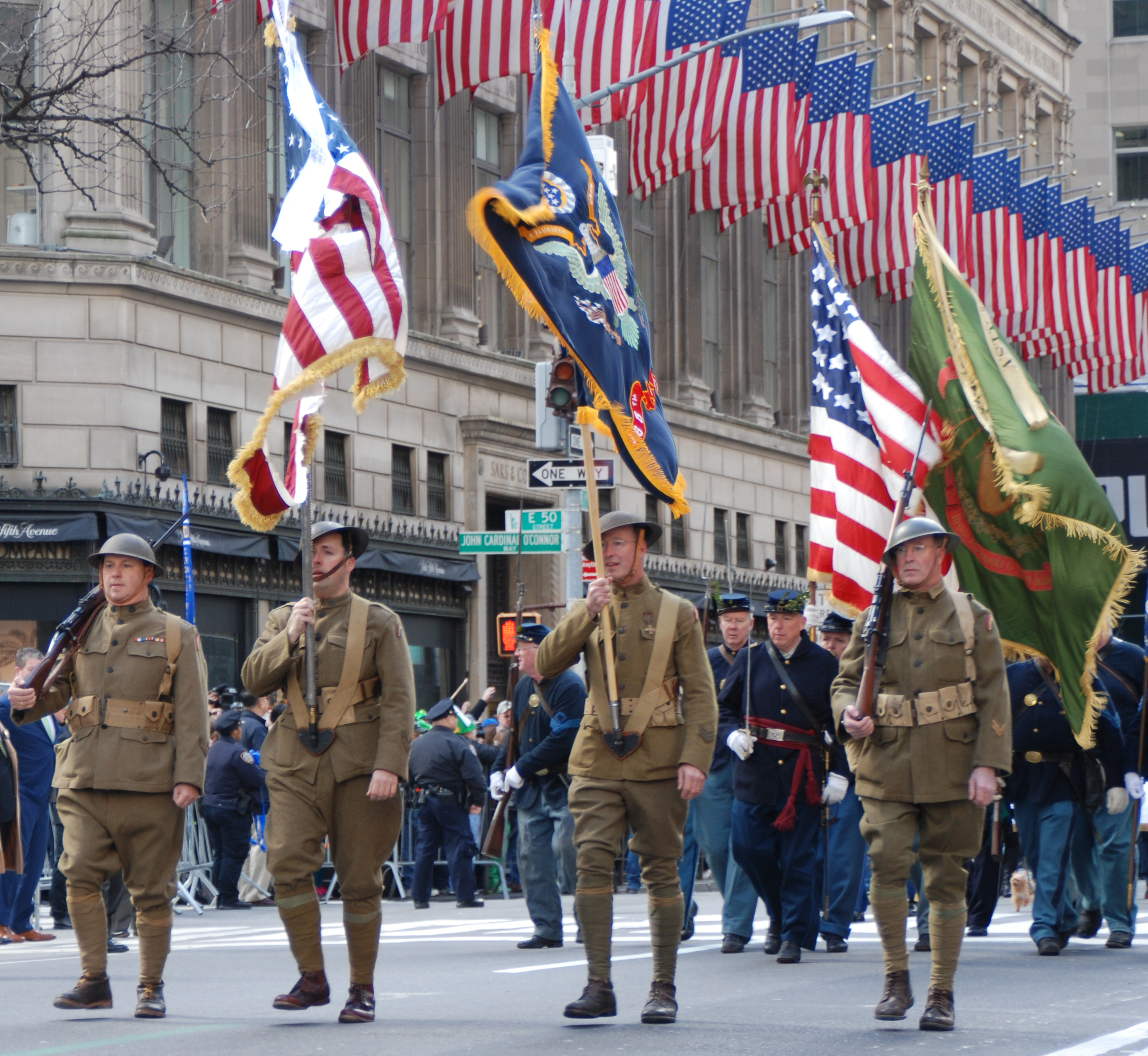 Members of the East Coast Doughboy's, historical reenactors who dress as Soldiers in the 69th Infantry Regiment during World War I follow the New York National Guard's 1st Battalion, 69th Infantry during the New York City St. Patrick's Day Parade on March 16, 2019. The 1st Battalion, 69th Infantry traditionally leads the world's largest St. Patrick's Day Parade. Soldiers of the 1st Battalion 69th Infantry and the 42nd Infantry Division Band led the parade up 5th Avenue. ( U.S. Army National Guard photo by Col. Richard Goldenberg) Members of the East Coast Doughboy's, historical reenactors who dress as Soldiers in the 69th Infantry Regiment during World War I follow the New York National Guard's 1st Battalion, 69th Infantry during the New York City St. Patrick's Day Parade on March 16, 2019. The 1st Battalion, 69th Infantry traditionally leads the world's largest St. Patrick's Day Parade. Soldiers of the 1st Battalion 69th Infantry and the 42nd Infantry Division Band led the parade up 5th Avenue. ( U.S. Army National Guard photo by Col. Richard Goldenberg) |
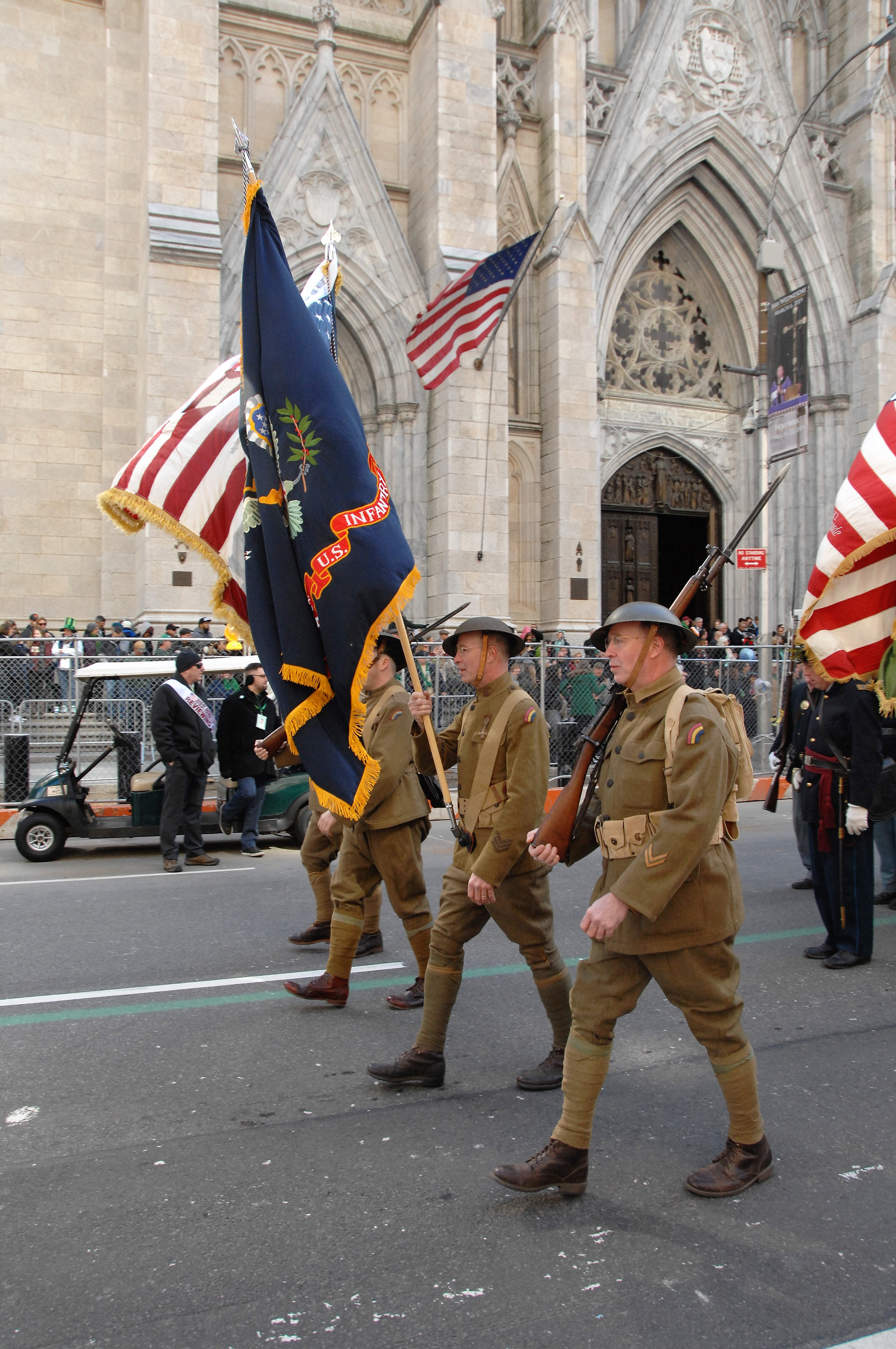 Members of the East Coast Doughboy's, historical reenactors who dress as Soldiers in the 69th Infantry Regiment during World War I follow the New York National Guard's 1st Battalion, 69th Infantry during the New York City St. Patrick's Day Parade on March 16, 2019. The 1st Battalion, 69th Infantry traditionally leads the world's largest St. Patrick's Day Parade. Soldiers of the 1st Battalion 69th Infantry and the 42nd Infantry Division Band led the parade up 5th Avenue. ( DMNA photo by New York Guard Capt. Mark Getman) Members of the East Coast Doughboy's, historical reenactors who dress as Soldiers in the 69th Infantry Regiment during World War I follow the New York National Guard's 1st Battalion, 69th Infantry during the New York City St. Patrick's Day Parade on March 16, 2019. The 1st Battalion, 69th Infantry traditionally leads the world's largest St. Patrick's Day Parade. Soldiers of the 1st Battalion 69th Infantry and the 42nd Infantry Division Band led the parade up 5th Avenue. ( DMNA photo by New York Guard Capt. Mark Getman) |
Read more: The East Coast Doughboys march in NYC St. Patrick’s Day Parade
 Rear Adm. Victor Blue (left center), Chief of the Bureau of Navigation, inspects Yeomen (F) on the Washington Monument grounds, Washington, D.C., in 1918.(NHHC Collection)
“Yeomanettes” Paved the Way for Women of All Navy Ratings Today
By YN1 Silvia Raya and YN2 Waltesia Crudup
via the Sextant web site
In order to fill severe clerical shortages caused by World War I, the U.S. Navy approved the enlistment of women in 1917. The Naval Reserve Act of 1916 made no specific gender requirements for yeomen, enlisted personnel who fulfill administrative and clerical duties.
So either by deliberate omission or accident, the act opened the opportunity to enlist women 97 years ago this week. One of the first through the door on March 17, 1917 was Loretta Perfectus Walsh, who became the first active-duty female in the Navy who wasn’t a nurse. Four days later, March 21, 1917, she was the first female to be named a chief petty officer. On April 6, 1917, Congress approved President Woodrow Wilson’s request to declare war against Germany.
The newly-enlisted Sailors were given the rating Yeoman (F), with the “F” designating female. More popularly referred to as “yeomanettes,” the majority worked in clerical positions, but they also served as translators, draftsmen, fingerprint experts, ship camouflage designers and recruiting agents.
Nearly 600 Yeomen (F) were on duty by the end of April 1917, a number that had grown to more than 11,000 by December 1918, shortly after the Armistice.
After the war, many “yeomanettes” continued in their positions during the post-war naval reductions. By the end of July 1919, there were just under 4,000 left in service, and all were released from active duty to return to their more traditional roles before the war.
Yeomen (F) continued on inactive reserve status, receiving modest retainer pay, until the end of their 4-year enlistments, at which point all women except Navy Nurses disappeared from the uniformed Navy until 1942.
Many honorably discharged Yeomen (F) were appointed to Civil Service positions in the same navy yards and stations where they had served in wartime. Entitled to veterans’ preference for government employment, they provided a strong female presence in the Navy’s civilian staff through the decades after World War I.
Read more: “Yeomanettes” Paved the Way for Women of All Navy Ratings Today
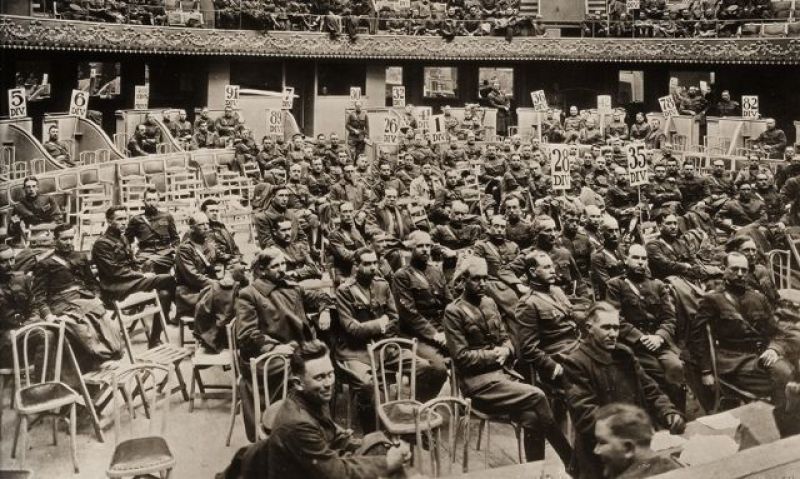 Members of the American Expeditionary Forces gathered for a planned “morale conference” in Paris in 1919. The Paris Caucus led to the creation of what would become The American Legion.
The American Legion
It all began in Paris a century ago
By Jeff Stoffer
via the American Legion web site
The American Legion organization’s 55 departments and nearly 12,500 posts across the country and around the world are celebrating a century of service to community, state and nation that began in Paris March 15-17, 1919, when war-weary members of the American Expeditionary Forces gathered for a “morale conference” that led to the creation of what would become The American Legion. Only 300 troops were expected to attend. Officially, 463 registered. Some have estimated that more than 1,000 came and went, with or without orders, during the weekend that launched a century of accomplishments unforeseeable, if not unimaginable, at the time.
Lt. Col. Eric Fisher Wood, a leader in the prewar Preparedness Movement who was wounded fighting with the British before U.S. entry in the Great War and was later gassed during the Meuse-Argonne offensive while with the U.S. Army’s 88th Infantry Division, served as secretary of the Paris Caucus’ first session and called it to order nearly five hours after it was scheduled to start.
Fisher Wood, who originally wanted the new association to be named the Liberty League and later designed the emblem of The American Legion, was joined at the Paris Caucus by Col. William Donovan, who would go on to become the father of U.S. intelligence; future Secretary of the Treasury Capt. Ogden Mills; and fellow founder Lt. Col. George A. White, a former editor of the Portland Oregonian. But this caucus was not going to be about officers.
In a telegram to Lt. Col. Theodore Roosevelt, Jr., a week before the gathering, Fisher Wood stated simply: “Am inviting enlisted men.”
Pvt. George Munroe, who participated in the caucus, recalled in Thomas A. Rumer’s “The American Legion: An Official History, 1919-1989,” that he “saw no evidence of registration at the caucus. As far as I could see, anybody who happened to wander in could sit down and take part. It was somewhat of a madhouse. When I reported to the Cirque de Paris, I presented my travel orders to the soldier on duty at the door, and he looked me over, handed them back, and directed me to the section reserved for the 1st Division. After that, I came and went as I pleased.”
Amid the chaos, The American Legion formed its first four committees: Convention, Permanent Organization, Constitution and Name. Following the March 15 opening, the 15-member committees worked on their specific topics before reconvening March 17 before the entire group.
Read more: The American Legion: It all began in Paris a century ago
 "Now that the design has come together, I'm heading back out to finish the last bit of fundraising," architect Joe Weishaar says of his work on the World War I Memorial in Washington, D.C. "Things have been going immensely well the past year in securing the necessary funds to build the memorial, and I think we're finally down to the last $10-$12 million. The sooner we have it all in hand, the sooner we can start construction." (Photo by Russell Cothren courtesy University Relations)
Three Minutes, Three Questions Architect Joe Weishaar
By Becca Martin-Brown
via the Northwest Arkansas Democrat Gazette newspaper web site
Born and raised in Fayetteville, Joe Weishaar remembers standing on the Champs Elysees in Paris as a University of Arkansas student and thinking, "What in the world is a kid from Arkansas doing here?" As it turned out, it was just a peek at the international limelight to come. Weishaar was only 25 when he was selected to design the national World War I Memorial in Washington, D.C.
Weishaar comes home April 3 to speak on "To End All Wars: The Fight for the National World War I Memorial" as part of the Honors College Invites lecture series at the UA. Here, he talks about his career thus far with What's Up!
Q. What influenced your career choice? Was there a moment when you thought, 'This is what I want to do'?
A. The moment I knew it was what I wanted to do must have come in the first 10-20 minutes of my first studio class [at the UA]. The professor walked into the room, told us to forget everything we thought we knew about buildings and made us to go buy five sheets of the biggest paper I had ever seen in my life. I can't even describe how hooked I was from that point on, and I've never looked back.
Q. How did the World War I Memorial end up on your plate?
A. I think I came across the World War I Memorial competition at the end of May in 2015. I wasn't even really looking for it; a link was just being hosted on one of the websites that I would visit for art and architecture ideas.
It would be entirely fair to say that up to this point in my life I knew close to zero about World War I. But I still clicked on the link. I cranked out a design in about three weeks, working after work and on weekends. Then I sent it off and completely forgot about it for the next two months.
Read more: Three Minutes, Three Questions Architect Joe Weishaar
Four Questions for Ryan Hegg
"We encourage folks to share this information with educators."
By Chris Isleib
Director of Public Affairs, United States World War One Centennial Commission
The Centennial Commission's efforts in the area of Education are among our most important endeavors. Ultimately, the mission of the Centennial Commission is to educate people, especially our coming generations, as the stories and lessons of World War I are their inheritance. We are thrilled to help our Education Department to roll out a new tool for educators -- a brief video entitled "Who We Were", which helps to describe the various resources available to teachers and students of World War I. We spoke with our friend Ryan Hegg about the new video. Ryan has long been with the Centennial Commission as a volunteer and as a staffer, and he was part of the production of this new video.
Tell us about the new video. What is it for? What audience is it designed to reach?
The Who They Were promotional video introduces the activity to educators in both school- and non-school settings. The video provides an overview of the activity and its goals, as well as some initial guidance on how to utilize the downloadable Activity Toolkit and Educator Guide.
What is the "Who We Were" program? Tell us about it.
Who They Were is a project-based activity that engages students in exploring their community’s World War I history and encourages them to participate in local commemorative activities. Using the free Who They Were Activity Toolkit, students create a short narrative about what their community was like 100 years ago, and how it shaped the men and women who served in World War I. This narrative can then be presented at their school or at a local event, and shared on the national Who They Were map. The activity can be adapted to grades 4-12, and aligns with key educational standards.
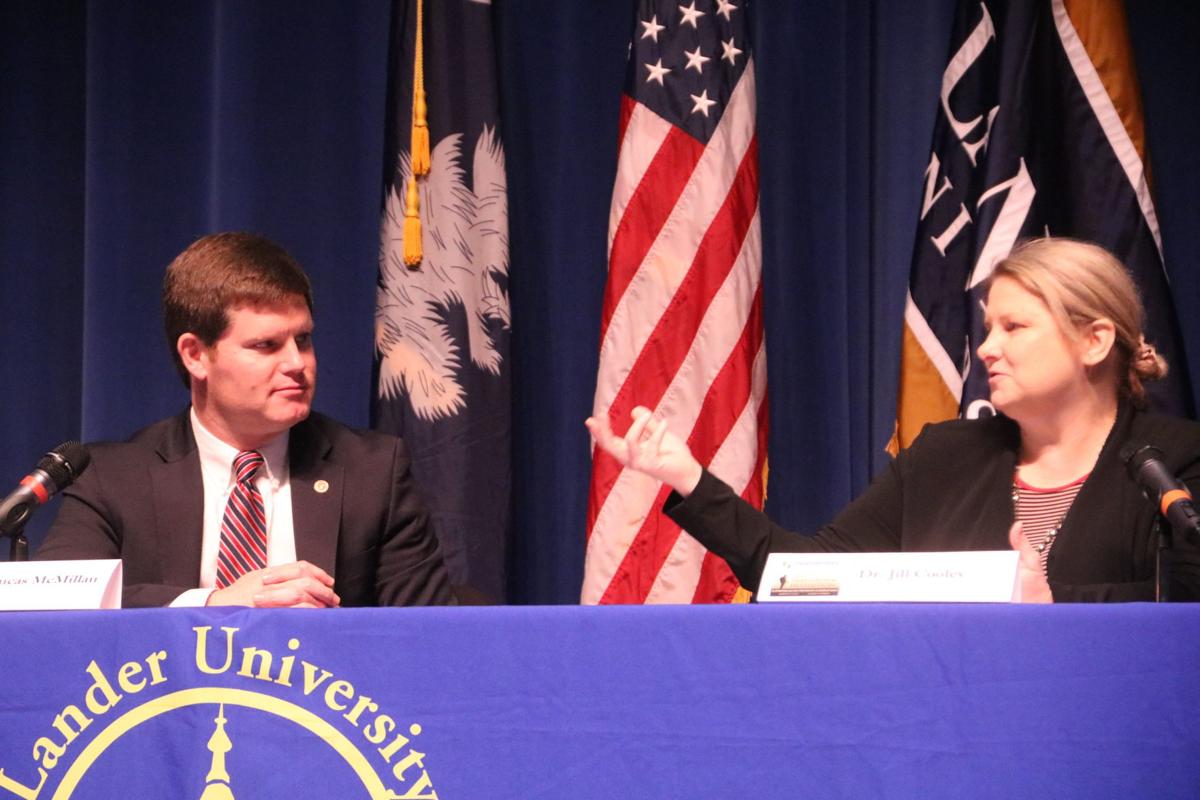 Landers University's Lucas McMillan (left) and historian Jill Cooley took part in a symposium on the South and World War I.
World War I was a boon to American South
By Aleks Gilbert
via the Index-Journal newspaper (Greenwood, SC) web site
“Wars bring terrible death, terrible destruction,” historian Courtney Tollison said Friday at Lander University. “Wars can also be incredibly beneficial for the economy.”
World War I was just that for the South.
Clothing, food, tobacco — European and American soldiers would need a massive amount of these goods, and the South was well positioned to provide them.
“This (WWI) is a real godsend, if you ask me, for the agricultural sector in the South,” said Ryan Floyd, Lander history professor. “It was a really wonderful time for them.”
Floyd, Tollison and two other historians began the second day of Lander’s symposium on the South and World War I with a pair of forums concerning wartime agriculture and economics.
Lucas McMillan, who moderated the panel on agriculture, said the two subjects could not be separated from one another in a region that defines itself with the production of cash crops.
“This structured the economy. This structured social life. This structured what we ate,” said McMillan, the dean of Lander’s College of Behavioral and Social Sciences. “Agriculture is in the heart of understanding Southern studies.”

Learn about the participation of women in the war
Women played vital roles in World War I
By Lara Vogt
National World War I Museum and Memorial
At the time of the First World War, most women were barred from voting or serving in military combat roles. Many saw the war as an opportunity to not only serve their countries but to gain more rights and independence. With millions of men away from home, women filled manufacturing and agricultural positions on the home front. Others provided support on the front lines as nurses, doctors, ambulance drivers, translators and, in rare cases, on the battlefield.
One observer wrote that American women “do anything they were given to do; that their hours are long; that their task is hard; that for them there is small hope of medals and citations and glittering homecoming parades.”
On The Home Front
The nations at war mobilized their entire populations. The side that could produce more weapons and supply more troops would prevail in the end. Women took on new roles in the work force, notably in war production and agriculture.
In 1914, the German armaments producer Krupp employed almost no women. By 1917, women made up nearly 30 percent of its 175,000 workers and a nationwide total of nearly 1.4 million German women were employed in the war labor force. Britain also stepped up its arms production by expanding the employment of women. In July 1914, 3.3 million women worked in paid employment in Britain. By July 1917, 4.7 million did. British women served in uniform as well in the Royal Navy and Royal Air Force. In fact, the last known surviving veteran of World War I was Florence Green of the RAF, who died in 2012.
As women took traditional male jobs in the United States, African American women were able to make their first major shift from domestic employment to work in offices and factories. Recent research also shows that a limited number of African American women served overseas as volunteers with the YMCA.
But even women in more traditional roles contributed to the war effort. Every housewife in the U.S. was asked to sign a pledge card stating that she would “carry out the directions and advice of the Food Administrator in the conduct of my household, in so far as my circumstances permit.” This meant canning food for future use, growing vegetables in the backyard and limiting consumption of meat, wheat and fats. Most of all, women were expected to bolster the morale of their families at home and loved ones overseas.