































World War I Centennial News
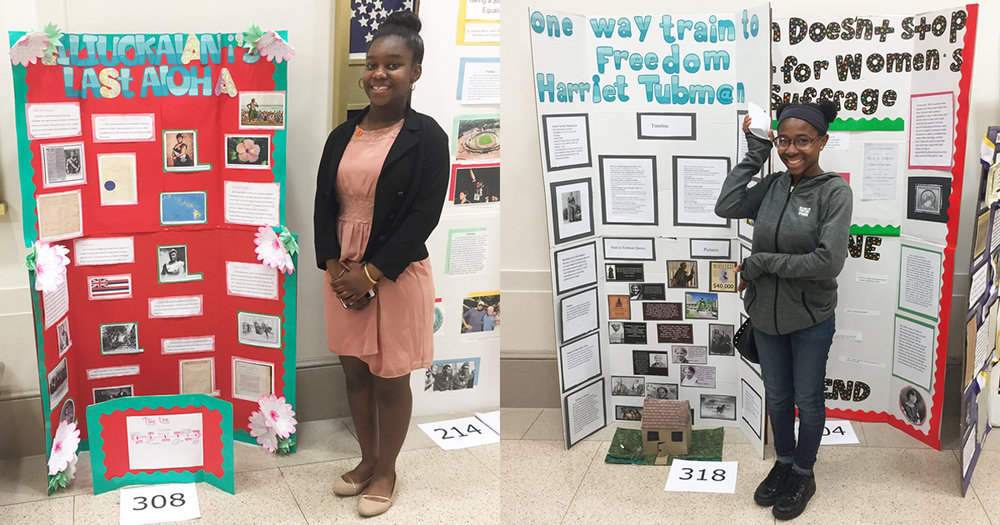 Proud 2017 National History Day competitors, and their projects in Washington, DC.
National History Day seeks Volunteers and Judges for regional competitions
By Chris Isleib
Director of Public Affairs, United States World War One Centennial Commission
National History Day (NHD) is an exciting way for students to develop their civic literacy as well as study and learn about historical issues, ideas, people, and events at our locations around the country
 The city-wide NHD contest in Washington, DC, is scheduled for Wednesday, April 10 (Junior Division – grades 6-8) and Thursday, April 11 (Senior Division – grades 9-12) at the National Archives Building in downtown Washington, DC.
Information on other regional competitions can be found here: https://www.nhd.org/search
The DC LE (Education and Public Programs Division) NHD team is recruiting judges and other volunteers for both days. Whether you have judged or volunteered before or you are receiving this invitation for first time, we hope that you will consider supporting this educational community event.
The NHD program promotes the study of history while providing a forum in which students compete for excellence in one of five categories: documentary, performance, exhibit, historical paper, or website.
Last year, over 300 DC students competed over the two days, and a similar number of students are anticipated this year. The students are busily working on their projects connected to this year's 2019 NHD theme: "Triumph and Tragedy in History". Prior to advancing to the DC NHD competition, the students’ projects will have been evaluated previously by teachers and by judges at their school competitions.
Read more: National History Day seeks Volunteers and Judges for regional competitions
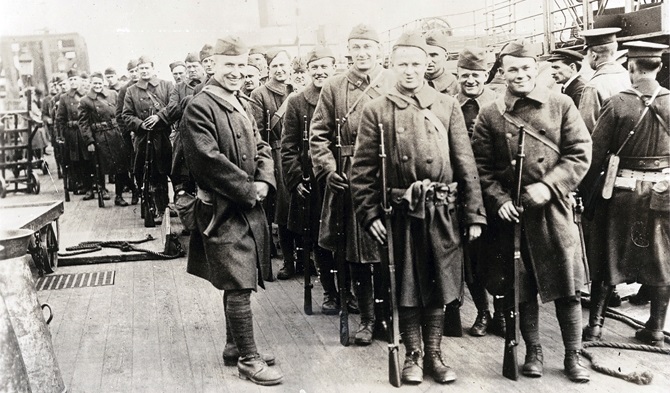 Doughboys from the U.S. Army’s 339th Infantry Regiment expected to be heading to the trenches of the Western Front in 1918. Instead they found themselves steaming for Russia.
The Polar Bear Expedition — The True Story Behind America’s Forgotten War in Communist Russia
By James Carl Nelson
via the Military History Now web site
IT WAS NOVEMBER 11, 1918 – Armistice Day. The fighting in Europe had just ended, but for a contingent of 5,000 Doughboys their war was only beginning.
Even as Germany’s surrender was being signed in a railway car at Compiegne Forest near Paris, even as throngs were celebrating in London and New York, Captain Robert Boyd and the men of the U.S. Army’s 339th Infantry Regiment, Company B, were fighting for their lives against hundreds of Bolshevik troops in the snowy, bitterly cold wastes of northern Russia.
It was a somewhat bizarre series of events that had brought this contingent of Doughboys to this remote and desolate place: the village of Toulgas on the Dvina River, 150 miles from the relative safety of the frozen port of Archangel on Russia’s northern coast.
Their mission had been devised mainly by the British during the Great War’s darkest hour the previous spring. The German offensive of March, 1918 threatened to break the Allied lines in France and roll the British all the way to the Channel ports before the United States, which had entered the war in April 1917, had enough troops ready for the Western Front. Desperate, the brass agreed to divert a small force of American soldiers to far off Russia of all places to fight in an entirely new war.
The collapse of the Czarist monarchy the same year had, by the end of 1917, resulted in the rise of a Bolshevist regime. By March, the revolutionaries hurriedly negotiated a treaty with Germany, signing the agreement in March of 1918. Secure in east, Germany rushed scores of veteran divisions from the Russian Front to France to take part in the offensive.
American presence in Germany from 1918-1923 had lasting effects on the culture, ideology and politics of the region
By Emma Greguska
via the Arizona State University web site
Sit in on any WWI history class in U.S. schools today and you probably won’t hear much about the American occupation of Germany that followed the war and lasted until 1923.
Arizona State University School of International Letters and Cultures German instructor Christiane Reves thinks that should change and hopes an exhibit now on display in the lobby of the Durham Language and Literature building will help.
On the 100th anniversary of the presence of American occupational forces in the regions between Trier and Koblenz, “Stars and Stripes Above the Rhine: The American Occupation in Germany after World War I” aims to educate ASU students, faculty, staff and the wider community about the laudable and conciliatory interactions between the Americans and the people who were once their military opponents.
“Those four years were significant not merely from a political and economic standpoint, but also due to effects on the culture and ideological history of the region,” Reves wrote in a description of the exhibit, which runs through March 1.
The exhibit will move to ASU’s West campus on March 25, where it will be on display until April 12.
Read more: Exhibit commemorates 100th anniversary of America's post-WWI German occupation
From the World War I Centennial News Podcast
Historian's Corner: Dr. Hal Chase on Fort Des Moines, IA
In February 8th's edition of the World War I Centennial News Podcast, Episode 109, host Theo Mayer spoke with historian and native Iowan Dr. Hal Chase about Fort Des Moines, Iowa, a significant landmark in African American history. Over 600 African American officers were trained and commissioned at Fort Des Moines, before deploying to France. The following is a transcript, edited for clarity:
Theo Mayer: Welcome to our segment we call The Historian's Corner. Some weeks ago, I was contacted by a gentleman named Larry Marquardt from the Iowa and Minnesota World War I Centennial Committees. Now Larry started to tell me about a remarkable venue that he thought was fascinating and deserved to have its story told. That location is Fort Des Moines in Iowa. It was a training camp not only for African American military officers, but also for African American medical officers.
Joining us today to introduce us to the camp, its history, and the officer training program is historian Hal Chase, who was actually born in Des Moines during World War II. Hal got his PhD in American Civilization with an emphasis on African American history from the University of Pennsylvania. Hal, thank you so much for coming in and speaking with our listeners today.
From the World War I Centennial News Podcast
100 Years in the Making: Pangolin Editions' Steve Maule
In February 22nd's edition of the World War I Centennial News Podcast, Episode 111, host Theo Mayer spoke with Steve Maule, a director at Pangolin Editions. One of the largest and most advanced art foundries in the world, Pangolin plays a crucial role in bringing the National Memorial to life. Mr. Maule provides us with incredible insight into that process. The following is a transcript of the interview, edited for clarity:
Theo Mayer: Welcome to "A Hundred Years in the Making," our segment specifically about the national WWI Memorial that we're building in Washington D.C. This ongoing series of reports and interviews provides our listeners with rare insider view into the intricate and complex process of creating a national memorial. As many of you know, a center piece element of the memorial is a giant bronze sculpture called "A Soldier's Journey' by sculptor Sabin Howard, whose been on the show several times talking about his own journey in creating it. There is another aspect in creating a giant bronze sculpture, especially those very rare works of this size. At some point the artist's vision needs to become manifest in metal, and of course you don't take out a giant block of bronze and a chisel and hammer and sculpt away. A bronze sculpture is cast from molten metal in a mold. You can start to imagine the scale, scope and challenges of doing that for something that's 7 ft tall and 60ft wide. This kind of work is done in a foundry, and there are very few in the world that are able to take on a sculpture the size the WWI Memorial sculpture. With us today is Steve Maule, the director of one of the most esteemed and advanced foundries in the world. Located just north of Bristol in the United Kingdom, its called "Pangolin Editions". Steve, thank you for joining us. Welcome to the podcast.
Steve Maule: Thank you Theo, great to be here with you guys.
Tolkien, Lewis, and the Lessons of World War I
By Desmond Berg
via the Sovereign Nations web site
Editor's Note: On the heels of the enormously successful World War I documentary They Shall Not Grow Old, by director Peter Jackson, FOX Searchlight Pictures has released the first trailer for their J.R.R. Tolkien biography, seen above. The new film will explore how the horrors of World War I that Tolkien witnessed were eventually channeled into "a fantastical adventure story about good and evil, destiny and prophecy", which we know as his Lord of the Rings trilogy. In a recent article on the Sovereign Nations web site, author Desmond Berg looks at the effects of the Great War on Tolkien and his lifelong friend author C.S. Lewis, and how "both used the experience of war to shape their Christian imaginations" and produce fantastic works of literature.
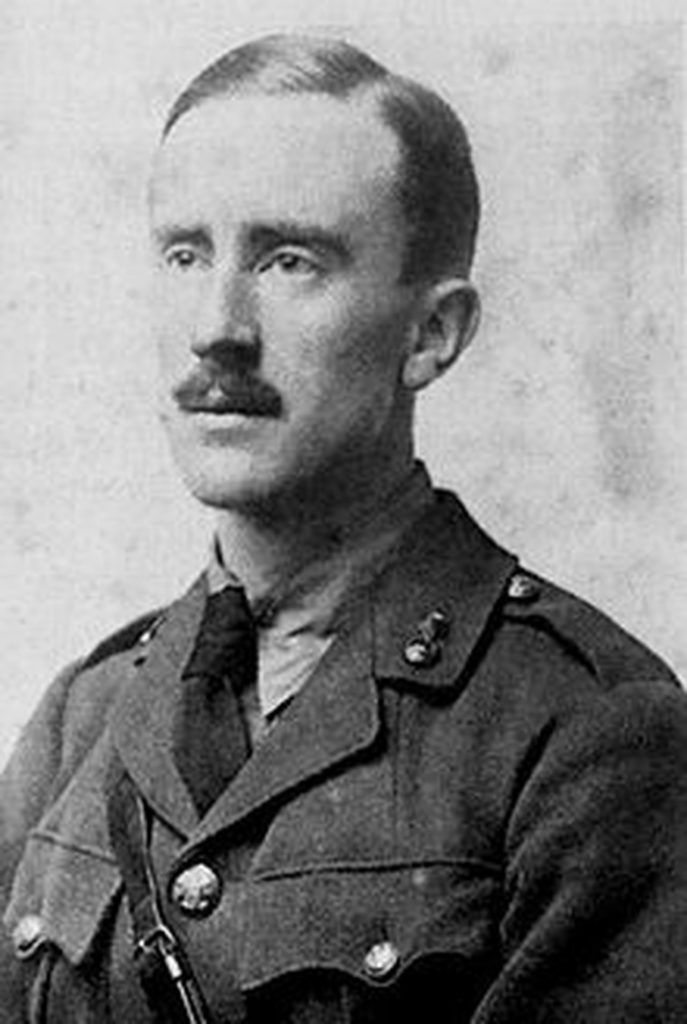 J. R. R. Tolkien, 1916In the spring of 431 b.c., Athens and Sparta went to war. Their dispute soon enveloped the entire Greek world. Thucydides, an eyewitness to the fighting, wrote that it would be “more momentous than any previous conflict.”
He was right. Dragging on for 27 years, the Peloponnesian War anticipated the suffering and deprivation associated with modern conflicts: the atrocities, refugees, disease, starvation, and slaughter. The war destroyed what remained of Greek democracy and left the Greek city-states vulnerable to demagogues and foreign invasion.
A hundred years ago, on November 11, 1918, another war begun by two European states—a local squabble that escalated into global conflict—came to an end. Struggling to describe its scope and destructive power, the combatants called it the Great War. Like its Greek counterpart, the war ravaged soldiers and civilians.
Over the course of four years, roughly 20 million people were killed, another 21 million wounded. National economies were ruined; empires collapsed. The war to “make the world safe for democracy” left European democracy in tatters.
And more than that: The core commitments of Western civilization—to reason, truth, virtue, and freedom—were thrown into doubt. T. S. Eliot saw the postwar world as a wasteland of human weariness. “I think we are in rats’ alley,” he wrote, “where the dead men lost their bones.” Many rejected faith in God and embraced materialistic alternatives: communism, fascism, totalitarianism, scientism, and eugenics.
Yet two extraordinary authors—soldiers who survived the horror of the trenches—rebelled against the spirit of the age. J. R. R. Tolkien and C. S. Lewis, who met at Oxford in 1926 and formed a lifelong friendship, both used the experience of war to shape their Christian imaginations. In works such as The Lord of the Rings, The Space Trilogy, and The Chronicles of Narnia, Tolkien and Lewis rejected the substitute religions of their day and assailed utopian schemes to perfect humanity. Like no other authors of their age, they used the language of myth to restore the concept of the epic hero who battles against the forces of darkness and the will to power.
Harder than the War: Disabled Doughboys Fight for Recognition
By Dr. Ed Lengel
via the A Storyteller Hiking Through History blog
Years after World War I ended, veteran Harry Zander happened across a former comrade walking the streets of his native Atlanta. “Miller,” he stammered with tears in his eyes, and took his old friend by the hand. But it turned out to be a painful encounter.
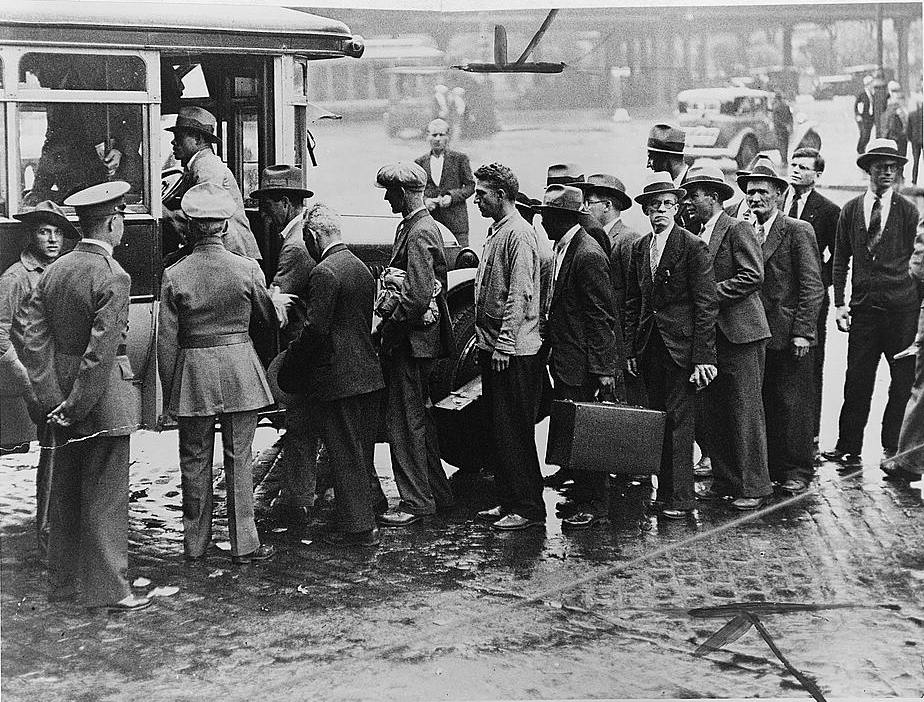 Veterans board a bus that will carry them to “dollar a day” jobs at a government reforestation project, 1933. Library of Congress Prints and Photographs Division“Miller was shabby and worn looking,” Zander remembered. “He had not even had a shave in days–his scraggly beard attested to that, and his red hair too, had lost its lustre and was dull and mixed with a lighter shade. Only his eyes were the same . . . the same haunted fearful look I remembered so well out there on the battlefield. I knew that for Miller the hell of war was not ended . . . that he still lived those days over again . . . the result of which faced him continually.”
Youth’s Follies
Zander and his friends had enlisted joyfully in the spring of 1917. He trained at Camp Gordon, Georgia, witnessing the challenges of integrating immigrant soldiers who barely spoke English into the U.S. Army. He also witnessed incidents of savage racism directed toward African American officers–the root cause of race riots that would erupt across the country in the summer of 1919. For a time, Zander had to stand guard over “shirkers” who had been drafted into service and would do anything to get out. Still, training was for Zander a positive experience on the whole, and he hoped that it would give him the tools he needed to face combat on the Western Front.
Zander’s unit of the 3rd Division sailed from New York in the spring of 1918. His first hint of the realities of war came in late June when he encountered some Marines just returned from brutal fighting in Belleau Wood: “Their uniforms were simply filthy,” he recalled; “their beards had grown long and shaggy, and there was a hard cold look in their eyes. All lines of sympathy and civilization were gone from their faces, and some of the men had a peculiar blank stare in their eyes.”
Read more: Harder than the War: Disabled Doughboys Fight for Recognition
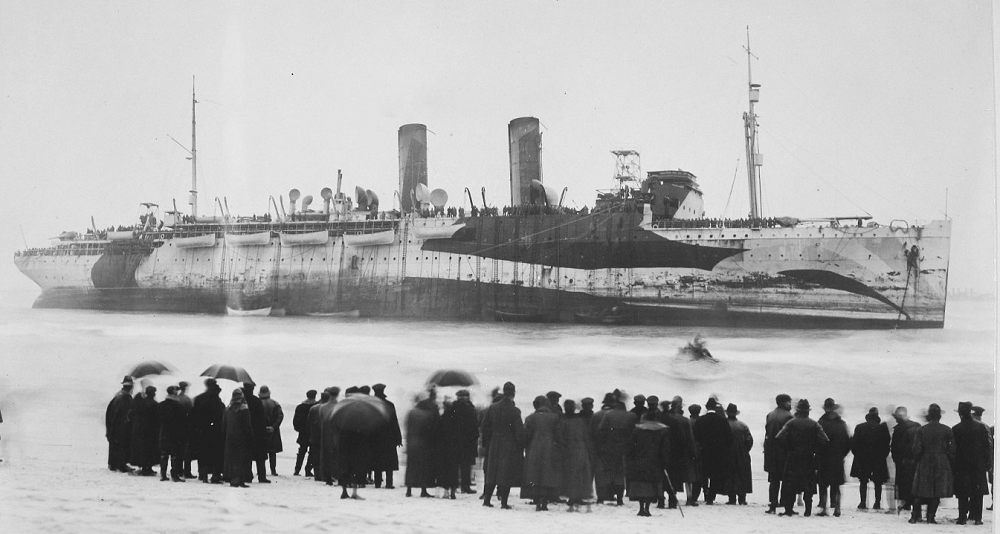 Transport Northern Pacific on Fire Island sand bar as she lay 200 yards off the Fire Island beach in approximately 11 feet of sand.
Troopship Rescue from Fire Island!
By Harry Kidd
special to the United States World War One Centennial Commission web site
Note: This article was written by Harry Kidd, volunteer at the U.S. National Archives working on textual and photographic digitization projects. Harry is a former Navy photographer, and came across this story while researching military photographers.— Chris Isleib, Director of Public Affairs, United States World War One Centennial Commission
In the early morning of January 1st 1919 Surfman Roger Smith reported sighting the U.S.S. Northern Pacific a few miles southeast of Fire Island, Coast Guard Station #83. Unbeknownst to Smith, the initial report was the beginning of an 18 day saga that remains one of the most amazing, yet often forgotten, rescue stories of World War I.
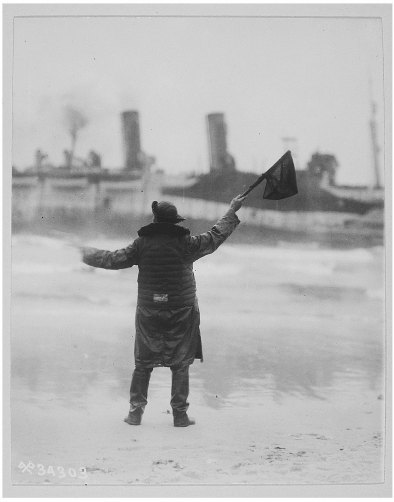 Signaling the transport.The U.S.S. Northern Pacific, a troop transport leased by the U.S. Navy from the Great Northern Pacific Steamship Company, was almost home on the westbound portion of its 11th transatlantic run. Carrying over 2500 troops returning from France, the ship was in route to the disembarkation port of Hoboken, New Jersey.
Of the passengers on the ship, more than fifteen hundred were recovering wounded, including 300 bed-ridden, plus a contingent of Navy nurses. As a result, when the Northern Pacific got stuck on the Fire Island sandbar the potential for disaster was imminent.
The efforts to rescue the stranded troops were made significantly more complicated by the treacherous conditions. The weather on the morning of January 1 was 45 degrees and raining with a strong wind out of the southwest. During the day efforts to refloat the Northern Pacific proved unsuccessful and the ship was forced further on shore by the winds, current and tides. The ship finally came to rest about 200 yards off shore, stuck to a depth of 11 feet of sand on the Fire Island sand bar.
With the situation stabilized, resources began arriving at the scene on the morning of January 2. Using Beebe-McLellen surfboats the Coast Guard began transferring soldiers, ten at time, from the ship to shore and to other nearby ships. The rescue necessitated a breeches buoy apparatus, which was essentially a life ring on a pulley system that ran from the stranded ship to the shore.
The foul weather conditions made the launching and recovery of the boats very hazardous. On its way back to shore, one of the rescue ships capsized and nearly killed three soldiers before Coast Guardsmen performed resuscitation.
African American Troops in World War I
A Military Experience Based on Separate and Unequal Treatment
By Calvin Mitchell
Assistant Curator of Philately, The Smithsonian’s National Postal Museum
via the Smithsonian National Postal Museum blog
Note: During Black History Month, we have been bringing forward a number of little-known, unique stories about the experiences of African Americans in World War I. Today, we offer a remarkable article, created by Mr. Calvin Mitchell, that gives a broad, insightful overview of the experiences of those 360,000 African Americans who served -- based on their letters home. Mr. Mitchell is Research Associate, and former Assistant Curator of Philately, at the Smithsonian’s National Postal Museum. He is a talented storyteller, as you will see.—Chris Isleib, Director of Public Affairs, United States World War One Centennial Commission
Despite concerns about racial discrimination in America, African Americans’ enthusiasm for supporting America’s entry in World War I was quite high in 1917. W.E.B Du Bois, one of the leading African American intellectuals of this period, rallied black support for the war effort in his memorable essay titled “Close Ranks.” Du Bois wrote: “Let us, while this war lasts, forget our social grievance and close ranks shoulder to shoulder with our fellow citizens and the allied nations that are fighting for democracy. We make no ordinary sacrifice, but we make it gladly and willingly with our eyes lifted to the hills.”
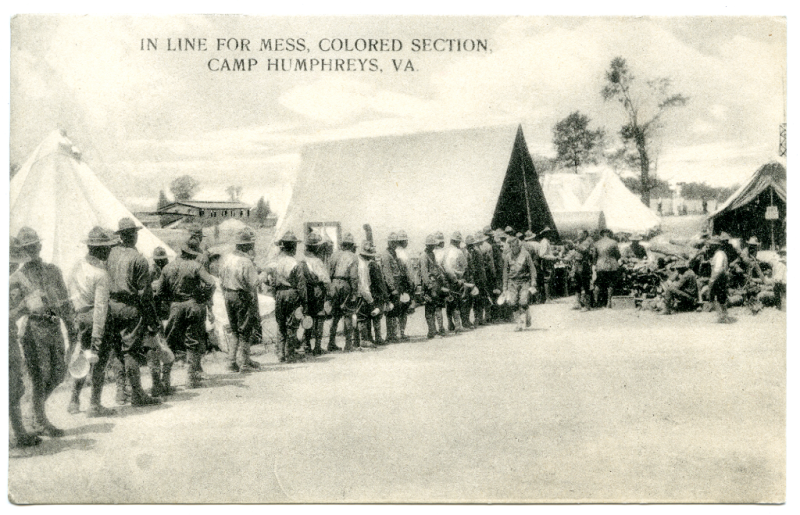 Postcard of African American troops at Camp Humphreys. Black troops were restricted to eating outside in tents despite the presence of indoor eating facilities at Camp Humphreys. Because of poor housing conditions for African American troops, the mortality rate for African American troops during the 1918 flu epidemic was much higher than for white troops at the camp. Smithsonian’s National Postal Museum image HSC.339Nearly 368,000 African American men became soldiers in an army of 4 million. Unfortunately, because of institutional racism, the US Army was not prepared to provide equal treatment to African American soldiers. Since the Civil War era, the US Army had been segregated and had only a small number of black officers.
Traditionally, black officers were allowed only to command black troops while white officers commanded both black and white units. The maintenance of racial segregation in the military was sanctioned by President Woodrow Wilson and the army’s senior and civilian command structure, including General John Pershing and the Secretary of War Newton Baker.
Adherence to this rigid policy meant that black troops, particularly draftees, were assigned to quartermaster and engineer units—occupational categories that performed the bulk of menial and unskilled labor for the army. 89% of all black troops drafted during World War I served in labor battalions, salvage companies, stevedore organizations, and infantry support units. Only 56% of white troops served in noncombatant units. Consequently, a disproportionate number of black troops in World War I were assigned to military camps throughout the United States, while military quotas and racism restricted the use of African American troops in the European Theatre, especially in combat units.
At several of these camps, such as Camp Sherman, Ohio; Camp Eustis, Virginia; Camp Humphreys, Virginia; and Camp Lee, Virginia, African American soldiers experienced mistreatment, racial discrimination and physical abuse by their white officers. African American troops were often degraded in rank, or prohibited from advancing. African American troops did not report these incidents through their military chain of command because they feared recriminations and reprisals from their commanding white officers, many of whom were part of the initial problem.
Read more: A Military Experience Based on Separate and Unequal Treatment
From the World War I Centennial News Podcast
A Teacher on Teaching WWI: Michael Sandstrom
On February 1st's edition of the WWI Centennial News Podcast, Episode 108, host Theo Mayer spoke with high school teacher and National History Day's Legacies of World War I participant Michael Sandstrom about his experiences teaching history, especially World War I history, to the current generation of high school students. The following is a transcript of the interview, edited for clarity:
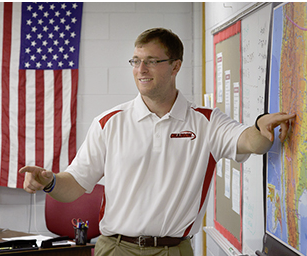 Theo Mayer: Last week we were joined by National History Day Executive Director Kathy Gorn. But this week, we're going to go directly to where the rubber meets the road, as we're joined by a foot soldier in the campaign to win the mind share and interest of our youth in both history, and for the legacy of World War I. With us today is Michael Sandstrom, Social Science teacher at Chadron High School in northwestern Nebraska, about 20 minutes from the South Dakota border. Michael, welcome to the podcast.
Michael Sandstrom: Well thank you very much. It's great to be here.
Theo Mayer: So Michael, you're quite literally the first high school teacher that we've had on the program, and I'm really happy to speak with you.
Michael Sandstrom: Well thank you. I think education, as we can all agree, is a cornerstone of American democracy, and I appreciate what you guys do on a weekly basis.
From the World War I Centennial News Podcast
The Civil War and Beyond: the Connection Between Reconstruction and the Great War
The following is a transcript from February 8th's edition of the World War I Centennial News Podcast, Episode 109, edited for clarity:
Theo Mayer: February is Black History Month. As we begin telling the story of African Americans in World War I, it occurred to us that in order to put it into context, we really needed to go back an additional generation to what is known as the Reconstruction Era. Now, this is a period of time in American history that started right after the Civil War and lasted about 10 years to 1877; a time during which constitutional amendments about civil rights, a stronger federal government, and what was meant by the words "United States" was redefined. Now the reason this matters to World War I is that this is the period when the parents of those who fought in World War I grew up. 1877 is only 40 years before we declared war on Germany. If you were an African American man of about 25, of drafting age or volunteer age, there's a good chance that your parents were born during this tumultuous Reconstruction Era. With that as a time reference, let's go back to examine the changes that came at the end of the US Civil War.
Theo Mayer: Now we've traveled back to the end of the American Civil War. The confederacy collapses, slavery is abolished, and four million black slaves are freed. During the Reconstruction Era that follows the war, national unity is slowly restored, the federal government expands its power, and civil rights are guaranteed to freed black slaves through amendments to the constitution and federal laws.
Making of the Novel “Anumpa Warrior: Choctaw Code Talkers of World War I”
By Sarah Elisabeth Sawyer
Choctaw Nation of Oklahoma Tribal Member
Special to the United States World War One Centennial Commission web site
“Who has heard of the Navajo Code Talkers of World War II?”
Hands went up all around the room.
“What about the Choctaw Code Talkers of World War I?”
Blank stares.
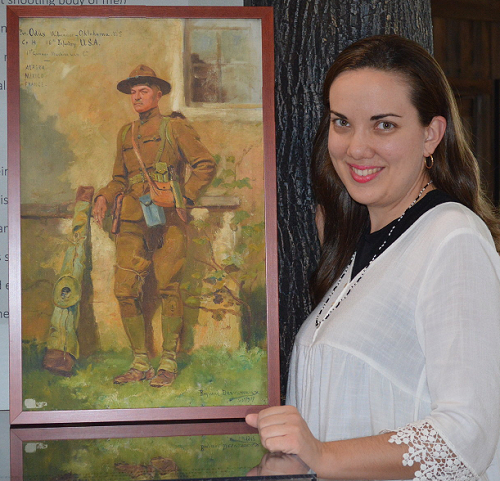 Sarah Elisabeth Sawyer with a painting of Choctaw Code Talker Otis Leader, pictured as the “ideal American Doughboy.” The rare historical painting was commissioned by the French Army Museum. Replica donated to the Choctaw Nation museum.This happened at every event where I spoke, or with friends, history buffs, or in casual waiting room conversations. A fantastic and monumental part of our American and military history was still unknown to the public. This is why I decided to write the novel Anumpa Warrior: Choctaw Code Talkers of World War I.
I can’t remember a time I didn’t know the story of the handful of Choctaws who used our language to save lives and help bring a swifter end to the First World War. I’ve written bits and pieces of their story throughout my writing journey, but couldn’t decide the point of view from which to tell the full story. When you write a novel, you get deep into the main character’s skin, deep into their thoughts, emotions, beliefs, doubts, and fears. I couldn’t do that with these real men who were known and loved by their descendants living today, so I chose to write the story from a fictional main character’s point of view. The story slowly fell into place from there. But one enormous hurdle still stood fast: research.
I began educating myself on WWI and quickly learned how little I knew about it beyond the black and white Sergeant York movie, a staple in my home when I was growing up.
Getting a stack of books from the library and gathering a few from around the house, I immersed myself in a bird’s eye view of the war. I dug up first-hand accounts — journals, letters. Then I turned to the specific history of the unit most of the Choctaws served in — the 36th Division, 142nd Infantry, Company E. Advanced researchers like Dr. William Meadows of Missouri State University and Code Talker scholar along with Judy Allen, Historic Projects Officer for the Choctaw Nation of Oklahoma, directed me to books and reports written by officers in the division and the chaplain of the 142nd. They also shared other resources like newspaper accounts about the Choctaw Code Talkers.
The time came for me to expand my research into the world and into the trenches — literally.
Read more: Making of the Novel “Anumpa Warrior: Choctaw Code Talkers of World War I”
 Ordinary Seaman Frederick R. Foulkes (right) poses proudly in full uniform. This photo most likely was taken at Fort Trumbell, New London, Connecticut, in April 1917, the same month he enlisted in the Coast Guard. Four days after his enlistment he wrote home requesting his camera, and used it frequently to chronicle his wartime service aboard the Coast Guard Cutter Manning (left) in the North Atlantic.
At Sea in the Great War
By Commander Stephen Surko, USN (Ret.)
via the United States Naval Institute/Naval History Magazine web site
A Coast Guardsman’s photos and letters home provide a ‘from-the-deckplates’ view of patrol service in the Atlantic. Originally published in Naval History Magazine, August 2012, Volume 26, Number 4. In civilian life, Stephen Surko, PE is Chief, Office of Technology Development (OTD, US Bureau of Engraving and Printing. (Reprinted from Naval History with permission; Copyright © 2012 U.S. Naval Institute/www.usni.org)
"You may send my new camera to me, without the tripod, as I am allowed to use it.” So wrote Frederick Richard Foulkes in a letter home on 17 April 1917, just four days after enlisting in the U.S. Coast Guard. Seaman Foulkes, the son of a Presbyterian minister, very quickly had acquired the nickname “Parson.”
When the United States declared war on Germany on 6 April 1917, the Coast Guard had been transferred from the Treasury Department to the Navy Department. Veteran crews were augmented with fresh recruits; Foulkes was assigned to the cutter Manning . A small warship by today’s standards, she was 205 feet long and displaced 1,155 tons. Commissioned on 8 January 1898, the Manning was a veteran of the Spanish-American War, one of the last class of U.S. revenue cutters rigged for sail, and the first to carry electric generators.
Powered by one steam engine, she could attain 17 knots and boasted two 3-inch gun mounts and two 6-pounder rapid-fire guns. Filled out to a full complement of 8 officers, 4 warrant officers, and 100 crew, the Manning was deployed to Gibraltar. She escorted her first convoy out through the danger zone, some 215 miles, on 19 September 1917.
Foulkes frequently wrote to his family in Philadelphia and made ample use of the camera he had requested—the result being a rich trove of letters and photographs. The excerpts from his letters reproduced here, along with a sampling of his dozens of photographs, provide an up-close look—nearly a century later—at wartime duty on board a heralded cutter of Squadron 2, Division 6, Atlantic Fleet Patrol Forces.