






























The Great War - Hawaii and the Red Cross
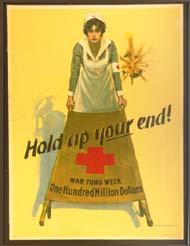 Hawaii may have been remote from the beginnings of World War I in June 1914, but residents felt compassion for all victims of the war. The Territory contributed generously to war relief efforts. While the US remained a neutral party, Hawaii, home to citizens of several combatant countries, donated to the British, Japanese, and German Red Cross groups. At a national level, in 1914 the American Red Cross responded to war in Europe by giving assistance to soldiers of all countries.
 When in 1917 the US joined Britain, France, Japan, and their allies against Germany and her partners, America and Hawaii refocused. America’s Red Cross took on a quasi-military role, governed by a War Council headed by Pres. Woodrow Wilson, and serving mostly US military and civilians. The Red Cross supplied 2 of every 3 Navy nurses and 4 out of 5 Army nurses. Red Cross World War I efforts were transformed from a humanitarian to a patriotic endeavor.
Hawaii pitched in. By September 1917, Hawaii’s War Relief Committee had merged with the Red Cross. Under A. L. Castle, the Red Cross membership drive challenged itself to surpass Hawaii’s Japanese Red Cross members (7500). On Oahu, the business networking group, Ad Club, organized the business districts, and women’s groups had charge of all else. Japanese workers at Hawaii Island’s Hakalau Plantation got in early with $302 [$5653 in 2015] spontaneously collected. Promotions included newspaper ads targeted to each economic and ethnic group. A 2-page ad encouraging Red Cross donations was signed by Queen Liliuokalani and Representative to Congress J. Kuhio Kalanianaole (“No True Hawaiian Will Evade It”). A full-page thank you from Pres. Wilson “to express to Queen Liliuokalani my personal appreciation” ran on the next page. The drive culminated in a territory-wide, day-long event. For every 500 new members (at $1 to $100) the Hawaiian Electric plant whistle let off a blast. Queen Liliuokalani handed over her own check for $100 to become the 8000th member, having previously sewn and donated a Red Cross flag. Final tally: in 1 day 16,330 Hawaii folks enrolled in “the Army all can join.”
Like many community groups, Elks Lodge 616 brain stormed fundraising ideas for the Red Cross. Considered were a club dance and a raffle scheme involving a rabbit fur coat. Both failed. The lodge offered its rooms for Red Cross meetings and for fundraiser theatrical rehearsals without takers. Finally, the lodge donated $200 [$3743 in 2015] to demonstrate their support. On May 6, 1918, Elks were honored to carry their service flag in the community Red Cross parade initiating a second fundraising drive.
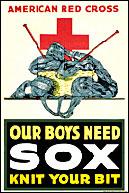
One Red Cross project recruited citizen knitters to make warm clothing for military men. Elks 616 voted to offer the lodge room for knitting parties. When the Red Cross solicited cash for a Wool Fund, 616 gave $148.50 in 12 months.
Across the Territory Ladies and Gentlemen, Boys and Girls took up their needles to warm American soldiers. School children, benevolent societies, churches, firemen and cab drivers setup knitting goals and competed against rivals. Olympic swimmer Duke Kahanamoku publically knit, giving ‘cover’ to guys who knit. The nuns at Fort Street Convent turned out superior socks. Mother Laurence told reporters the Sisters were well qualified, making their own socks for years, even knitting in the dark! The Territory finished a whopping 58,241 items using specific patterns issued by the Red Cross.
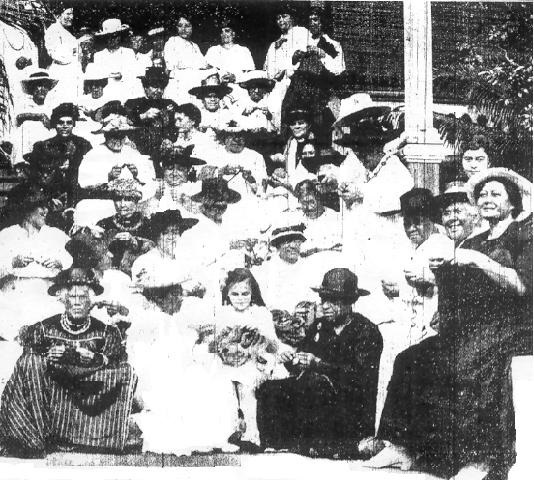 Grainy photo from microfilmed newspaper shows the spirit of knit-in at Princess Kawananakoa’s home (Honolulu Advertiser March 21, 1918)Hawaii’s special knitting corps was the Daughters of Hawaiian Warriors. Members began clicking their needles toward 450 sweaters, watch caps, and socks on March 20, 1918, at Princess Kawananakoa’s home. After a 3 hour knit-in by 75 women, each departed with a yarn allotment supplied by the Princess and other ranking members of the group. Many members had sons or close relatives “in Uncle Sam’s service. ...Enthusiasm is spontaneous because [the sweaters] are to clothe our boys of Hawaii...”
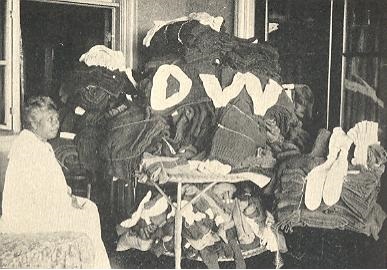 Mrs. E. K. Reis with garments knit by Daughters of Hawaiian Warriors (Hawaii in the World War)In a triumphant pre-shipment photo, the Daughters of Warriors ‘branded’ their finished knitting with their initials (DW in socks). When Ad Club members later saw the photo in Ralph Kuykendall’s official history of Islanders’ war efforts, they surely moaned, “Wish I’d thought of that.”
Anita Manning, Historian Elks Lodge 616
References:
Advertiser Sep 21, 23, 30, 1917; Mar 21, 1918
Ka Nupepa Kuokoa, Apr 5, 1918, pg 1
Kuykendall, R. Hawaii in the World War. 1928. Hist. Com. Terr of Hawaii
Minutes 616 Jun 15, 28-9, Jul 6, 20, Dec 7, 1917; Feb 1, 22, Mar 15, Apr 16, May 3, Jul 12, Nov 6, 1918
Star-Bulletin Sep 18, 28, 29, 1917
www.redcross.org/museum/exhibits/
- At war's end, nearly one-third of U.S. residents were Red Cross members or volunteers.
- Today they are the Daughters and Sons of Hawaiian Warriors, men being admitted at a later date.