
































Merle Wright Carter
By Molly Daniel, Charleston, IL (maryjdaniel@outlook.com)

Merle Wright was born 29 Sept 1892 in Wright, IA, a town named for her ancestors. She was the daughter of George M. Wright and Mary Emma Moss, both of whom died before Merle was eight years old. Merle was raised by her paternal grandparents. Though she wanted to become a nurse, her aunt insisted that she become a teacher. She enrolled at Penn College Academy in Oskaloosa, completed training for a teacher’s certificate and taught for twelve months in a rural school before convincing her family that she was not cut out to be a schoolteacher.
She attended three months of nurses training at Mahaska County Hospital in Oskaloosa, and then heard about the nurses training school at the newly built Jefferson County Hospital in Fairfield IA. She enrolled there in 1912 and was one of five nurses in the first graduating class in 1915, completing a three-year course. She remained at Jefferson County Hospital as the night supervisor for a couple of years, and in October 1917, accepted a position as assistant superintendent of the Washington County Hospital.
A few months later, Merle was invited to join a unit preparing for overseas duty. Amy Beers, hospital superintendent of Jefferson County Hospital, invited Merle enlist in Unit R, a volunteer group organized by Dr. J. Fred Clarke of Fairfield. Despite an attempt to block her enlistment by a Washington hospital administrator who arranged for a doctor to diagnose Merle with “chronic appendicitis,” Merle received a clean bill of health from a different doctor and was accepted in the unit. She took her oath of office on 26 January 1918 and joined other 20 other nurses assembled at Ellis Island on 30 January 1918. As she recalled years later for the Fairfield Ledger newspaper, the Army provided the nurses with uniforms:
"On February 9 we received passes to the city to be equipped for overseas duty. We were happy with the street uniforms: two-piece navy blue suits, two white blouses, a red-lined Red Cross cape, hat, shoes, and everything. However, when we saw the ugly gray duty uniforms, we were sure that the officers' wives and enlisted men's sweethearts had been instrumental the designing. They were awful! So, sure enough, we were in the army now."
On 16 February 1918, the officers, nurses and enlisted personnel of Unit R departed the U.S. aboard the SS Carmania. After a brief stop in Liverpool, the nurses traveled separately to France, landing at Le Havre on 7 March 1918 and reaching Contrexeville three days later.
In Contrexeville, the personnel of Unit R joined Base Hospital 32, staffed and equipped by an Indianapolis group which had arrived a little more than three months earlier.
 "We found nursing in the war zone very different from civilian nursing. For one thing, we did not have the satisfaction of watching our patients recover. We were constantly urged by the surgeon general to keep our patients moving. As soon as they recovered from the first shock and were diagnosed and classified, they were sent to hospitals farther back for recovery and convalescence or, in some cases, for return to the lines."
Merle formed close bonds with other nurses of Unit R.
"Once I was sent to nearby Vittel when some of the nurses there were hospitalized with influenza. I was put on night duty and I got so lonesome for my friends in Contrexeville that after breakfast, I would bum a ride in an empty ambulance, or with a policeman on a motorcycle, or any way I could get there. Sometimes I even walked back to Vittel in time for duty at 7 pm. Fortunately this lasted only about a month and then I was back with my friends."
The day after the Armistice was signed, Merle and Sarah Greenhalgh, another nurse from Unit R, were granted leave, and they traveled to Nice and Paris. In Paris, the city was crowded with troops celebrating the end of the war, but they found Major J. Fred Clarke, the commander of Base Hospital 32, who joined them for dinner. As Merle recalled, “Sarah was more experienced than I in dining out and knew how to order the wine. I said ‘I think I’ll pass,’ but Major Clarke said, ‘Oh, no, we’re in Paris, we must have wine. I’ll order for you.’”As the AEF hospitals began to pack up and head home, a call was issued for volunteers to relieve nurses at the nearby Base Hospital 90 in Chaumont. Merle volunteered to go, and from 17 January to 5 February 1919, she was in Chaumont. “However,” she recalled, “I became ill with an attack of influenza and had few days of service at Base Hospital 90. Shortly thereafter we were recalled to Contrexeville to await traveling orders.”
Unit R departed Contrexeville on 19 February 1919, bound for home. But while most of the group boarded the SS America to depart from Brest on 4 March 1919, due to a lack of space, Merle and eleven others were asked to wait for the next transport. She left France on 8 March 1918 on the USS Louisville and arrived in New York on March 22nd. On 14 April 1919, she was back home in Wright, IA. She was discharged from active duty on 29 April 1919.
Following her war service, Merle served as the public health nurse in Jefferson County, IA (1920-1922.) She married Dr. Charles Carter (Professor of Biology and Geology at Parsons College in Fairfield) on 9 Sept 1921, and they had one daughter, Joan. In 1944, Dr. Carter died suddenly of a heart attack, and Merle returned to nursing. She was the director of nursing at Jefferson County Hospital from 1947-1950 and resident nurse at Cornell College in Mt. Vernon, IA (1946-47) and Parsons College in Fairfield (1950-51.)
In 1951, Merle moved to Santa Fe, NM, and continued working as a nurse. In 1974, she moved to California. When she died on 3 March 1988 at Veterans Administration Medical Center in Sepulveda, CA at the age of 95, Merle was believed to be the last surviving member of Unit R. She is buried at Libertyville, Jefferson County, IA.
Photo credits:
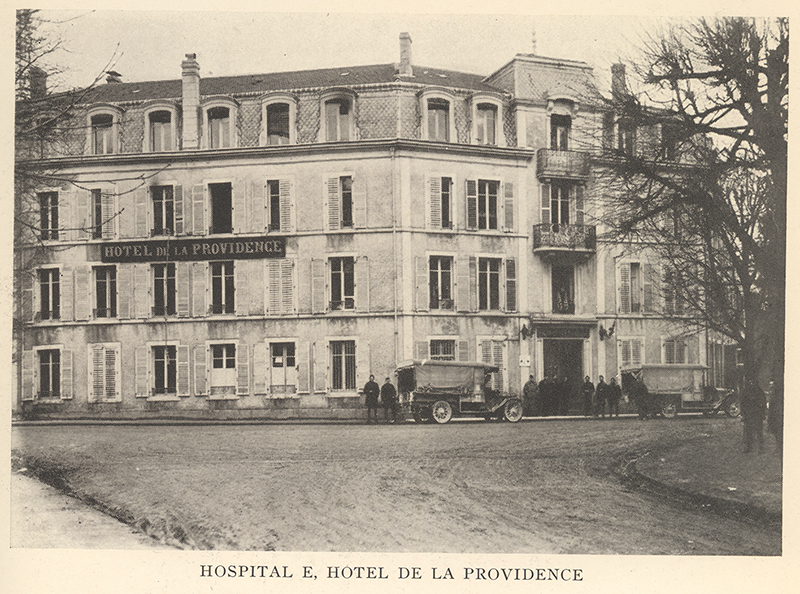
BH32-0025b.jpg - Hotel de la Providence served as Hospital E, where Merle Wright was assigned for much of her time in Contrexeville. This image is from the Unit History of Base Hospital 32 and in the public domain.
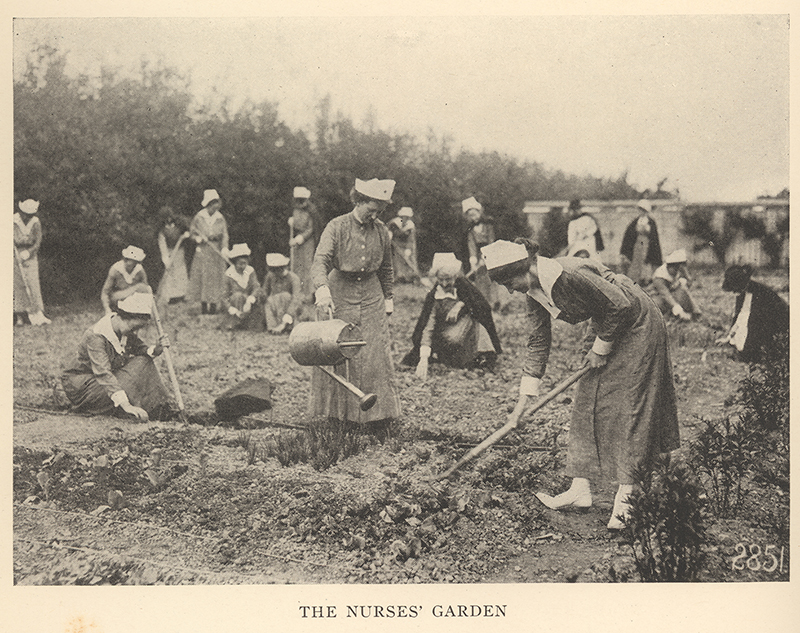
BH32-0036b.jpg - the "nurses' garden," as depicted in the Unit History of Base Hospital 32 (though I have yet to see any mention of gardening in the letters or journals of the nurses -- the most frequent leisure time activity I read about was taking walks in the countryside or to nearby villages)
Merle Wright Carter in 1919 from Palimpsest V67 N5 SepOct1968.jpg - this is the only photo I could find of Merle Wright Carter. It was published in both the Fairfield Ledger (1986 articles) and in the Palimpsest, a publication of the State Historical Society of Iowa. The image is from Merle's own collection.