




























Stories of the Fallen - Lt. LUCJAN CHWALKOWSKI Volunteer from America to General Haller's Polish Army in France
THE DEATH OF A POLISH AMERICAN HERO 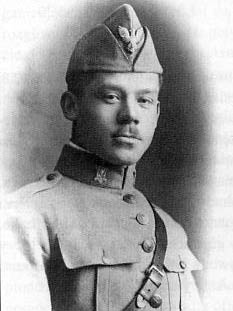 Lt. Lucjan Chalkowski, in this portrait, is seen wearing a bonnet de police (side cap) rather than the more traditional four cornered rogatywka. The bonnet was favored at the front because it could be worn under the helmet for additional padding. The cap eagle is non-regulation.
Story by Jan Lorys, Polish Roman Catholic Union of America
PATROL! Perhaps the most disliked military operation. A small unit, working far away from its lines and support. At the same time its mission is most vital – to discover the intent of the enemy, his security, check out the terrain for an advance, capture a prisoner.
During the night of July 9 and 10t, 1918, a small patrol is surprised approaching the German trenches. Its leader is wounded and the next day, 2nd Lieutenant Łucjan Chwałkowski dies. His last words were to have been “To dla Polski”. (This is for Poland). How did the young immigrant to America find himself in “no man’s land” near Reims, France?
Łucjan Chwałkowski, was born on December 6, 1892, in Praszka, currently in the vicinity of Opole but then in the Russian partition. His father Tomasz, a tailor, trying to support a family of ten, left with his wife and some of their children for America. Arriving in New York City on May 15, 1906 they lived in a tenement house. The young Łucjan soon followed his father’s lead and worked in the clothing industry. (On his enlistment document in October, 1917 he lists his occupation as being an assistant designer in women’s wear). He also joins the Związek Sokołów Polskich w Ameryce, (Alliance of Polish Falcons in America), a patriotic gymnastic society. In 1910 the male Chwałkowskis – Tomasz and his sons Wincenty and Łucjan march in a parade commemorating the 500th Anniversary of the Polish and Lithuanian victory over the Teutonic Knights at Grunwald. They probably had the sharpest uniforms in their Nest.
Łucjan takes a more active part in the Falcons Nest No. 7. The national organization had adopted a more militant stand becoming a para-military training group. According to Arthur Waldo’s (another officer of the Polish Army in France) history of the Falcon movement, „Sokolstwo, Przednia Straz Narodu,” (The Falcons, Advance Guard of the Nation) in Volume IV, Chwałkowski’s first mention is as a participant of the first “war course” organized from March 25 to April 8, 1913 for the four Falcon councils in the Mid-Atlantic States of New York, New Jersey and Pennsylvania. The course was organized for the senior leadership to instruct their subordinates in the councils and nests. The subjects taught included: "military techniques”, and physical training, general studies (?), first aid and field sanitation, history and social studies, theoretical military engineering: w Austrian Army officer and later a veteran of the Boer Wars, fighting against the British, so he knew from practical experience how important protection was from the quick firing guns used by both sides. The next time Chwałkowski is mentioned in Volume IV, he has advanced to be the head of Council XII.
In 1916 the Falcons, in anticipation of America’s entry into the war sought a sponsor for a future Polish Army to be based on the Falcon organization. Americans, eager to fight on the side of the Allies had joined either the French Foreign Legion or the so-called „American Legion” formed as part of the Canadian Armed Forces. A few Polish Americans had enlisted and agitated the Polish language press in America to form a “Polish-American Legion” in Canada. While that did not happen, enough interest must have been sparked so that the Falcon President Teofil Starzyński and Canadian Chief of Staff General Sir Willoughby Gwatkins agreed to train 22 officers at the Canadian Officer Training Course (COTC) at York University (now The University of Toronto) for a future Polish Army.
Because the United States was still neutral, all these events were conducted in secret. The volunteers were not told until the last minute where they were going. The Falcons issued border crossing passes to the participants. Mail correspondence was handled by the Falcon headquarters in Pittsburgh and censored. Opponents of the Falcons spread the rumor that the organization had “sold” the young men to the Czarist Army.
The COTC was run by civil engineering professor and Canadian Army reservist Lt. Colonel Arthur De LePan. Since he was running the Polish course on the same standards as the regular Canadian course, how the volunteers expressed themselves in English was very important. Colonel LePan sent an evaluation of the 23 candidates (Andrzej Małkowski, the founder of Polish Scouting back in 1910, had joined the Canadian Army and was sent from his regiment to complete the Polish course, but not to return to the United States) to Falcon Headquarters. Chwałkowski was evaluated highly by LePan and praised as being “sharp and keen”. In the end 18 finished the course and were commissioned in the Canadian Army, with a proviso that their service would be delayed until the resolution of the problem of sponsorship.
The newly commissioned officers returned to the United States shortly after the US declaration of war against Imperial Germany. They were used as instructors for the Falcons and helped run the Non-commissioned officers’ course at Alliance College in Cambridge Springs, Pennsylvania and later in Canada.
On June 14, 1917, French President Raymond Poincaire announced France’s willingness to form an autonomous Polish Army under French command. A Franco-Polish mission went to the States to encourage enlistment and were surprised by the militant stance and degree of preparation of their peers. American Polonia would not send individuals, it could send battalions. They requested an official French Military Mission to deal with a reluctant US War Department.
The agreement among France, Canada, the United States and the Falcon Military Commission in September of 1917 established the rules for recruiting, training, transport and payment of the volunteers for the Polish Army in France. Lt. Chwałkowski was sent to Canada and after taking additional courses in the use of machine guns at Camp Borden, Ont. he was in the first convoy to sail to France on December 15, 1917 with some of the troops that he had trained.
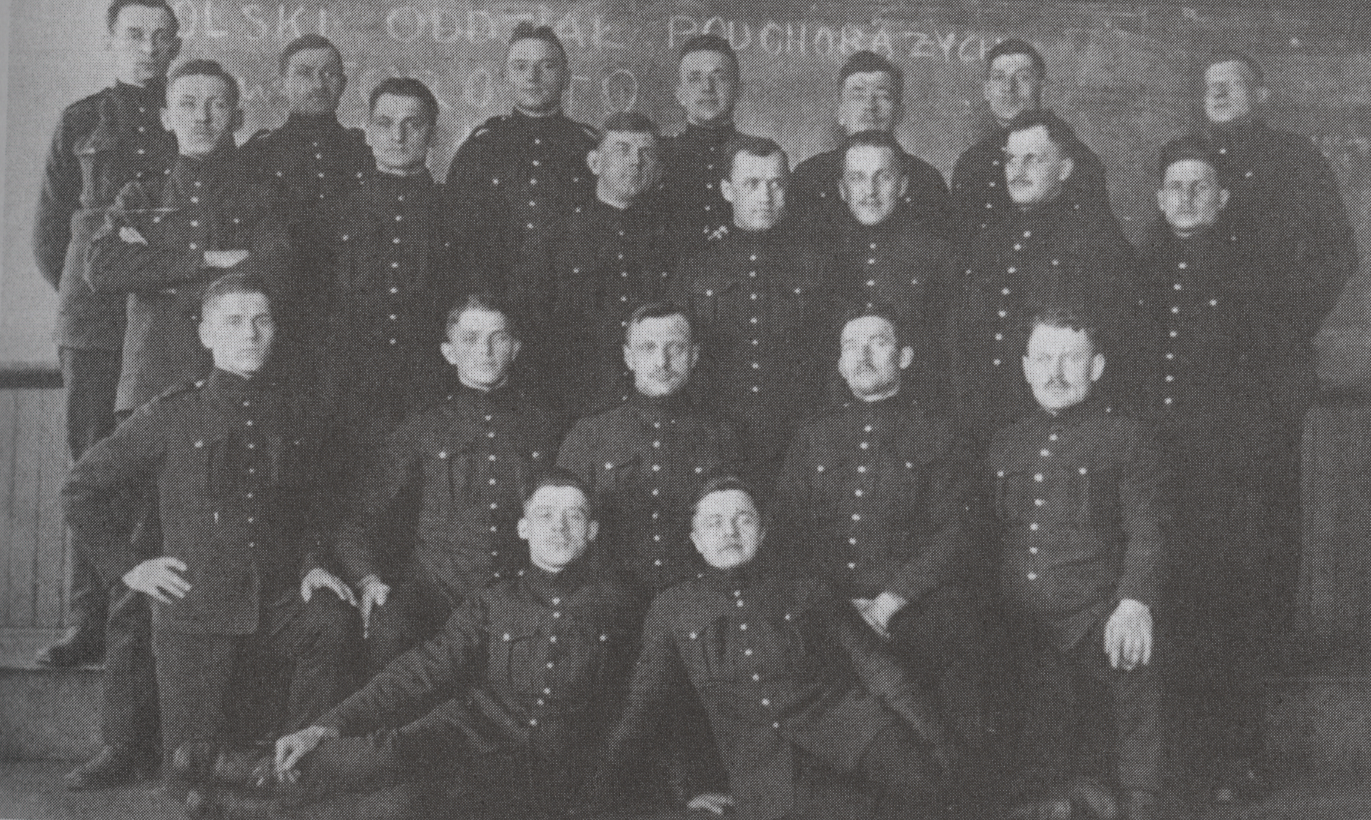 THE FIRST CANADIAN OFFICER TRAINING COURSE (POLISH PROBATIONERS) Chwałkowski is on the left, first row. Andrzej Małkowski, is third row, second from right not looking at the camera.
The French wanted the Polish Army to be a well-trained force and the junior officers were additionally trained and evaluated by the French at Qiutin in Brittany. The American volunteers were mixed in with Polish veterans from the disbanded Russian Expeditionary Corps to France, men of Polish extraction in the French Foreign Legion and Frenchmen who could trace their family roots to the soldiers fighting with Napoleon or exiles from the failed 1830-1831 Uprising against Czar Nicholas.
The First Rifles Regiment of the Polish Army, commanded by Colonel Jasieński, a veteran of the French colonial Army and descendent of an 1830/31 Uprising participant, who barely speaks Polish. was sent to the Champagne region near Reims and St. Hillaire to serve in the trenches with a French unit and learn the fundamentals of trench warfare, including patrolling.
Wojciech Albrycht, also a veteran of the first COTC course, who stayed in Poland after the war, found a participant of the patrol and an eyewitness to the death of the young officer. He wrote a long article published in the Polish Army Veteran’s magazine “Weteran” in New York in March of 1939.
The participant and eye-witness was Franciszek Fuśniak, a sergeant armed with a light machine gun to cover the patrol if they were discovered and had to retreat. From his narration we find that Lt. Chwałkowski volunteered to lead a patrol into “no man’s land” to capture a prisoner, a task French patrols had not accomplished during the two previous nights. The patrol consisted of Lt. Chwałkowski as the leader, another officer Lt. Krzywkowksi –Wolinski was to be the observer, two medics, four enlisted men as escorts for any prisoners and the afore mentioned light machine gunner. The patrol was discovered as it approached the German lines and came under machine gun fire, preplanned artillery and grenades (these left no telltale muzzle fire). The patrol members retreated individually and Fuśniak found himself with three others in a shell hole. The artillery fire had deafened them. Lt. Wolinski is knocked into the shell hole and stunned temporarily. However, he recovers and orders the four men to find the others. Fuśniak found one man, a Pole from Holland, critically wounded and got him to the shell hole. The men move out again and this time they are guided by a sharp cry and Fuśniak finds the young officer with his left are shorn off to below his shoulder. Of course, the Germans are also directed to the cry and machine gun fire makes it difficult to retrieve the wounded man. Fuśniak picks up the officer and drops into some cover every few steps, reaching his comrades who try to bandage Chwałkowski. Eventually, they find the French medics and return to friendly lines. Unfortunately, the position is under fire and they can’t evacuate the wounded men. Chwałkowski continues to cry out “Where’s my hand?” until he dies in the early evening.
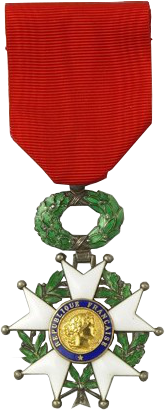
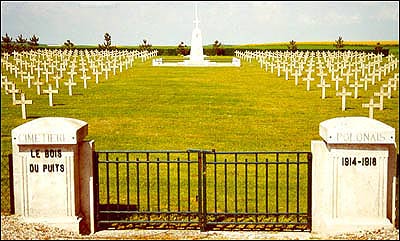
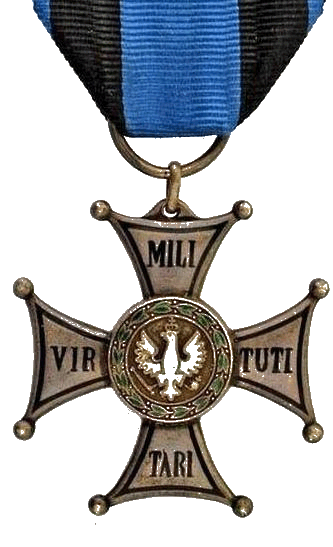
Other reports have him being evacuated and then dying in the field hospital, in where his last words are “This is for Poland”. Letters of condolence were issued by the French Army and government, the Polish language press in the United States as well as the English language press. The French honored the young volunteer by decorating him with the Chevalier’s Cross of the Legion of Honor. The Polish government, which was established on November 11, 1918 and shortly afterwards was engaged with border disputes as well as a full-fledged war with Bolshevik Russia in 1919-1921, posthumously awarded the officer with the Virtuti Militarii 5th Class. His grave is in France at the cemetery.