





























Regimental Aid Stations
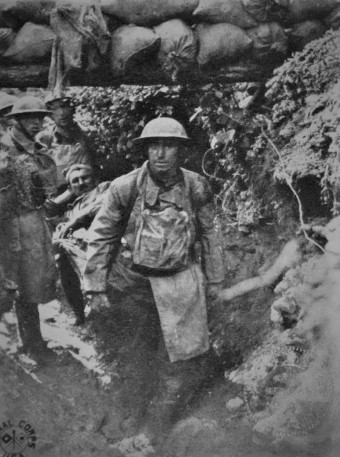 Stretcher Bearer in TrenchMedical support at the closest point to the front line was provided by physicians and Medical Corps enlisted men who were assigned to an army infantry division. These men were identified as "Medical Department personnel on duty with division troops." Their purpose was to provide medical care for the division’s infantry and artillery regiments, their machine gun and mortar battalions, the engineers, signalmen and other supporting units.
The Regimental Aid Station was staffed by 4-7 officers and 31-43 enlisted men. It would be these men who provided the first level of professionally directed care for the regiment’s sick and wounded. However, after the infantry divisions were reorganized in August, 1918, the Regimental Aid Station personnel were disbursed to provide immediate medical support to the regiment’s infantry battalions. This resulted in the creation of three Battalion Aid Stations.
Each station was intended to support four infantry companies by locating its station to the rear of the battalion and by placing two Medical Corps enlisted men with each infantry company to man a Company Aid Post. These eight men were trained and supervised by the physician assigned to the Battalion Aid Station. The Regimental Aid Station’s role now became a headquarters to command the battalion stations and if needed could combine the dispersed stations back into one unit, if needed.
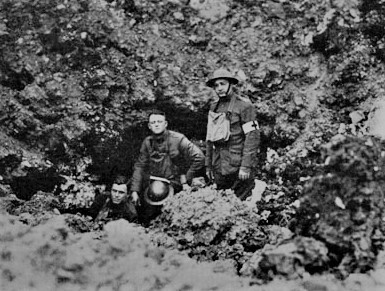 Aid Station, 7th Artillery Regiment, 1st Division, Serevillers, July 5, 1918The Company Aid Post was sited in a sheltered location very near the front line if the unit was garrisoning a trench system. However, if the company was out of its protected position making an assault or in retreat the post would move and establish a succession of posts to provide emergency medical care.
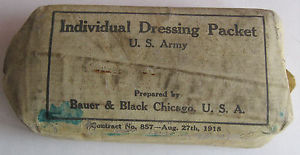 Individual Field Wound DressingIt was expected that the initial treatment of a man’s wounds would begin with his own application of his first-aid dressing. To do this each man was provided with two gauze bandages (4”x84”), two gauze compresses (3 ½” x 3 ½ “), two safety pins and was instructed on how to apply the dressing by one of the physicians assigned to his battalion. The purposes of this dressing was to protect the wound from further trauma, prevent loss of blood, and reduce the possibility of secondary infection and to give the man some physical and psychological comfort. If a wounded soldier could not care for himself, the dressing may have been applied by a comrade. More likely, this was done by stretcher bearers or by company aid post personnel, who were trained in how to apply field dressings, control hemorrhage, splint fractures and to protect the wounded from gas.
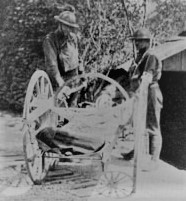 Battalion Aid Station, 101st Infantry, 26th Division, Bois de la VoisogneAbout 40% of the wounded men were able to walk to the rear. The remainder would need to be carried by regimental stretcher bearers, who were men assigned from the battalion, to the next level of care which was the Battalion Aid Station where they would be seen by a physician. The locating, marking, gathering and directing of the sick and wounded to the next level of care would have been an important patient management task performed by the two men assigned to the Company Aid Post.
The Battalion Aid Station was centrally located at 500 to 1000 yards behind the infantry companies in a building, dugout or specially constructed shelter. Its location was carefully selected because it had to be easily reached from the front by foot and on a road, if possible, to allow ambulances to pick up the patients for transport to their next level of care.
An aid station’s site could be anything from a hasty shelter to set of above or below ground rooms constructed over time that could treat from 12 to 30 patients for their injuries, project them from further harm, hold them for evacuation, plus store medical supplies for the station and company aid posts. The Battalion Aid Station was staffed by one medical officer, four to six Medical Corps enlisted men, two runners and one or more stretcher bearer squads.
Initial treatment was limited to physician-directed emergency care, and might include:
- Controlling hemorrhage
- Application or readjustment of field dressings and splints
- Administration of the anti-tetanus serum and morphine for pain
- Treatment for gas injuries
- Anti-shock treatments such as warmth, hot food and drinks
The first step in a long process of sorting the sick and wounded began here with the filling out of the patient’s field card that noted whether he was:
- Very slightly wounded but able to return to the line
- Slightly wounded and requires evacuation
- Seriously wounded
- Patient with fractures
- Severely wounded with attendant shock
- Gassed patient
- Psychoneurotic
- Sick
If the patient was slightly wounded or not seriously sick he would be retained at battalion level. More seriously-wounded were evacuated. Those to be evacuated, included those with serious wounds or fractures, were likely to receive the attentions of the physician whose treatment might include:
- Painting around the wound with iodine
- Injection of 500 units of the anti-tetanus serum
- One-fourth grain of morphine for pain to slightly to seriously wounded
- Control of hemorrhage through ligature, hemostats or a tourniquet
- Immobilization of fractures with wooden splints or the Thomas Splint
- Shock treatment such as blankets and hot drinks
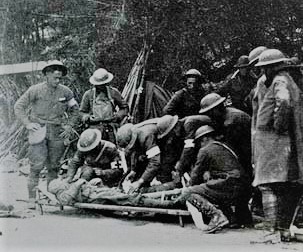 Regimental Aid Station, 29th Infantry, near CantignyPhysician directed treatment was designed to stabilize the man and prepare him for transport. This might be the divisional dressing station or field hospital. At the same time the stabilizing treatment was given the staff coordinated his evacuation with the personnel of the next level of care: the ambulance company and its dressing station.
Given that the aid station could not provide surgical procedures; retain patients for any length of time; were subject to enemy artillery fire; and were constantly receiving new patients it was essential to evacuate their patients as soon as possible. This was especially important due to the risk that the wounded could develop a life, or limb, threatening gas-gangrene infection if he did not receive a surgical intervention within 12 hours of his wounding.
Timely evacuation was a challenge due to the weather, terrain, enemy fire, how to move the patient and the patient’s condition. Weather and terrain were variables that could not be controlled. The threat from enemy fire could be mitigated by a night evacuation.The means of evacuation, by stretcher bearers, wheeled stretcher cart or ambulance and preparing the patient for movement were variables that the station’s staff focused on.
Sources
Jaffin, Colonel Jonathan H. Medical support for the American Expeditionary Forces in France during the First World War (Fort Leavenworth 1990)
Volume VIII, Field Operations, The Medical Department of the United States Army in the World War (Washington, 1925)
Volume XI, Section I, General Surgery, The Medical Department of the United States Army in the World War (Washington, 1925)