






























JOHN TALASKA - USMC - Rochester NY 
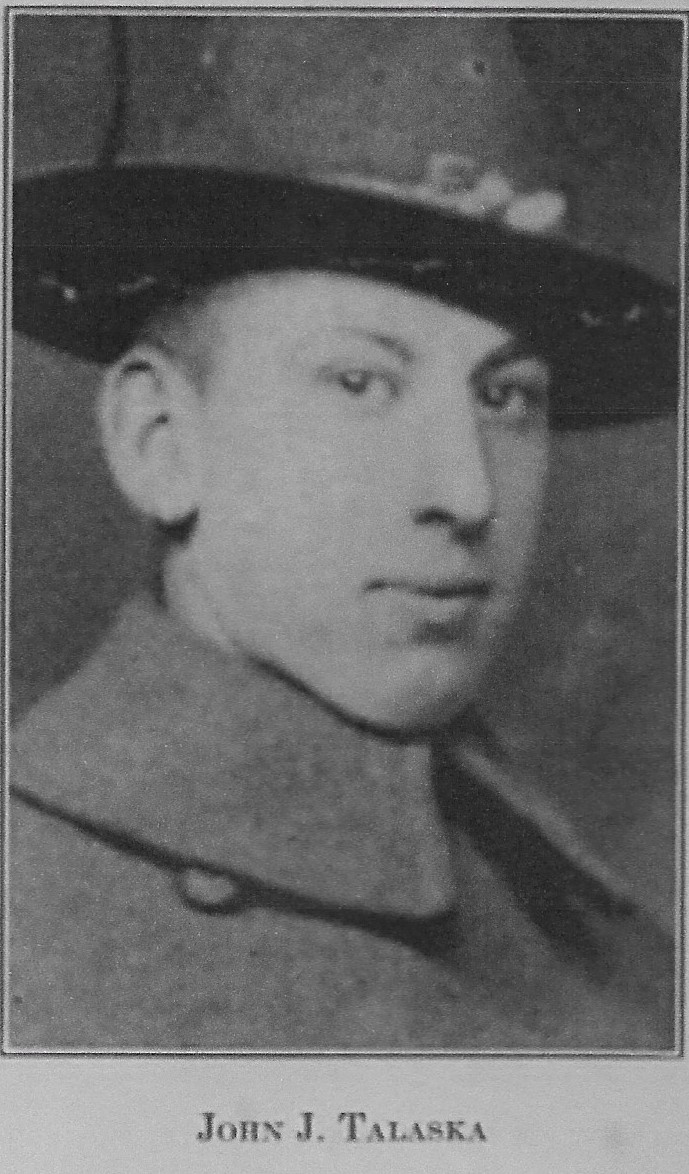 John Talaska served in the U.S Marine Corps from April 18, 1917, until his death on June 24, 1918, from wounds received in action. He received the “Character Excellent” Commendation from the USMC.
John Talaska was born on July 2, 1895, in Morris Run, Pennsylvania. He was the son of Carl and Theophila Talaska. It is likely that Carl and Theophila, with three of their young children, immigrated to the United States from Osnowo, a village in the Prussian town of Kulm (Chelmno). Chelmno was given back to Poland in 1920 following World War I.
We meet the family in Rochester for the first time in the 1905 US Census. Seven of their 10 children were living with their parents at 63 Weddel Way (later renamed Roycroft Drive). In the 1905 Rochester City Directory, Carl Talaska is listed as a laborer; Joseph Talaska (b 1884) as a gardener, and Max Talaska (b1886) as a baggage man for NYC station.
John Talaska was a member of St. Stanislaus Church and he was employed by the Sibley, Lindsay, & Curr Company.
Immediately upon enlisting in April, 1917 he was assigned to Company G Marine Barracks at Port Royal, South Carolina.*
John Talaska embarked overseas August 22, 1917 to join up with the “Fighting Fifth”, the first contingent of Marines to engage in action in the Toulon Sector, Aisne Defensive, Chateau -Thierry. On June 7, 1918, he was wounded at the Battle of Belleau Wood, a fierce battle that earned the regiment another nickname, “Devil Dog”.**
Battle of Belleau Wood
Pvt. John Talaska died on June 24, 1918 of wounds received in the Battle of Belleau Wood. He was 23 years old. He had spent the last 10 months and 2 days of his life overseas in the service of his country.
Pvt. Talaska was initially laid to rest in France. On July 2, the transport “Wheaton” brought his remains back to America. On July 26, 1921, Pvt. John Talaska was buried, with military honors, in Holy Sepulchre Cemetery, Rochester, New York, Lot 34, Section South 6.
Members of William H. Cooper (Marine) Post, Number 603, American Legion, acted as bearers and firing squad. Members of the Pulaski Post Number 783, American Legion, attended in a body and acted as escort.
*From the USMC History Chronology Website: June 1, 1911 - A recruit depot began operation at Port Royal on a three-company basis as a secondary function of the Marine Officers’ School, after it had been postponed from its original startupdate of November 1910.
April 6, 1917 - Nov. 11, 1918 - The recruit depot underwent a massive expansion of installations, number of Marines trained and the type of instruction recruits received in order to meet the demands of the ongoing World War I. It was also during this time that Marine Barracks, Port Royal, was redesignated as Marine Barracks, Paris Island, and the government took possession of the remaining private land on Parris Island. Marine Corps Order No. 32 officially changed the name "Paris" to "Parris" on May 3, 1919.
**World War I (Wikipedia) The unit was activated on June 8, 1917, in Philadelphia, Pennsylvania, as the 5th Regiment of Marines. They immediately deployed to France
, arriving on June 26, and were assigned to the 1st Infantry Division of the United States Army. Later that year, in October, they were reassigned to 4th Brigade of Marines under the 2nd Infantry Division. In spring 1918, the regiment was involved in the fierce battle of Belleau Wood and was given the nickname Devil Dog.
The Fifth subsequently participated in the offensive campaigns at Aisne, Battle of Saint-Mihiel and in the Meuse-Argonne offensive. They also participated in the defensive campaigns at Toulon-Troyon, Château-Thierry, Marbache and Limey. From 1918 until 1919 the regiment participated in the occupation of the German Rhineland. In August 1919 it relocated back to Marine Corps Base Quantico, Virginia. It was inactivated on August 13, 1919. The regiment's actions in France earned them the right to wear
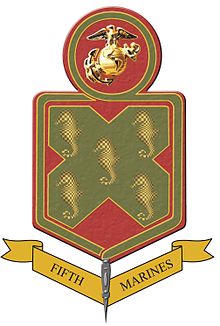
the Fourragère (seen in the outline of the unit's logo), one of only two in the Marine Corps (the other being the 6th Marine Regiment). The award was a result of
being the only regiments in the American Expeditionary Force to receive three Croix de guerre citations: two in the order of the army and one in the order of the corps— Fourragère and Croix de guerre with two Palms and Gilt Star. The Fourragère became part of the uniform of the unit, and all members of the organization are authorized to wear the decoration on the left shoulder of the uniform while members of the organization.