































O beautiful for spacious skies,
For amber waves of grain,
For purple mountain majesties
Above the fruited plain!
America! America! God shed His grace on thee,
And crown thy good with brotherhood,
From sea to shining sea!
(Refrain)
O beautiful for pilgrim feet,
Whose stern, impassion'd stress
A thoroughfare for freedom beat
Across the wilderness!
America! America! God mend thine ev'ry flaw,
Confirm thy soul in self control,
Thy liberty in law!
(Refrain)
O beautiful for heroes proved,
In liberating strife,
Who more than self their country loved,
And mercy more than life!
America! America! May God thy gold refine,
Till all success be nobleness,
And ev'ry grain divine!
(Refrain)
O beautiful for patriot dream
That sees beyond the years
Thine alabaster cities gleam
Undimm'd by human tears!
America! America! God shed his grace on thee,
And crown thy good with brotherhood,
From sea to shining sea!
(Refrain)
Refrain: America! America! God shed His grace on thee!
Written in the summer of 1893, Katherine Bates, a professor at Wellesley College, was inspired to write the lyrics for “America the Beautiful” while travelling west for the first time. In her memoir, she recalls how her trip led her to encounter the Chicago World’s Fair and the Colorado Springs - experiences that are reflected in the grandeur lyrics of the song. Silas G. Pratt, the first composer to set the lyrics to music published the song in 1895. Although many people enjoyed the lyrics, there were calls to revise it. They felt that the music did not match the eloquence of the lyrics. Consequently, many other composers tried to set the lyrics to their own music and the song was repeatedly revised with Bates’ permission to fit their own music. The song was not associated with one tune. The lyrics today are usually set to Samuel A. Ward’s “Materna” composed in 1882.
The version in the Army Song Book was written by Will C. Macfarlane, an organist and composer of Portland, Maine. Ms. Bates says in her memoir that Macfarlane’s version was played on the city chimes of Springfield, Massachusetts and was received with “widest acceptance. This spirited march was also arranged for band music and hymn singing. Both hymn and march versions are said to have been used in war-recruitment and patriotic meetings.
Prior and during the war, the beginning of the fourth stanza, “O beautiful for patriot dream” was changed to “O beautiful for patriot drum” in reference to the military. In a copy from a church leaflet, the stanza was also changed to “O beautiful for patriot dress.” In Bates’ memoir, she recalls that the song was popular in church services. The mention of “patriot dress” may refer to the new uniform the soldiers were wearing. One can imagine the climactic effect this stanza would have produced when recalling how people must have felt bidding their young soldiers farewell.
“America the Beautiful” also expresses a love of home that includes patriotic references. As the song progresses, soldiers are called to defend the homeland: “Oh, beautiful for heroes proved In liberating strife, Who more than self their country loved, And mercy more than life!” This would have led soldiers to believe that their love of home justified their efforts of defeating Germany and preventing the enemy to attack the homeland.
http://museumsonthegreen.org/wp-content/uploads/Katharine-Lee-Bates-describes-how-she-wrote-America-The-Beautiful-after-1922-signed.pdf
https://digitalcommons.library.umaine.edu/cgi/viewcontent.cgi?article=1437&context=mmb-me
http://www.loc.gov/jukebox/recordings/detail/id/7689
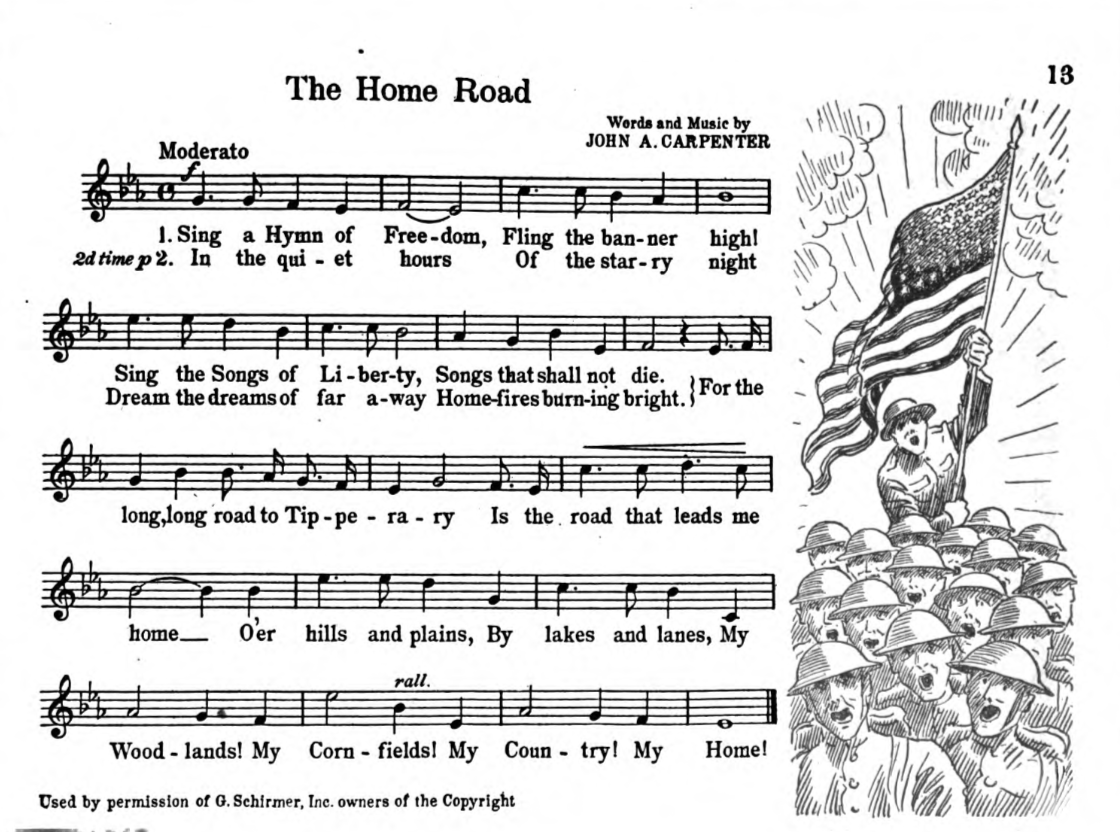
1. Sing a Hymn of Freedom, Fling the banner high!
Sing the Songs of Liberty, Songs that shall not die.
2. In the quiet hours Of the starry night
Dream the dreams of far away Home fires burning bright.
(Refrain)
For the long, long road to Tipperary Is the road that leads me home
O’er hills and plains, By lakes and lanes, My Woodlands! My Cornfields! My Country! My Home!
This song was composed by John Alden Carpenter, a member of the National Committee on Army and Navy Camp Music. Educated at Harvard by the conservative German-influenced composer John Knowles Paine, Carpenter abandoned the German style and became known as a conservative composer influenced by 20th-century French and German music. He later explored on combining his impressionistic compositional style with jazz rhythms. His “Concertino for Piano and Orchestra” composed in 1917 and ballet “Krazy Kat: A Jazz Pantomime” completed in 1922 incorporate jazz rhythms with traditional conventions of harmony.
Carpenter composed two songs to support the war effort: “The Home Road” and “Khaki Sammy.” Howard Pollack’s book John Alden Carpenter: A Chicago Composer briefly discusses the inspiration for “The Home Road.” “On a hot summer’s night in 1917 (presumably in Charlotte, Vermont), he watched a seven-piece band followed by a group of young inductees marching along with their suitcases in hand. At first, he found the procession amusing, but then he sobered at the thought of what lay ahead for the recruits and immediately wrote the words and music to ‘The Home Road.’”
The refrain,” “the long, long road to Tipperary,” refers to the 1912 English music hall popular song. “It’s a long, long way to Tipperary,” a well-known song among British and American soldiers. Perhaps Carpenter heard this song being played by the newly recruited soldiers during their march that summer night in 1917. Although not a direct quotation, Carpenter kept the words while modifying the melodic shape.
There are three versions of the song: a preliminary untitled sketch with only a melodic line with one verse, a fair copy entitled “Land of Mine,” also just one verse that was published on August 4, 1917. Schirmer however published a version with two verses dated July 1917. The July date Schirmer adopted may refer to its original composition rather than the actual publishing date. Schirmer’s edition was chosen for the Army Song Book.
Examining the three versions reveal rhetorical musical differences. While the sketch begins “Sing a song of freedom! Sing a song of joy! Sing a song of victory, as our boys march by,” the song in the Army Song Book reads, “Sing a hymn of freedom! Fling the banner high! Sing the songs of liberty, Songs that shall not die.” Changing “sing a song of joy!” to "fling the banner high!" shifts the focus from the bystander watching the parade to the active duty soldier. "Song of freedom" is also changed to "hymn of freedom" giving the song a more patriotic communal feel.
These changes may have been done to tailor the song to the objectives of the singing army. Similarly, the fair copy reads, “My Cornfields! My Rivers!” While providing references to country and home, the asymmetrical cadence lets the song’s climax fall on “Rivers.” By changing the phrase to “My Woodlands! My Cornfields!” the emphasis is now on “Cornfields.” This change portrays the American landscape as an untouched place that soldiers dreamed to return to, a place in stark contrast to the European battlefields destroyed by the war. “The Home Road” not only provide soldiers references to look forward going home, but also serve as a reminder of the causes they were fighting for and the protection of the American homeland from the destruction they witnessed on the battlefield.
John Alden Carpenter: A Chicago Composer. By Howard Pollack (Champaign: University of Illinois Press, 2001.

http://www.loc.gov/jukebox/recordings/detail/id/2832
Dear Land of Hope, thy hope is crowned,
God make thee mightier yet!
On Sov'ran brows, beloved, renowned,
Once more thy crown is set.
Thine equal laws, by Freedom gained,
Have ruled thee well and long;
By Freedom gained, by Truth maintained,
Thine Empire shall be strong.
(Chorus)
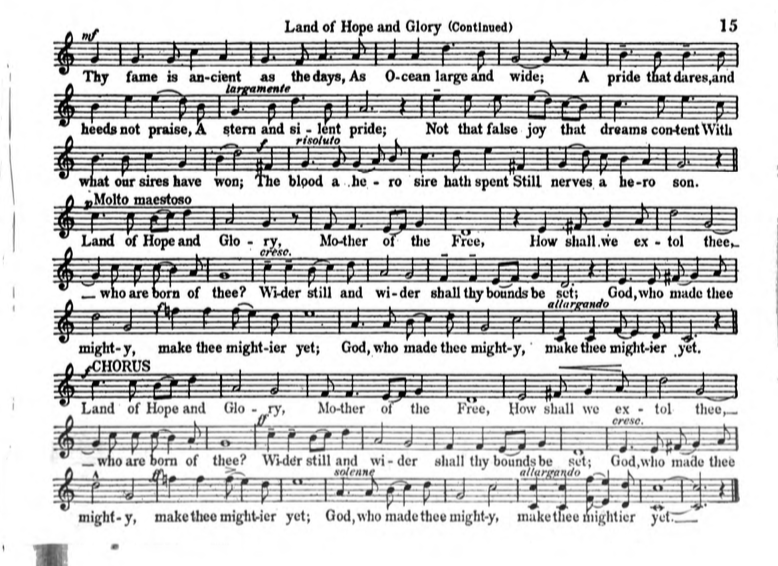
Land of Hope and Glory, Mother of the Free,
How shall we extol thee, who are born of thee?
Wider still and wider shall thy bounds be set;
God, who made thee mighty, make thee mightier yet,
God, who made thee mighty, make thee mightier yet.
Thy fame is ancient as the days,
As Ocean large and wide:
A pride that dares, and heeds not praise,
A stern and silent pride;
Not that false joy that dreams content
With what our sires have won;
The blood a hero sire hath spent
Still nerves a hero son.
Land of Hope and Glory, Mother of the Free,
How shall we extol thee, who are born of thee?
Wider still and wider shall thy bounds be set;
God, who made thee mighty, make thee mightier yet,
God, who made thee mighty, make thee mightier yet.
(Chorus)
The creation of the British patriot song, “Land of Hope and Glory,” was brought about by the combined efforts of Sir Edward Elgar and Arthur C. Benson. Originally composed without words, Edgar composed the melody in 1901 as the Trio for his “Pomp and Circumstance March No. 1.” The premier performance was done at Queen’s Hall during the London Promenade Concert. Conducted by Henry Wood, he remembered that the piece was very much appreciated by the audience and they “rose and yelled … the one and only time in the history of the Promenade concerts that an orchestral item was accorded a double encore.” (Henry Wood, My Life of Music, p.154). Soon, the trio caught the attention of the soon-to-be-crowned King Edward VII who suggested to Elgar that adding words to the trio would make a great song. Elgar enlisted the help of Arthur C. Benson, a prolific writer and poet, to provide the lyrics. In time for Edward VII’s coronation in August 1902, Elgar and Benson finished the Coronation Ode and placed the “Land of Hope and Glory” as the climax and finale. The song evolved into a patriotic song ever since it was premiered and many lobbyists today are calling to replace the current national anthem, “God Save the Queen” with this song.
The song was introduced to America soon after its premiere. In 1905, Elgar was invited by his friend, Samuel Sanford, to receive an honorary doctorate at Yale University. At the end of the graduation ceremony, Sanford directed the band to play “Pomp and Circumstance” as the recessional music. The faculty was delighted with the music and later adopted it for future graduations. Princeton soon followed the practice in 1907.
As with the previous selections featuring foreign national anthems, the goal of including “Land of Hope and Glory” in the Army Song Book would have been to unify the Allied forces. The song continued to be very popular in Britain. At the Grand Patriotic Concert held at the Royal Albert Hall in October 1914, Clara Butt, a popular singer, sang this song as the finale with Elgar as the conductor. Audiences jumped to their feet waving Union Jack flags. The upper portion of the concert flyer includes a quotation of the fifth stanza of the second verse. “Land of Hope and Glory” proved to be a popular song during the war.
https://www.pri.org/stories/2016-06-17/wild-english-roots-song-youll-hear-every-graduation-summer
https://www.royalalberthall.com/about-the-hall/news/2014/august/music-at-the-royal-albert-hall-during-the-first-world-war/

We gather together to ask the Lord’s blessing;
He chastens and hastens His will to make known;
The wicked oppressing cease them from distressing,
Sing praises to His Name, He forgets not His own.
Beside us to guide us, our God with us joining,
Ordaining, maintaining His kingdom divine,
So from the beginning the fight we were winning;
Thou, Lord, wast at our side, all glory be Thine!
We all do extol Thee, Thou Leader in battle,
And pray that Thou still our Defender wilt be.
Let Thy congregation escape tribulation:
Thy Name be forever praised! O Lord, make us free! Lord, make us free!
Originally a Dutch Christian hymn written in 1597 by Adrianus Valerius as “Wilt heden nu treden,” this song was composed to celebrate the Dutch victory over the Spanish forces at the Battle of Turnhout. The melody, however, is borrowed from a familiar Dutch folk melody. Overcoming religious oppression, the Dutch Protestants celebrated their victory over the Catholic Spanish forces by adopting a folk tune and setting a religious text. This would have been forbidden under the Spanish rule and seen as an act of defiance.
Although foreign in origin, the song has strong connections to American culture that can be traced back to two origins. As suggested by Melanie Kirkpatrick, “it’s tantalizing to think that the English Pilgrims – in exile in Holland, the only place where could worship freely – may have been familiar with ‘Wilt heden nu treden.’” This is because many of the pilgrims spoke Dutch and were Dutch citizens. The second origin may have been attributed to the Dutch settlers who brought it with them to America as early as the 1620s. Although the piece contains religious references, it is important to note that this hymn would not have been sung in Dutch Protestant churches since they saw this as idolatry. They only allowed psalms to be sung in the church.
However, in 1937, the Christian Reformed Church in North America composed of Dutch immigrants made the controversial decision to include it in the hymnal.
Perhaps attesting to its popularity, the translated “We Gather Together” was chosen as the first hymn in the hymnal. It was already popular in school songbooks prior to the decision of the Christian Reformed Church. The Methodist-Episcopal Church adopted this song in 1935.
The English translation came from the American composer, Theodore Baker. In 1894, he arranged it for a choir and translated it as a “Prayer of Thanksgiving.” Thus, the piece was associated with Thanksgiving among the non-Dutch speaking communities and public schools at the turn of the 20th-century in America. Both associations with war and Thanksgiving helped spread the popularity of the piece. Michael Hawn, professor of sacred music at Southern Methodist University’s Perkins School of Theology, said that “by World War I, we started to see ourselves in this hymn.” He continued that “people take stock of themselves at Thanksgiving...we’ve all survived some turbulent times.” The popularity of this song would have achieved a number of objectives. First, the association with Thanksgiving would have reminded soldiers of their families, their homes, and their country – entities that they have vowed to protect from destruction. Second, the song’s popularity would have resonated in the Belgian Dutch-speaking community on the Western Front and allowed the Americans and Belgian resistance to unite in their war efforts.
While the hymn’s original purpose referenced “the wicked oppressing” of the Spanish Catholics, the soldiers would have viewed the hymn in the context of World War I as a plea to be defended against the German army.
Kirkpatrick, Melanie (November 22, 2005). "A Hymn's Long Journey Home: The surprising origins of "We Gather Together," a Thanksgiving standard". Wall Street Journal. New York
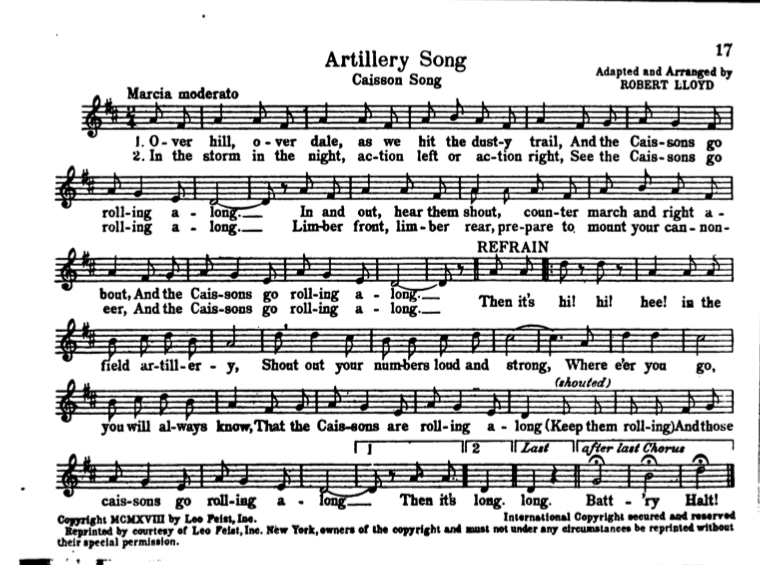
Over hill, over dale,
As we hit the dusty trail,
And the caissons go rolling along.
In and out, hear them shout,
Counter march and right about,
And the caissons go rolling along.
(Refrain)
Then it's hi! hi! hee!
In the field artillery,
Shout out your numbers loud and strong,
For where e'er you go,
You will always know,
That the caissons go rolling along.
In the storm in the night,
Action left or action right,
See the caissons go rolling along.
Limber front, limber rear,
Prepare to mount your cannoneer
And the caissons go rolling along.
Then it's hi! hi! hee!
In the field artillery,
Shout out your numbers loud and strong,
For where e'er you go,
You will always know,
That the caissons go rolling along.
(Keep them rolling)
And those caissons go rolling along.
Then it's long, long. Batt'ry Halt!
The “U.S. Field Artillery March” is a patriotic military march written by John Philip Sousa in 1917. U.S. Army Lieutenant George Friedlander of the 306th Field Artillery asked Sousa, who served in the U.S. Navy, to compose a march for his regiment based on “The Caisson Song” thinking that the song was originally from the Civil War. Mistakenly presuming the composer was dead and the song in public domain, Sousa agreed, changed the harmonic structure, set a different key, made it more march-like, and added more material. Both Sousa and Friedlander were later surprised to learn that the composer, artillery First Lieutenant Edmund L. Gruber, was still alive and that the song was composed in 1908 when Gruber was stationed at Fort Stotsenburg in the Philippines during the American occupation following the Philippines-American war.
The lyrics for “The Caisson Song” was written by Lieutenant Robert M. Danford. It was a recount of the difficult march encountered by Gruber and Danford through the Zambales Mountains of Luzon, Philippines. Gruber scouted the area with a small detachment to select the best route for his battalion. Climbing higher to get a better view, he looked back at the marching companies and heard one of the section chiefs shout to his drivers, “Come on! Keep ‘em rolling!” Since the song stated that “the caissons go rolling along,” this phrase referenced the artillery rather than the men. Caisson, a two-wheeled cart designed to carry artillery and ammunition, was pulled by horses. The version in the Army Song Book was arranged by Robert Lloyd for piano and voice in 1918. Viewed as an instant success in the army, this song would have been popular among the soldiers and thus included in the song book.
This song inspired “The Army Goes Rolling Along” which would later be adopted as the official song of the U.S. Army. Interestingly, Gruber was the descendant of Franz Gruber, composer of “Silent Night,” the song sung during the Christmas Truce of 1914.
https://www.loc.gov/item/ihas.200000019/
Bierly, Paul. The Works of John Philip Sousa, pp. 93-94 (Integrity Press, 1984)
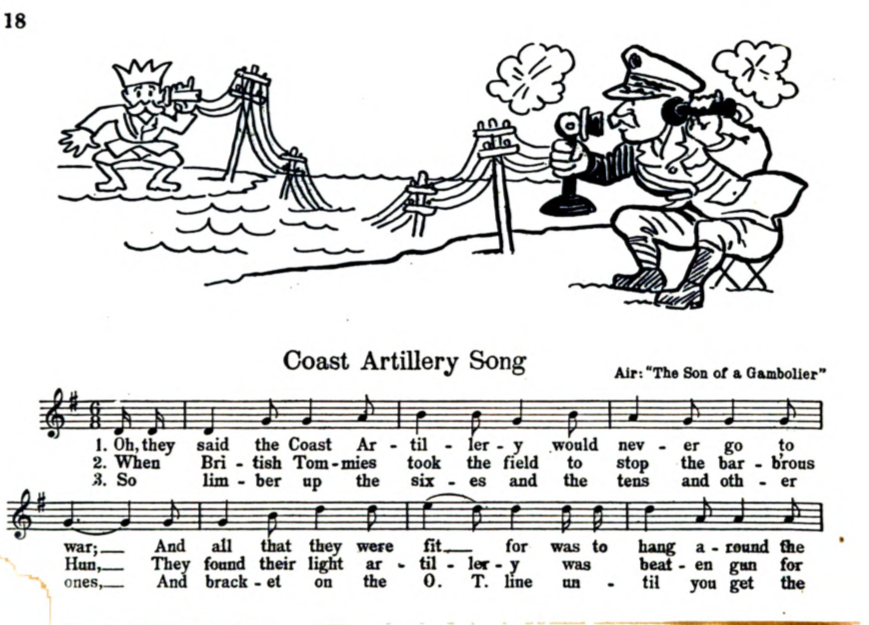
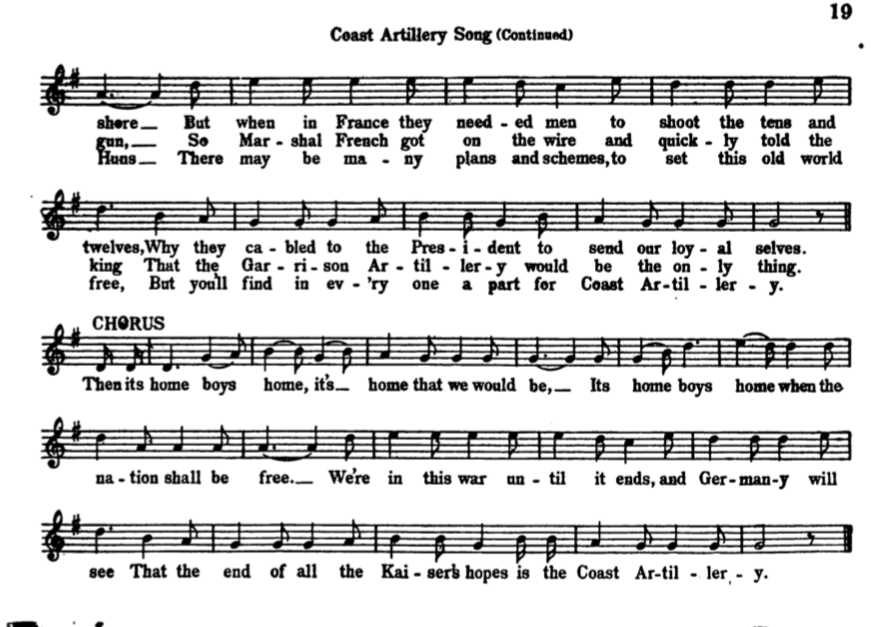
Oh, they said the coast artillery would never go to war,
And all that they were fit for was to hang around the shore.
But when in France they needed men to shoot the tens and twelves.
Why, they cabled to the President to send our loyal selves.
(Chorus)
Then, it’s home, boys, home, it’s home that we should be.
It’s home, boys, home, when the nation shall be free.
We’re in this war until it ends, and Germany will see
That the end of all the Kaisers is the Coast Artillery.
When British Tommies took the field to stop the barb’rous Hun,
They found their light artillery was beaten gun for gun.
So Marshall French got on the wire and quickly told the king
That the garrison artillery would be the only thing.
(Chorus)
So, limber up the sixes and tens and other guns,
And bracket on the O.T. line until you get the Hun.
There may be many plans and schemes to set this old world free,
But you’ll find in every one a part for the coast artillery.
(Chorus)
This song is adopted from the Irish tune “Rambling Wreck of Poverty” or “The Son of a Gambolier” which has served as an inspiration for Georgia Tech’s school song, “I’m a Rambling Wreck From Georgia Tech” and Woody Guthrie’s “Biggest Thing That Man Has Ever Done.” Charles Ives also adapted this tune as part of his song cycle Five Street Songs.
The subject of this song has little to do with the American army. Marshall French, mentioned in verse three was the First Earl of Ypres who commanded of the British Army from 1914 to 1915 and earned the title of earl for his efforts on the Second Battle of Ypres in May, 1915. Since America entered the war in April 1917, the American coast artillery was not involved in the Second Battle of Ypres.
This song would have appealed to Irish-American soldiers and other soldiers would have viewed the song as a collage of the leaders: president, king, and kaiser. However, the mention of “home” in the chorus would have appealed collectively to the soldiers as a reassurance that they were heading home once victory was won and “the nation shall be free.”
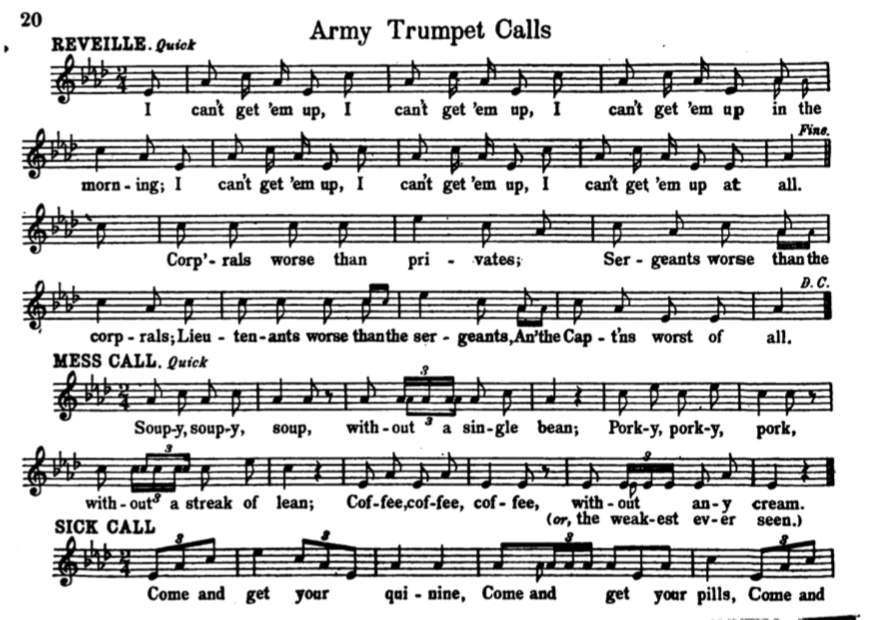
Reveille:
I can't get 'em up,
I can't get 'em up,
I can't get 'em up this morning;
I can't get 'em up,
I can't get 'em up,
I can't get 'em up at all!
Corporal's worse than the privates,
Sergeant's worse than the corporals,
Lieutenant's worse than the sergeants,
An’ the Capt’ns worst of all.
Mess Call:
Soupy, soupy, soup, without a single bean;
Porky, porky, pork, without a streak of lean;
Coffee, coffee, without any cream (or the weakest ever seen.)
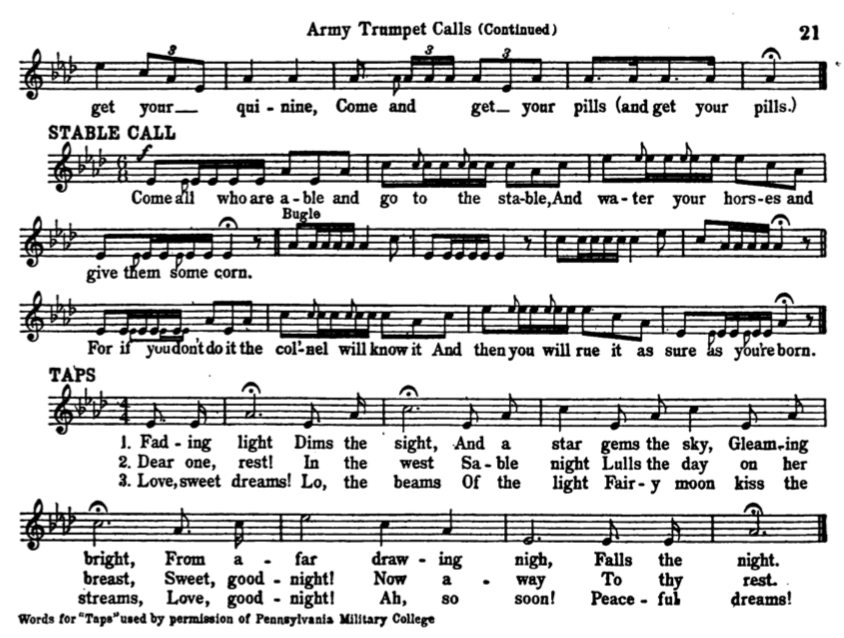
Stable Call:
Come all who are able and go the stable,
And water your horses and give them some corn.
For if you don’t do it the colnel will know it And then you will rue it assure as you’re born.
Taps:
1. Fading light
Dims the sight
And a star gems the sky, Gleaming bright,
From afar drawing nigh, Falls the night.
2. Dear one, rest!
In the west
Sable night Lulls the day on her breast,
Sweet goodnight! Now away To thy rest.
3. Love, sweet dreams!
Lo, the beams
Of the light Fairymoon kiss the streams,
Love, goodnight! Ah, so soon! Peaceful dreams
These short tunes comprise a collection of trumpet or bugle calls designed to announce both scheduled and non-scheduled events in a military setting. Historically used to communicate with troops during battles, the bugle was eventually used also to indicate the change in daily routines of the camp. Since there are no moveable valves in the bugle, the notes on all the calls come from a single overtone series. Although there are no official lyrics for these trumpet calls, soldiers eventually added their own lyrics.
Reveille: This call was used to wake military personnel at sunrise at which time the U.S. flag is raised and all U.S. military personnel are required to stand at attention outdoors in uniform and salute the flag.
Mess Call: As implied by the lyrics, this call is played as signal to personnel mealtimes which is used for all meals.
Stable Call: Used by Cavalry forces, this call was played as signal to those tending the stables that the horses needed to be fed and watered. It was also during this time that the horses were groomed and the stables cleaned.
Taps: This was played as the last call for the day and signaled that unauthorized lights be extinguished. The call was also used to signal the completion of a military funeral ceremony and the end of war. On November 11, 1918 at 11AM, General Pershing ordered Hartley Edwards, lead bugle of the drum and bugle corps, to play Taps that signaled the end of World War I.
http://www.library.ucsb.edu/OBJID/Cylinder15884
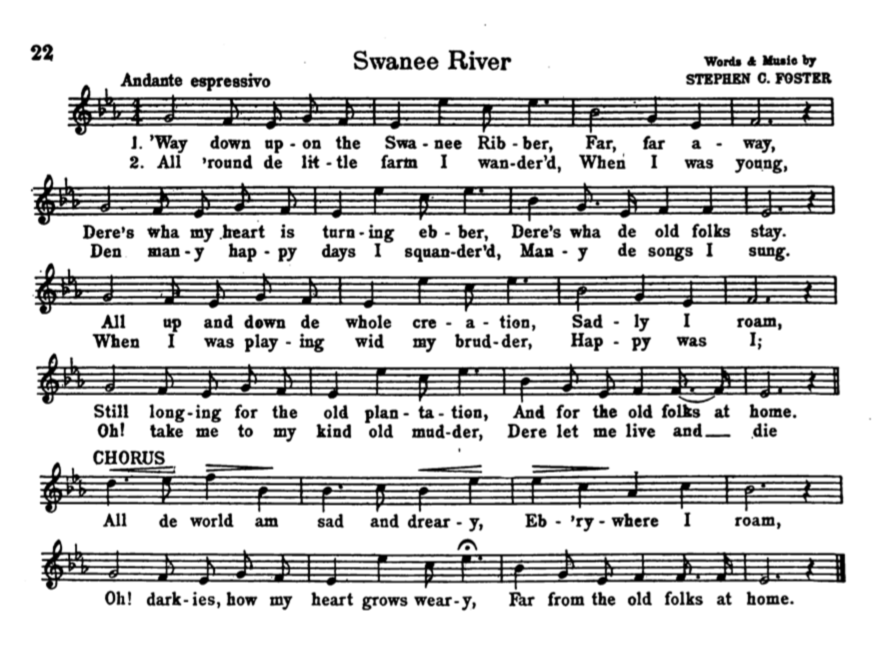
Way down upon de Swanee Ribber,
Far, far away,
Dere's wha my heart is turning ebber,
Dere's wha de old folks stay.
All up and down de whole creation
Sadly I roam,
Still longing for de old plantation,
And for the old folks at home.
(Chorus)
All de world am sad and dreary,
Eb-rywhere I roam;
Oh, darkeys, how my heart grows weary,
Far from de old folks at home!
All 'round de little farm I wander’d
When I was young,
Den many happy days I squander’d,
Many de songs I sung.
When I was playing wid my brudder
Happy was I;
Oh, take me to my kind old mudder!
Dere let me live and die
(Chorus)
Originally composed as a minstrel song by Stephen Foster in 1851, “Swanee River” or “Old Folks at Home” captured the American spirit of the 19th century with its distinct dialect spoken by African-American slaves. The song was a tribute to Suwanee River, a major river running through South Georgia into Florida.
Written from the perspective of a slave, the narrator expresses his “longing for de old plantation.” Although the theme is about the desperation of family separation due to the practice of slave owners selling a slave to another plantation, this phrase has often been misunderstood as romanticizing slavery. Indeed, Foster wrote that “One reviewer called the ‘homely tune’ a ‘catching, melodic itch of the time’….. and nearly everyone scratched, be they Irish or German immigrants feeling homesick for the old country, frontiersmen or forty-niners pining for the folks they had left behind in the East or African Americans forcibly separated from their birthplaces and families. ‘Old Folks at Home’ was all things to all people” (Emerson p.182).
Many people would have been familiar with this song. The song became so popular that it attracted tourists to visit Suwanee River in Florida to view the symbolic and idyllic home described in the lyrics. It was even included in several songbooks prior to the war. From 1935 to 2013, “The Swanee River” was the official state song of Florida.
This Dixie song would not only have evoked nostalgia and homesickness to soldiers in the trenches, but would have also appealed to most soldiers from the Southern states. Foster’s songs were so popular that many of his songs were published as song sheets. In 1951, the U.S. Congress paid tribute to Foster by designating his songs, “Old Black Joe,” “My Old Kentucky Home,” and “Old Folks at Home” as “national expressions of democracy” and declared Stephen Foster as the “Father of American folk music.” All three songs were included in the Army Song Book.
Reinventing Dixie: Tin Pan Alley's Songs and the Creation of the Mythic South. By John Bush Jones
The Oxford Handbook of Music Making and Leisure edited by Roger Mantie, Gareth Dylan Smith p.247
Doo-Dah!: Stephen Foster and the Rise of American Popular Culture. By Ken Emerson. New York: Simon & Schuster, 1997.
http://www.library.ucsb.edu/OBJID/Cylinder2464
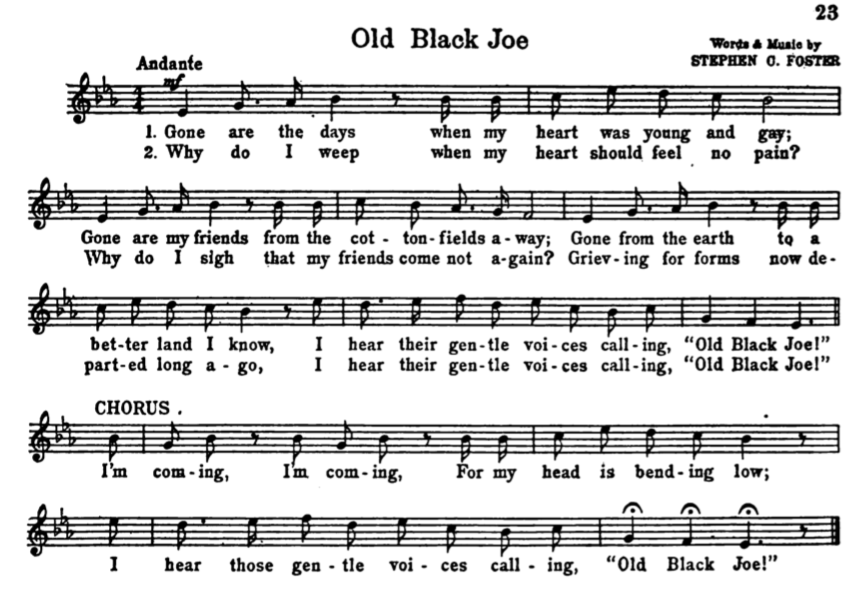
1. Gone are the days when my heart was young and gay;
Gone are my friends from the cotton fields away;
Gone from the earth to better land I know,
I hear their gentle voices calling, “Old Black Joe!”
(Chorus)
I’m coming, I’m coming, For my head is bending low;
I hear those gentle voices calling, “Old Black Joe!”
2. Why do I weep when my heart should feel no pain?
Why do I sigh that my friends come not again?
Grieving for forms now departed long ago,
I hear their gentle voices calling, “Old Black Joe!”
(Chorus)
Another song by Stephen Foster, “Old Black Joe” expresses the narrator’s friendship with a slave farm worker, the grief he experiences after their passing. Foster, a supporter of the North during the Civil War, is heavily influenced by Charles Shiras, a friend who led abolitionist activities in Pennsylvania. With this mindset, Foster would humanize his characters in his songs that convey a message that people, regardless of ethnicity or class share a longingness of family and home. His songs in the Army Song Book would have resonated with the soldiers the importance of home, family, and compassion for their comrades in the battlefield.
http://www.library.ucsb.edu/OBJID/Cylinder0078
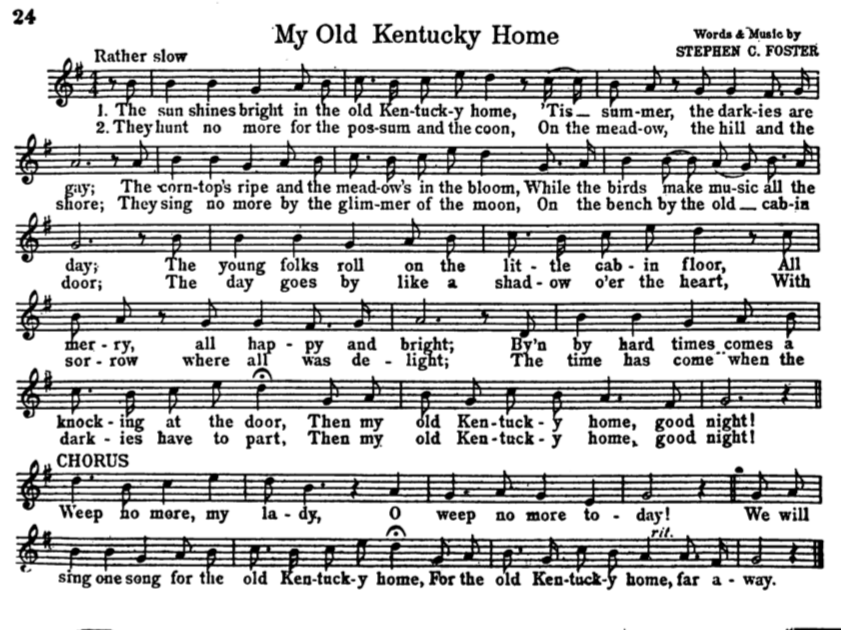
The sun shines bright in the old Kentucky home.
'Tis summer, the darkies are gay,
The corn top's ripe and the meadow's in the bloom
While the birds make music all the day.
The young folks roll on the little cabin floor,
All merry, all happy, and bright.
By’n by hard times comes a-knocking at the door,
Then my old Kentucky home, good night.
(Chorus)
Weep no more my lady, O weep no more today!
We will sing one song for the old Kentucky home,
For the old Kentucky home, far away.
They hunt no more for the 'possum and the coon,
On the meadow, the hill and the shore,
They sing no more by the glimmer of the moon,
On the bench by the old cabin door.
The day goes by like a shadow o'er the heart,
With sorrow where all was delight.
The time has come when the darkies have to part,
Then my old Kentucky home, good night!
(Chorus)
Also known as “Poor Uncle Tom, Good Night,” this song by Foster was written in 1852 as a response to Harriet Beecher Stowe’s novel, “Uncle Tom.” Aligned with his support for the Abolitionist movement, Foster wrote the lyrics so that the narrator laments his imminent move away from home and looks fondly back on his life in Kentucky before being sent away to slavery. The song carries overtones of death as the slave forecasts overwork and brutal mistreatment in the “land where the sugar canes grow.” His master sold him to a plantation in the Deep South.
As soon as it was first published in 1852, the song grew popular quickly and sold thousands of copies within days of its release. The issue of equality in American social and political hemispheres evolved rapidly in the years leading to the Civil War and the years prior to America’s entry into World War I.
America’s idea of equality, an element that was still in its infancy in World War I, was noted by the abolitionist Frederick Douglass, “My Old Kentucky Home awakens the sympathies for the slave, in which anti-slavery principles take root, grow, and flourish.”
This song was adopted as the official state song of Kentucky in 1928.

http://www.library.ucsb.edu/OBJID/Cylinder5177
I wish I was in de land ob cotton, Old times dar am not forgotten,
Look away! Look away! Look away! Dixie Land.
In Dixie Land whar I was born in Early on one frosty mornin’
Look away! Look away! Look away! Dixie Land.
(Chorus)
Den I wish I was in Dixie, Hooray! Hooray!
In Dixie Land, I’ll take my stand to lib and die in Dixie;
Away, Away, Away down south in Dixie,
Away, Away, Away, down south in Dixie.
Dars buckwheat cakes an’ In genbatter, Makes you fat, or a little fatter,
Look away! Look away! Look away! Dixie Land.
Den hoe it down an’ scratch your grabble, To Dixie Land I’m bound to trable
Look away! Look away! Look away! Dixie Land.
(Chorus)
Daniel Decatur Emmett in 1859 wrote this song for a blackface minstrel show that would become popular in the North. Although Emmett was an abolitionist, “Dixie” would later be associated with the Confederacy and the South.
The song acknowledges that blacks long to be in “de land ob cotton,” and like many minstrel songs, the song reinforces the image of African-Americans as happy yet enduring the hardships of slavery. The song carries an ironic tone – why will the narrator, a slave, be happy to remember the “Old times dar am not forgotten?” Allowing Southerners to believe the black man as happy despite slavery would have let soldiers on both sides laugh at the whole situation. Soldiers in the trenches would have felt something similar to this. It is not difficult to speculate that these horrible conditions encountered would have shared light-hearted moments with their comrades by singing this tune. This song would have appealed to a diverse audience.
The song was popular prior and during the war. The earliest known recording of this song was performed by Billy Murray, in a duet with Ada Jones, in 1916.