




























Propaganda and Ohio’s Homefront
By Andrew Hall, Ohio History Connection
February 13, 2018
World War II is often seen as the height of focused propaganda efforts in the United States, but WWI saw the greatest impact of written propaganda and posters in American history. Upon America’s entry to World War I Governor James Cox, a staunch supporter of the conflict, decided that Ohioans needed to be regularly and vigorously informed about the government’s needs. Working in tandem with the national Committee of Public Information, Cox empowered statewide propaganda efforts to ensure that every Ohioan did their part. This propaganda came in a variety of forms, and acted as the average citizen’s most reliable link to the wartime experience. Appearing everywhere, from the newspaper to the billboard, propaganda carried numerous messages on how to support the troops from home.
The military’s need for items like fuel and wheat pushed forth a massive conservation campaign. Propaganda relating to conservation appeared regularly in newspapers, reminding citizens of the “suggested” limits on various food items. In 1918 the Ohio War Board gave suggested New Year’s resolutions on how to better support the war at home, including changing “habits of eating” to preserve crucial supplies. Ration cards offered alternative meal plans, such as exchanging corn flour for wheat, to provide excess supplies for the military while also acting as a consistent reminder of the war abroad.
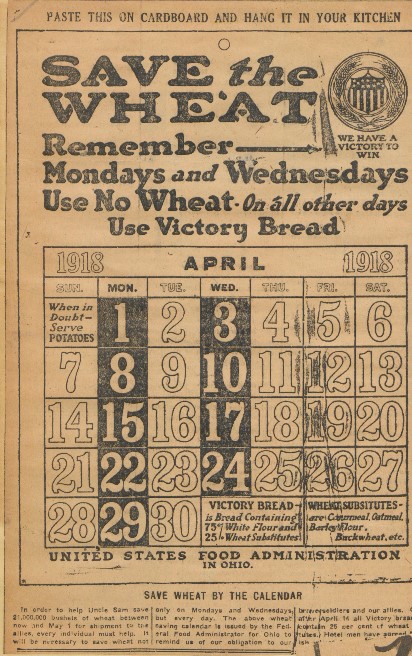 Save the Wheat. SA Box 7069, Ohio History Connection Archives/Library
Personal sacrifices of fuel came alongside food conservation. Newspapers and broadsides bore constant reminders to residents that any fuel they saved could go to the front. The Columbus Dispatch reminded readers in 1918 that fuel was not to be used in public spaces on Mondays, with the exception of places such as hospitals and grocery stores. Fuel in homes could still be used, but the state encouraged citizens to keep lights off at night and limit their use of fuel as much as possible. State officials considered fuel and food to be as important as bullets, and expected people to follow their recommendations.
Ohioans often found ample encouragement to participate in wartime activities through guilt, as a great deal of propaganda displayed what might happen the war were not properly supported. Newspapers across the state encouraged readers to report the names of “slackers,” leading often to public shaming in local newspapers and sometimes mandatory work assignments. Advertisements often leveraged guilt by insisting that liberty bonds prevented German attacks at home. The Springfield News Sun ran a full page story in 1918 that explicitly described the destruction of Springfield by German planes and zeppelins, all resulting from a lack of participation in liberty bond efforts. Though in reality there was no threat of an imminent attack from the Axis Powers, print propaganda played on peoples’ heightened fears of everything German to increase participation in war support efforts.
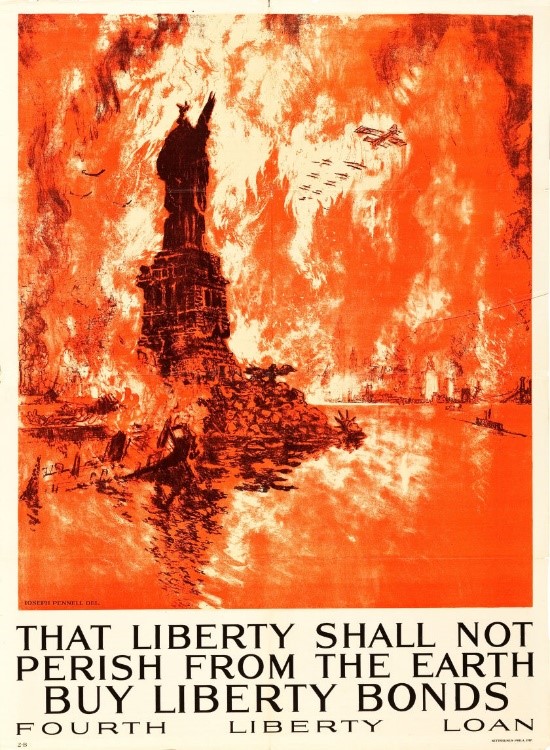 That Liberty Shall Not Perish From the Earth: Buy Liberty Bonds. Historical Commission of Ohio. 2729 AV, Ohio History Connection Archives/Library
Guilt-ridden propaganda also encouraged many to support anti-German sentiment. American propaganda campaigns villainized Germany as a whole, leading to a general acceptance that anything German was un-American and in an indirect way supported the enemy. Despite having an estimated 175,000 German-born immigrants living in Ohio as of 1917, with many more residents having ties to Germanic heritage, Ohio strongly embraced this national message. As attempts to erase German heritage occurred throughout the state news of its happening, such as when students in New Philadelphia burned German books while singing “patriotic airs,” came with a positive spin. These kinds of advertisements even appeared in the political sphere. Prohibition supporters took advantage of anti-German fervor to build up their own agenda. One advertisement specifically calls out beer as a German product, and that “the saloon is Germany’s ally.” Germany, and anything associated with it, provided
another valuable conduit for state and national war committees to transmit their messages through.
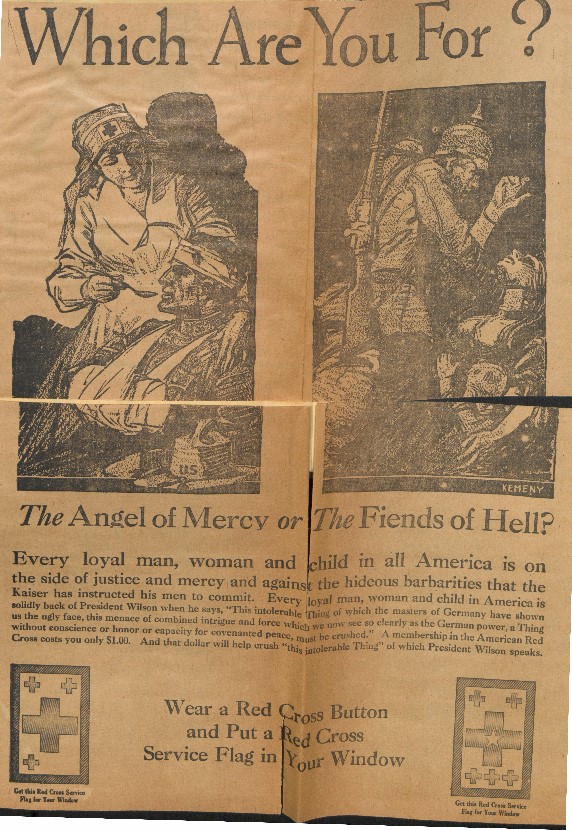 Which Are You For? SA Box 7069. Ohio History Connection Archives/Library.
Print was the primary media of the 1910s, and Ohio’s statewide propaganda campaigns utilized it effectively. As WWI’s patriotic fervor swept through Ohio and the nation, propaganda connected people on the homefront to those in the trenches.
George Knepper, Ohio and Its People. The Kent State University Press: Kent 1989, pg. 345
Ohio War Board Suggests New Year’s Resolutions For You. SA7069_B05_Franklin Co_1918_1. Ohio History Connection Archives/Library, Columbus, Ohio.
Fuelless Day Pointers. SA7069_B05_Franklin Co_1918_114. Ohio History Connection Archives/Library, Columbus, Ohio.
Knepper pp. 345-346
If Springfield Was Threatened by the Huns. SA7069_B05_Clark Co_1918_52. Ohio History Connection Archives/Library, Columbus, Ohio.
“Statistical Abstract of the United States, 1917.” United States Census Bureau, 27 July 2015, Pp 34-62. https://www.census.gov/library/publications/1918/compendia/statab/40ed.html
German Textbooks Are Burned As Students Sing Patriotic Airs. SA7069_B04_Tuskarawas Co_1918_45. Ohio History Connection Archives/Library, Columbus, Ohio.
Get the Kaiser Day in Ohio. SA7069_B09_Greene Co_1918_41. Ohio History Connection Archives/Library, Columbus, Ohio.