

































The Lynching of Robert Prager and the Sedition Act of 1918
By Becky Preiss Odom, History Curator, Ohio History Connection
June 7, 2018
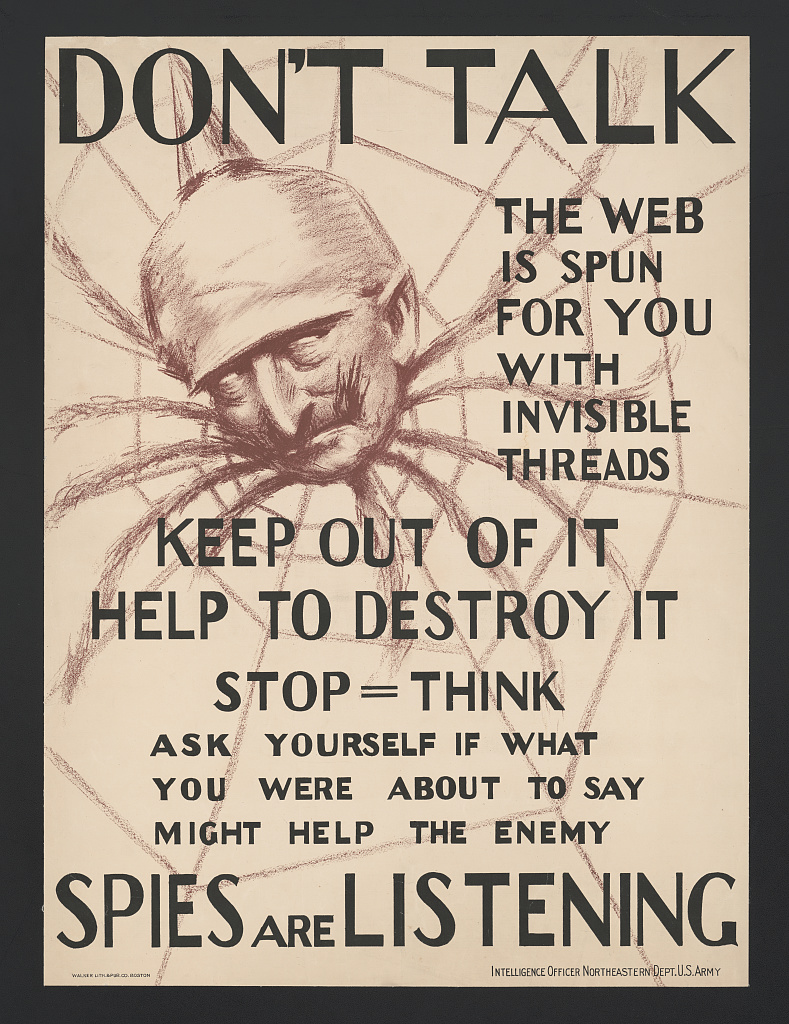 Americans feared that German spies had infiltrated their communities and workplaces from the beginning of the war. The Espionage Act and later the Sedition Act sought to punish both spies and disloyal Americans. From the Library of Congress, Prints and Photographs Division, World War I Poster Collection, https://lccn.loc.gov/93515950.
It was just after midnight. The bright headlamps of several automobiles illuminated the mob of about 100 people gathered around the tree. Several men pulled fiercely on a rope thrown over the tree limb, and Robert Prager flew up in the air, gasping and grabbing at the rope around his neck. The men released the rope, and Prager’s struggling figure fell to the ground. Someone in the crowd produced a handkerchief, and another man stepped forward and bound Prager’s hands behind his back. Thus restrained, the men pulled the rope, and Prager rose into the air again. Suspended, without his hands to pull at the noose around his neck, Prager kicked his feet until suddenly he went still. The men tied off the rope, and the crowd slowly dispersed, leaving Prager’s dead body hanging from the tree limb in the darkness.
Robert Paul Prager, a German immigrant accused of uttering disloyal remarks against the U.S. government and President Woodrow Wilson, was lynched just outside of the small town of Collinsville, Illinois, at about 12:30 in the morning on April 5, 1918. He was the first person suspected of disloyalty during World War I to be killed in the U.S. by a vigilante mob. [1]
The war against Germany increasingly generated fears of disloyalty and spies. In early June 1917, President Wilson directed all U.S. government agencies to root out German spies. He issued the directive, in part, because members of Congress claimed that German spies in the U.S. Navy and War Department supplied Germany with information to give it a tactical advantage over the U.S. in the war.[2] The Espionage Act, signed into law later that same month, prohibited and punished acts that threatened the safety of the U.S., undermined U.S. military actions, or interfered with recruitment for or enlistment in the U.S. military.[3] This law infringed on Americans’ right to freedom of speech in order to ensure the successful defeat of Germany in the war, and it resulted in the close scrutiny of German-Americans for potential German loyalties and the persecution of any American who spoke out against the war or the federal government.
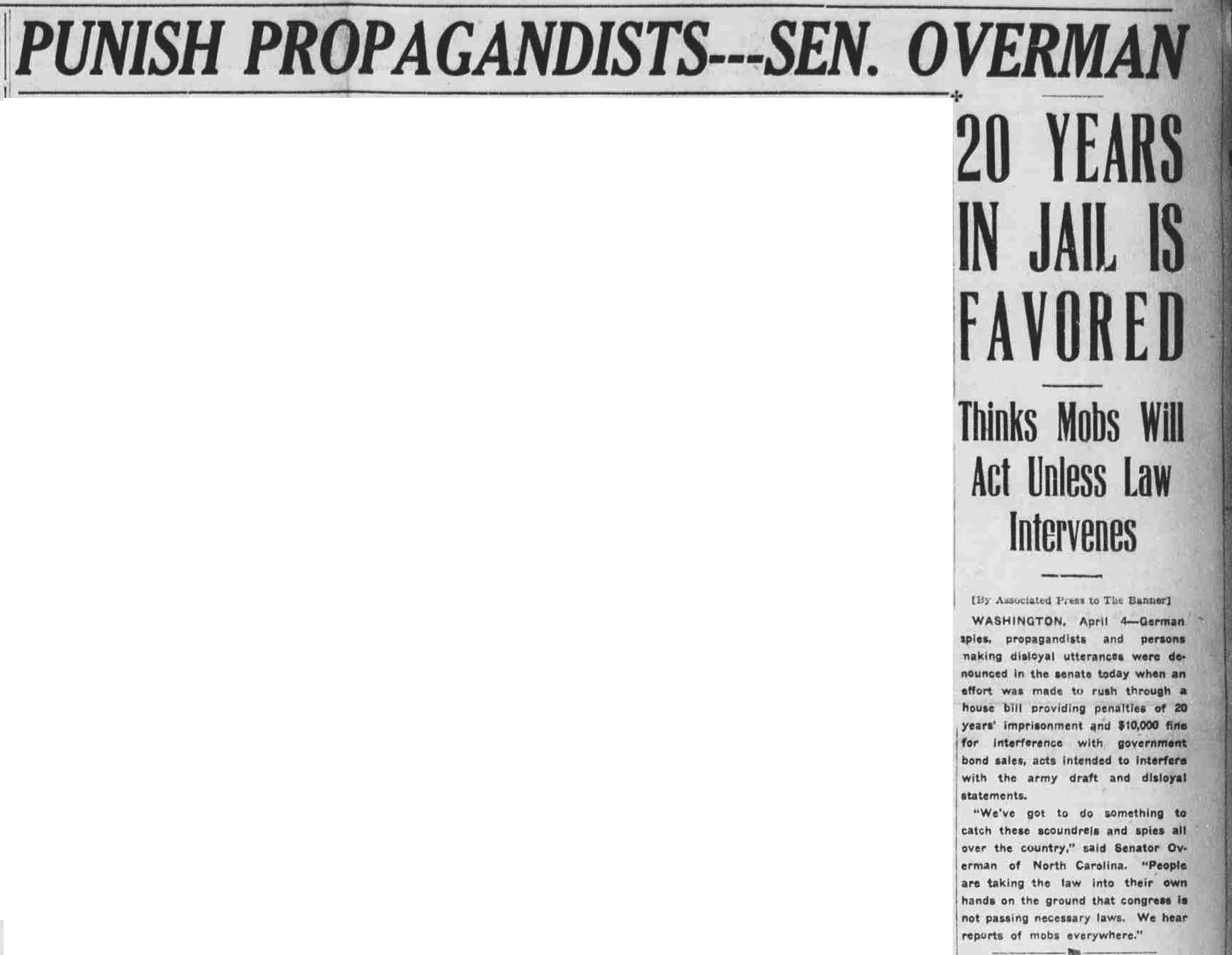 This article in The Democratic Banner (Mt. Vernon, Ohio) calls for stricter punishments for disloyal Americans during World War I. Ironically, the article was published on April 5, 1918, the same day Robert Prager was lynched and the Senate voted in favor of the Sedition Act. http://chroniclingamerica.loc.gov/lccn/sn88078751/1918-04-05/ed-1/seq-1/
President Wilson, his Cabinet, Congressional representatives, and other public officials used Prager’s lynching as evidence of continued, rampant disloyalty in the U.S. and argued for laws to punish disloyal speech. The President and his Cabinet blamed Prager’s death on Congress, claiming that its failure to pass adequate laws prohibiting and punishing disloyalty forced citizens to take justice into their own hands. U.S. Attorney General Thomas Gregory concurred, saying in a statement to the press, “It cannot be condemned. The department of justice has repeatedly called upon Congress for the necessary laws to prevent just such a thing as happened in the Illinois town.”[4] The attorney general explicitly blamed Congress for Prager’s lynching, and, more importantly, he condoned the mob’s actions.
Congress addressed Prager’s lynching and the motivations of the vigilante mob on the Senate floor later that same day. Senator Henry Cabot Lodge argued that Prager’s death signaled the need for stricter laws against disloyal speech, and Senator William Borah explained, “…[U]nless these people were dealt with in an orderly way and a legal way the mob would undoubtedly deal with them.…I simply call attention to the fact that I have received notice by telegraph that at Collinsville, Illinois, April 5, a mob of 300 men lynched a man by the name of Prager for disloyalty.”[5] Despite inflating the size of the mob, the Senator’s words were heeded by his fellow Senators who voted in favor of amending the Espionage Act of 1917 to outlaw all disloyal speech against the U.S., its government, and its armed forces in what was commonly called the Sedition Act.[6]
Sources:
“Collinsville man killed for abusing Wilson,” St. Louis Daily Globe-Democrat, April 5, 1918.
“Will comb for German spies,” St. Charles [MO] Daily Cosmos-Monitor, July 6, 1917.
Charles Cheney Hyde, “The Espionage Act,” The American Journal of International Law 12, no. 1 (Jan. 1918): 142-146.
“Investigation waits on inquest Monday,” New York Times, April 6, 1918.
Senator Lodge of Massachusetts and Senator Borah of Idaho, speaking for the amendment to the Espionage Act of 1917, on April 5, 1918, to the Senate, H. R. 8753, 65th Cong., 2d sess., Cong. Rec. 56, pt. 5: 4645.
Sedition Act of 1918, Public Law 150, 65th Cong., 2d sess. (May 16, 1918), 554.
[1]“Collinsville man killed for abusing Wilson,” St. Louis Daily Globe-Democrat, April 5, 1918.
[2]“Will comb for German spies,” St. Charles [MO] Daily Cosmos-Monitor, July 6, 1917.
[3]Charles Cheney Hyde, “The Espionage Act,” The American Journal of International Law 12, no. 1 (Jan. 1918): 142-146.
[4]“Investigation waits on inquest Monday,” New York Times, April 6, 1918.
[5]Senator Lodge of Massachusetts and Senator Borah of Idaho, speaking for the amendment to the Espionage Act of 1917, on April 5, 1918, to the Senate, H. R. 8753, 65th Cong., 2d sess., Cong. Rec. 56, pt. 5: 4645.
[6]Sedition Act of 1918, Public Law 150, 65th Cong., 2d sess. (May 16, 1918), 554.