

































“Spring Forward, Fall Back”: Daylight Saving Time and World War I
By Kristen Newby, WWI Project Coordinator, Ohio History Connection
March 13, 2018
Last Sunday at 2am, America (with the exceptions of Arizona and Hawaii) turned its clocks forward one hour. Although we look forward to longer days with more sunlight in the spring and summer, and an extra hour of sleep in the fall, our bodies struggle to adjust our internal clocks to the time shift. People often suggest that daylight saving time is an obsolete measure, and actually counteracts its original intentions. Daylight saving time was a hotly contested topic even in its beginnings during World War I.
Germany was the first to enact daylight saving measures in April 1916, when Germany and its allies turned their clocks forward, with the United States and Great Britain soon to follow. On March 19, 1918, Congress passed President Wilson’s proposed Standard Time Act, or “An Act to save daylight and to provide standard time for the United States,” which divided the country into the five time zones in use today. Additional hours of daylight were intended to both increase productivity for wartime industries as well as conserve energy, as more hours of daylight meant less fuel consumption to for artificial light. With national and local programs for rationing food and conserving valuable materials like metals and rubber, daylight saving time was another way civilians on the American home front could support the war effort.
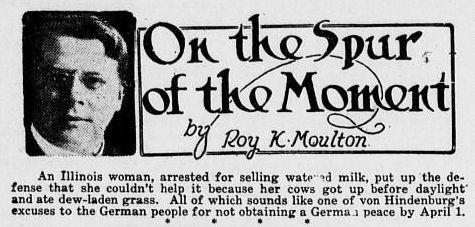 The May 30, 1918, issue of the Perrysburg Journal features this "On the Spur of the Moment" column by American humorist Roy K. Moulton, in which he describes a woman arrested for selling watered milk, claiming her cows ate “dew-laden grass” due to the lack of morning sun. Via Chronicling America.
Many believe daylight saving time was instituted to provide farmers with more daylight to increase agricultural production, especially during the war when there was a huge push for victory gardens at every home. However, farmers were one of the largest opponents of daylight saving time because more hours of daylight in the evenings meant fewer hours of daylight in the morning, which they heavily relied on for harvesting, preparing produce for market, and milking dairy cattle.
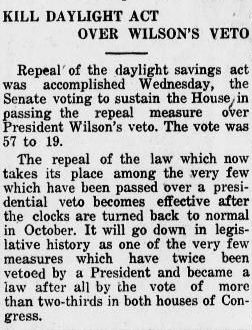 On August 22, 1919, the Medina Sentinel announces the repeal of the Standard Time Act. Via Chronicling America.
On April 20, 1919, the Standard Time Act was repealed over President Wilson’s veto, although some local governments maintained its use. Daylight saving time was re-instituted during World War II on February 9, 1942, when clocks were moved ahead an hour until the war’s end. After its repeal in September 1945, its use was once again deferred to local decision makers.
Congress passed the Uniform Time Act on April 13, 1966, under President Lyndon B. Johnson, which established daylight saving time across the United States and re-instituted the five time zones defined in the original 1918 legislation. The length of daylight saving time was later extended in 1986, and most recently in 2007 to the current daylight saving period from the second Sunday of March to the first Sunday of November.