


























 Postcards from Pancho Villa -- Part 3 of 3
EL PASO, TEXAS (January 18, 1917) -- This final batch of postcards that came home with Joseph L. Bachus after his Mexican Border Service in 1916-1917 with the Michigan National Guard gives us a glimpse not at the exotic and dramatic events unfolding in Mexico, but rather gives us an idea of how the United States Army and the supporting Guard units began to transform themselves from the 17th largest army in the world to a force to be reckoned with.
While the tents, tactics, artillery pieces, and trenches pictured in these 1916 postcards from Texas would not be too unfamiliar to the Civil War veterans who were still alive a century ago, we begin to see the influences of modern technology and warfare making their debut as the soldiers on the border trained and kept busy. While new machinery was still pretty scarce above the Mexican border, it's no surprise that the intrepid war photographers were drawn to the latest advances in modern warfare that appeared on the training grounds around El Paso and other garrisoned towns.
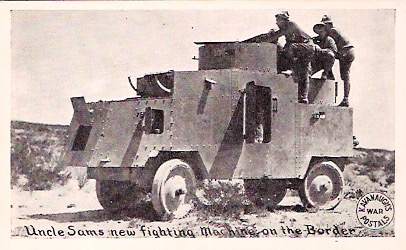
13. Uncle Sams new fighting machine on the Border (Kavanaugh's War Postals)
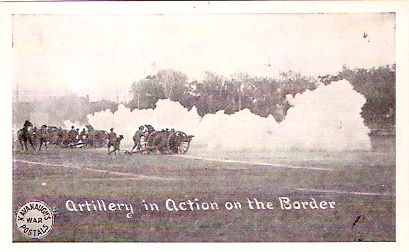
14. Artillery in Action on the Border (Kavanaugh's War Postals)
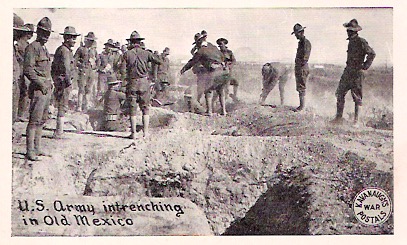
15. U.S. Army intrenching in Old Mexico (Kavanaugh's War Postals)
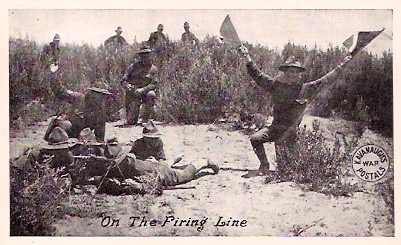
16. On The Firing Line (Kavanaugh's War Postals)
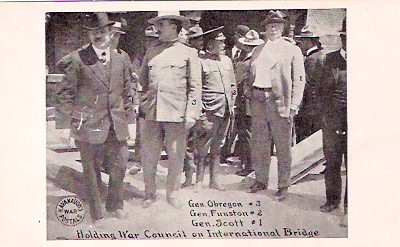
17. Holding War Council on International Bridge, Gen. Oberon # 3, Gen. Funston #2, Gen. Scott #1 (Kavanaugh's War Postals)
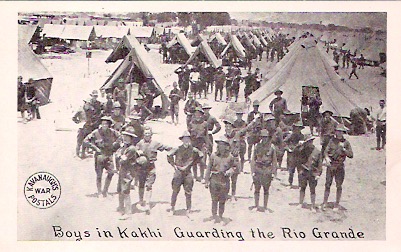
18. Boys in Kakhi Guarding the Rio Grande (Kavanaugh's War Postals)
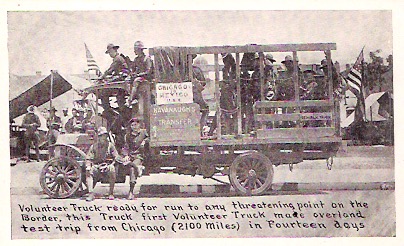
19. Volunteer Truck ready for run to any threatening point on the Border, this Truck first Volunteer Truck made overland test trip from Chicago (2100 miles) in Fourteen days
This postcard holds a clue about Kavanaugh's War Postals, since the writing on the side of the truck says "Chicago to Mexico U.S.V. Kavanaugh's Transfer, Republic Truck." According to upthewoods.net, an historic postcard enthusiast website, Kavanaugh's War Postals were published by the Chicago Daily News and credited to G.J Kavanaugh of El Paso, Texas. Perhaps this truck was the mobile platform for Kavanaugh's photographic operation. According to upthewoods.net, these postcards bore a reverse side imprint: "The Chicago Daily News. G.J. Kavanaugh. War Postal Card Department" on the upper end of the message half. None of my grandfather's postcards carry the Chicago imprint, however, suggesting that it was added later when the film made its way back to Chicago.
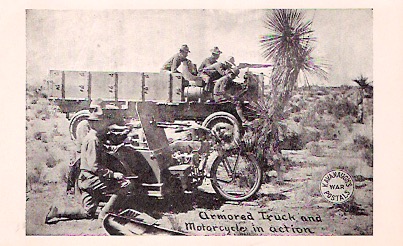
20. Armored Truck and Motorcycle in action (Kavanaugh's War Postals)
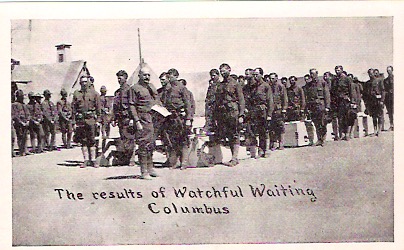
21. The results of Watchful Waiting Columbus
This supposition deserves further research, but I believe this funeral detail is bearing the caskets of fallen troops who were killed in Pancho Villa's original March 9, 1916, raid on Columbus, New Mexico -- the last straw that drove the U.S. Army and Guardsmen to the Mexican border in the first place.
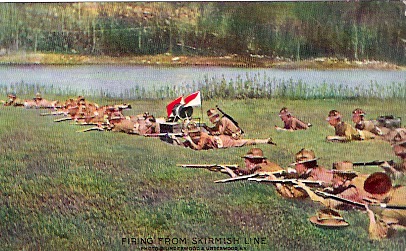
22. FIRING FROM SKIRMISH LINE (PHOTO © UNDERWOOD & UNDERWOOD)
This colorized postcard is labeled "No 1. Published by American Colortype Co., Chicago" on the back, and includes the following caption: "Probably the most important part of infantry training. While firing from the prone position, the soldier offers the smallest possible target to the enemy's marksmen. In the United States army, the men are even taught to dig shallow protection trenches while lying in this position. Each man carries a small entrenching tool -- axe, pick or spade -- in his pack for this purpose. While firing from a skirmish line, it is important that no man get ahead of the others lest the noise and concussion from his neighbors' gun do harm to his hearing. Note the semaphore flags which signal the officers' commands and sighting instructions to the men of his command."
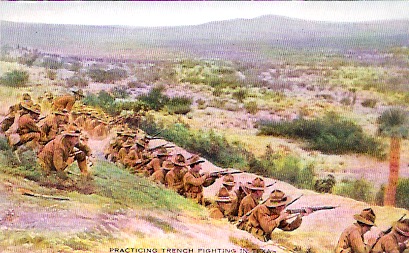
23. PRACTICING TRENCH FIRING IN TEXAS
This next colorized postcard is labeled "No 26. Published by American Colortype Co., Chicago" on the back, and includes the following caption: "Our Infantry had a taste of genuine trench-digging and trench-fighting while guarding the Texas border last summer. Most of the boys in this group seem to be enjoying it, although there is no enemy in sight -- perhaps that's why. Anyway, the time they spent down there and the things they learned will prove invaluable to them when they get over to France and get after the Kaiser's men. Note that the dirt taken out when digging the trench is thrown up to form a sort of breastwork in front. This serves as added protection and also gives the men a rifle rest. (PHOTO © UNDERWOOD & UNDERWOOD)"
It's interesting to note that these postcards came out sometime after the army and guard units had returned home from the Punitive Expedition and Mexican Border Service. It may not have been Pancho Villa's intention, but his reckless attacks on American soil helped to turn the small U.S. Army into a force better prepared to take on the much more dangerous and sweeping challenges that lay ahead in France. Thanks, Pancho!
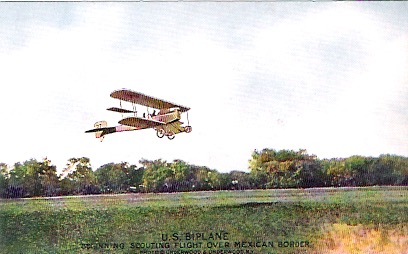
24. U.S. BIPLANE BEGINNING SCOUTING FLIGHT OVER MEXICAN BORDER (PHOTO © UNDERWOOD & UNDERWOOD)
Here's the detail on the colorized postcard from the top of the article, which is labeled "No 5. Published by American Colortype Co., Chicago" on the back, and includes the following caption: "The Mexican trouble proved of considerable value to our army as a practical training field in which to try out the efficiency of the several arms of the service. Here our aeroplanes were put into use for scouting purposes, and from the service they saw down there, the Aviation Corps learned a great deal regarding the demands that would be made on them in actual warfare, and just how their equipment could be improved. Our aviators have won from the cavalry their right to the title "the eyes of the army," and are demonstrating to the world every day, their effectiveness in this field."
What the Mexican Border Service and Punitive Expedition against Pancho Villa lacked in decisive battles they made up for in helping to turn a largely untested mob into the soon-to-be American Expeditionary Force. For men like my grandfather, this extended exercise was an opportunity to not only size up his own men, but to demonstrate his mettle to his fellow officers in the Michigan National Guard.
Even the mighty among them learned valuable lessons. A middle-aged Capt. George Patton learned that he did, indeed, have the courage and resolve to handle a real fire fight. And an aging Gen. John Pershing learned that the era of horse-mounted cavalry troops had come to an end. Although horses would continue to play a vital supporting role in France, Mexico was the last U.S. campaign of massed horse soldiers. From then on, cavalry would become a mostly mechanized affair.
Joseph L. Bachus returned home to his wife Lina, his daughter Betty, and his traveling salesman job, but it would not be long before the Great War would call him back into uniform.
NEXT TIME: "Camp Cotton"
~~~