




























Flag of honor, flag of daring,
Flag of legions onward faring,
Flag our hands and hearts are bearing,
Lead to victory!
From the dyes of battle glory,
Foam and wave of ocean’s glory
And the stars that tell thy story
Freemen fashioned thee.
Flag of love unbounded!
Flag of hopes unsounded!
How float thy bars, how gleam thy stars,
By Heavens stars surrounded!
We thy sons shall fail thee never!
Time nor tide our faith shall sever!
All for thee, and thousand forever,
Flag of victory!
By the standards that have shown thee,
By the battles that have known thee,
By the heroes that have flown thee,
Guide us in the fight!
Bless the soldier in his sleeping;
Hush the mother in her weeping;
Hold the helpless in thy keeping,
Warder of the Right!
By the guns that scarred thee,
By the guns that guard thee,
Thine eagles soar
From war to war,
But never stain has marred thee!
We thy sons shall fail thee never!
Time nor tide our faith shall sever!
All for thee, and thou forever,
Flag of victory!
Using the same melody of “Men of Harlech,” George Sterling dedicated this song to the 81st Field Artillery Regiment of the U.S. Army in 1917. The recently organized artillery group was originally from the 23rd Cavalry from Chickamauga and later served in Brittany, France during World War I.
Sterling, a poet from California, wrote the lyrics at the suggestion of Captain Davies. A newsletter from The Cambrian in 1918 states that this song “won the first prize for the Eighty-first Regiment” although it is not clear what kind of competition the author was referring to. Further, the newsletter suggests that this song be “sung in every Welsh home, church, or society.”
This song may be an example of an effort to create a unified Allied force by adopting a well-known Welsh tune. Changing the lyrics makes American soldiers easily relate to its meaning. With the indication to sing it con fuoco (with fire), marching to this song is unavoidable.
The Cambrian. Published in "The Interest of the Welsh People and ...," Volume 38
http://www.library.ucsb.edu/OBJID/Cylinder5456
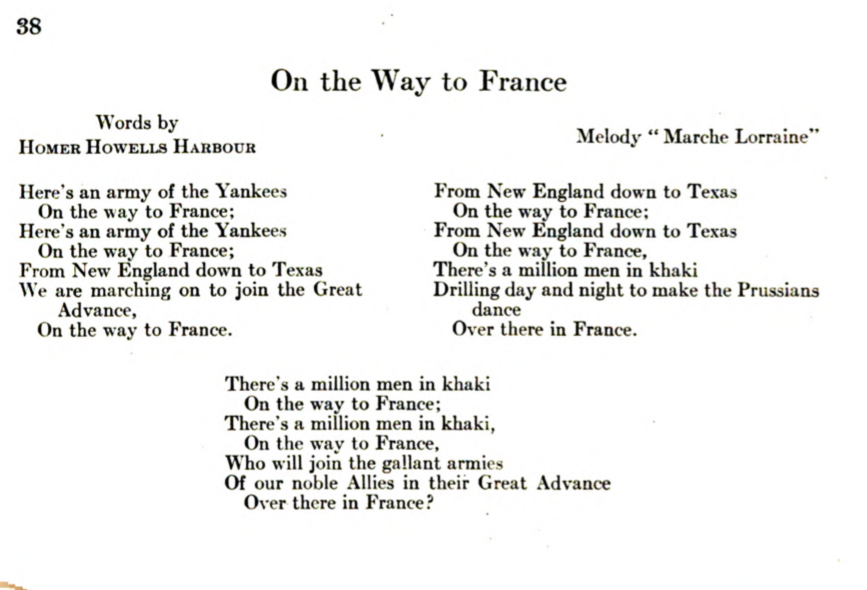
Written on the air of “Marche Lorraine,” this is an example of a well-known foreign tune that was adopted in America. The lyrics are changed to fit the war effort. The absence of the music score may indicate that there was no need to include it because of its overwhelming popularity.
The melody was originally written as an instrumental work by Louis Ganne, a French composer. Rising to prominence before and during the war, the song was recorded by Conway’s Band in 1917 led by Patrick Conway. This band was also known as The Ithaca Band that specialized in patriotic songs, similar to John Philip Sousa’s band. The melody was a staple in the repertory of wind and brass bands that was used to begin an event. Later, this song was transcribed into braille music during the war.
With the words “On the Way to France,” this song created an inherent connection between American and French troops. The lyrics express strong “Yankee” support for France.
https://blogs.loc.gov/nls-music-notes/2017/03/ganne-alford-holst-and-others-music-of-world-war-i/
http://www.library.ucsb.edu/OBJID/Cylinder4137
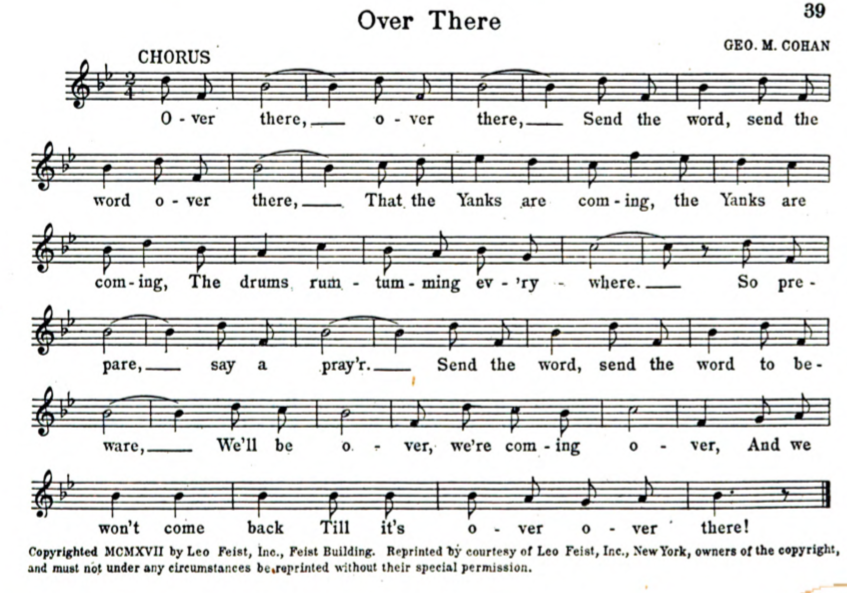
Over there, over there,
Send the word, send the word over there,
That the Yanks are coming, the Yanks are coming,
The drums rumtumming ev'ry where.
So prepare, say a pray'r.
Send the word, send the word to beware,
We'll be over, we're coming over,
And we won't come back
Till it's over over there!
Arguably the most popular song during World War I, George M. Cohan’s “Over There” was written on April 6, 1917 as a response to the United States’ declaration of war on Germany. It was designed to call young American men to enlist in the army and fight the “Hun.” The song was heavily reprinted that by the fall of 1917, two million copies of sheet music had been sold. It appeared in many different covers. Given its popularity, the song helped shift public opinion to pro-war and galvanized the public into action to help the war effort. Prior to this, the U.S. maintained a neutral stance.
Cohan's daughter Mary tells how her father composed this song. She remembers how her father proclaimed to his family that he just finished a new song. Wearing a kitchen pan on his head, Cohan began to mark time and marched with a broom in hand for a gun. She further relates, "We kids had heard, of course, that the United States was at war, and how here was Dad acting just like a soldier. So I began to sob, and I threw myself down, hanging for dear life to his legs as he marched, begging him, pleading with him not to go away to the war. I kept clinging to him until he stopped."
“Over there” can be considered as one of the greatest wartime propaganda songs. It was made famous by the singer Nora Bayes and was recorded several times by Enrico Caruso. Further, Louis Delamarre wrote a French translation of the song alongside the English original that appealed to both American and French audiences. However, by 1918, Americans would realize that “Over there” was an artifact, written during a more innocent and naïve time. The levels of bloodshed and cruel devastation by the war operated by machines had reached unimaginable levels. By the time the war ended in 1918, more than a hundred thousand Americans had lost their lives. In 1940, President Franklin D. Roosevelt awarded Cohan the Medal of Honor for his contribution to the war effort in World War I. Cohan’s clever response was “Funny about them giving me a medal. All I wrote was a bugle call” as he referred to the melody of the refrain mimicking a military bugle call.
Pegler, Martin (2014). Soldier's Songs and Slang of the Great War. Osprey Publishing
Morehouse, Ward. George M. Cohan, Prince of the American Theater. Philadelphia: J.B. Lippincott, 1943.
https://www.loc.gov/item/ihas.100010360/
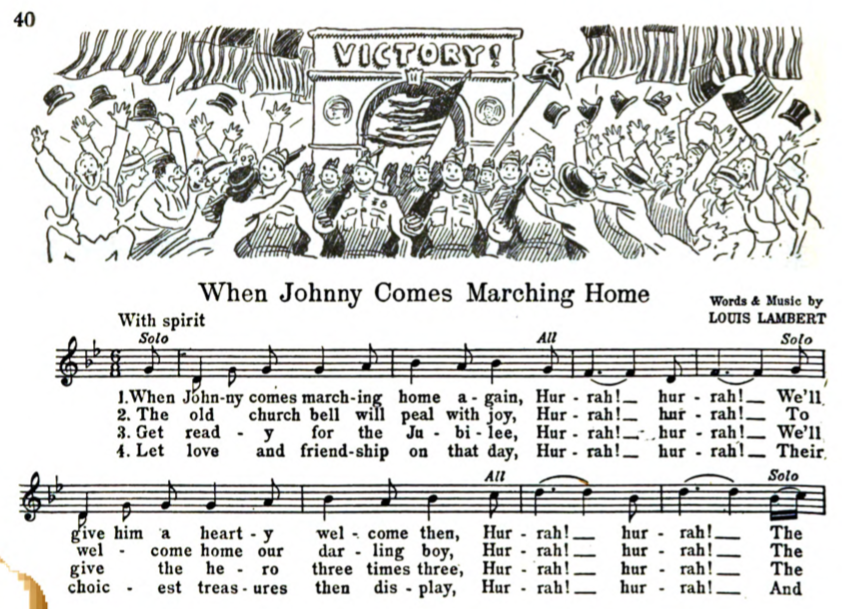
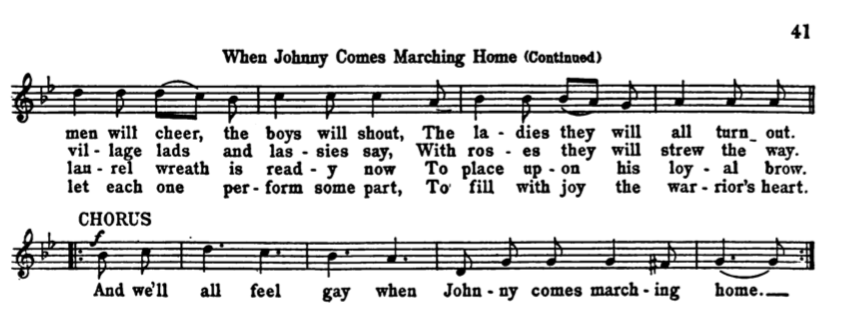
1. When Johnny comes marching home again,
Hurrah! hurrah!
We’ll give him a hearty welcome then,
Hurrah! Hurrah!
The men will cheer, the boys will shout,
The ladies they will turn out.
(Chorus)
And we’ll all feel gay when Johnny comes marching home.
2. The old church bell will peal with joy,
Hurrah! hurrah!
To welcome home our darling boy,
Hurrah! hurrah!
The village lads and lassies say,
With roses they will strew the way.
3. Get ready for the Jubilee,
Hurrah! hurrah!
We’ll give the hero three times three,
Hurrah! hurrah!
The laurel wreath is ready now
To place upon his loyal brow.
4. Let love and friendship on that day,
Hurrah! hurrah!
Their choicest treasures then display,
Hurrah! hurrah!
And let each one perform some part,
To fill with joy the warrior’s heart.
Published under the pseudonym, Louis Lambert, "When Johny Comes Marching Home" was written by Patrick Sarsfield Gilmore in 1863. Migrating to Boston from Ireland in 1848, Gilmore showed his admiration for America by composing patriotic songs and was dubbed "Father of the American Band." He was often compared to John Philip Sousa. Gilmore was made Grand Master of the Union Army in 1863, the same year he composed this song. Besides leading the band and composing songs, Gilmore was also ordered to reorganize the state military bands. His band was attached to the 24th Massachusetts Infantry.
Although Gilmore claimed that he adapted the song from an African-American spiritual, the melody of the song is very similar to the Irish song “Johnny, I Hardly Knew Ye” which was considered a protest song against Irish conscription into the British Army. The song has sentimental lyrics:
Where are your legs that used to run, huroo, huroo,
Where are your legs that used to run, huroo, huroo,
Where are your legs that used to run when first you went for to carry a gun?
Alas, your dancing days are done, och, Johnny, I hardly knew ye.
Interestingly, there are no negative references in Gilmore’s version and the song is only used as a motivation song that tells what will happen to American veterans when they return home. The song ignores the lifelong injuries that veterans would have suffered. It is also interesting to consider what Irish-Americans serving in World War I would have felt while singing this patriotic song and remembering its origins describing war injuries.
https://www.loc.gov/item/ihas.200000024/
http://www.library.ucsb.edu/OBJID/Cylinder0466
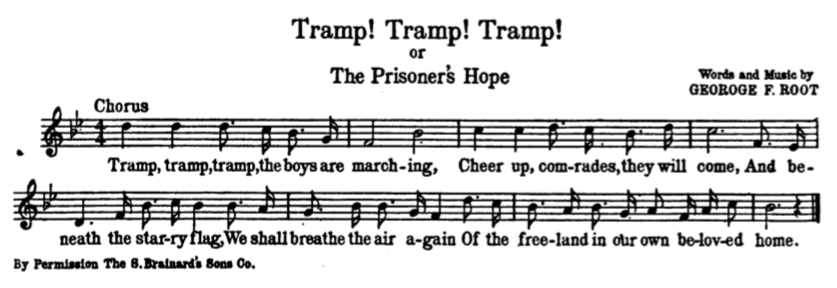
Tramp, tramp, tramp, the boys are marching,
Cheer up, comrades, they will come,
And beneath the starry flag,
We shall breathe the air again
Of the freeland in our own beloved home.
“Tramp! Tramp! Tramp!” was a very popular song from the Civil War. George F. Root wrote it from the perspective of Union prisoners of war in 1864 with the message of hope. Hope of liberation was the only thing that stood between prison experience and total despair.
The Army Songbook omitted the sentimental first verse that tells how the soldier remembers his mother and dreams of his return home. The first few verses omitted are:
In the prison cell I sit, thinking Mother, dear, of you,
And our bright and happy home so far away,
And the tears they fill my eyes 'spite of all that I can do,
Tho' I try to cheer my comrades and be gay.
George Root was notably successful as a composer of military and patriotic songs. His 35 war-time “hits” were sung both on the home front and front lines. As “Tramp, Tramp, Tramp" became more popular for troop marches, the song was subjected to parodies and variants. In 1914, the melody and meter were used by Mark Sheridan as the basis for the British World War I song, “Belgium Put the Kibosh on the Kaiser.”
Smith, Stories of Great National Songs, p. 127
http://www.library.ucsb.edu/OBJID/Cylinder1456
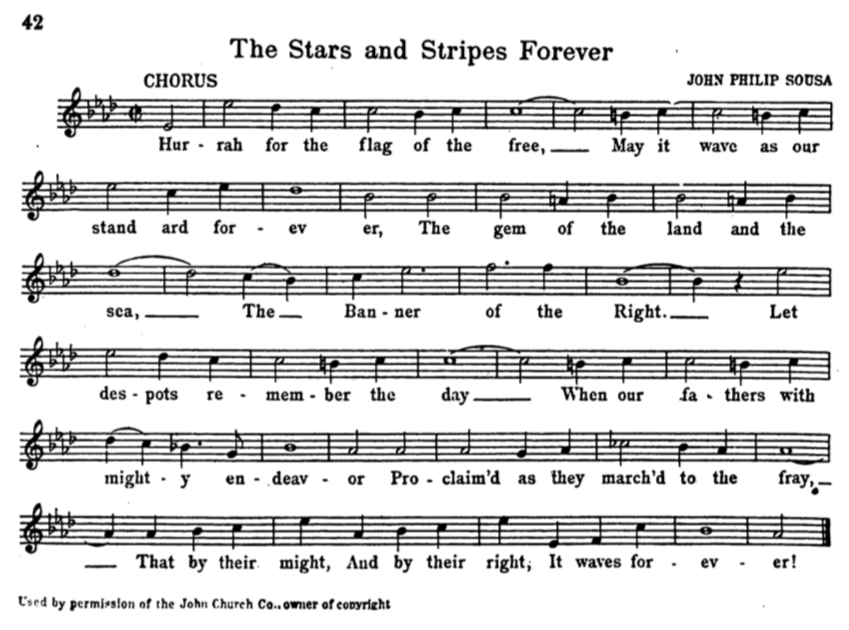
Hurrah for the flag of the free,
May it wave as our standard forever,
The gem of the land and the sea,
The Banner of the Right.
Let despots remember the day
When our fathers with mighty endeavor
Proclaim’d as they march’d to the fray,
That by their might, And by their right, It waves forever!
This patriotic American march is widely considered to be John Philip Sousa’s greatest work. By act of Congress in 1987, this song is the official National March of the U.S. In his autobiography, Marching Along, Sousa remembers that he composed the march on Christmas Day, 1896 while on board an ocean liner on his way to Europe for a vacation. He had just learned that David Blakely, his band manager, passed away.
In Paul Bierly’s The Works of John Philip Sousa, Sousa’s response to interviewers regarding this song appeared to be that this song was born out of homesickness:
“Who influenced you to compose ‘Stars and Stripes Forever,’” and before the question was hardly asked, Sousa replied, “God–and I say this in all reverence! I was in Europe and I got a cablegram that my manager was dead. I was in Italy and I wished to get home as soon as possible. I rushed to Genoa, then to Paris and to England and sailed for America. On board the steamer as I walked miles up and down the deck, back and forth, a mental band was playing ‘Stars and Stripes Forever.’ Day after day as I walked it persisted in crashing into my very soul. I wrote it on Christmas Day, 1896.”
Further, it was an attempt to create a patriotic spirit - something that set apart America from other countries.
“In a kind of dreamy way I used to think over old days at Washington when I was leader of the Marine Band...when we played at all public official functions, and I could see the Stars and Stripes flying from the flagstaff in the grounds of the White House just as plainly as if I were back there again. Then I began to think of all the countries I had visited, of the foreign people I had met, of the vast difference between America and American people and other countries and other peoples, and that flag of ours became glorified...and to my imagination it seemed to be the biggest, grandest, flag in the world, and I could not get back under it quick enough. It was in this impatient, fretful state of mind that the inspiration to compose ‘The Stars and Stripes Forever’ came to me, and to my imagination it was a genuine inspiration, irresistible, complete, definite, and I could not rest until I had finished the composition. Then I experienced a wonderful sense of relief and relaxation. I was satisfied, delighted, with my work after it was done. The feeling of impatience passed away, and I was content to rest peacefully until the ship had docked and I was once more under the folds of the grand old flag of our country.
Then I began to think of all the countries I had visited, of the foreign people I had met, of the vast difference between America and American people and other countries and other peoples, and that flag of ours became glorified...and to my imagination it seemed to be the biggest, grandest, flag in the world, and I could not get back under it quick enough.
Although not included in the songbook, the trio that usually follows the chorus was specially composed. Sousa explained to the press that the three themes of the final trio were meant to typify the three sections of the United States. The broad melody, or main theme, represents the North. The South is represented by the famous piccolo obbligato, and the West by the bold countermelody of the trombones.”
Bierley, Paul E. The Works of John Philip Sousa. Columbus, Ohio: Integrity Press, 1984.
http://www.library.ucsb.edu/OBJID/Cylinder5427
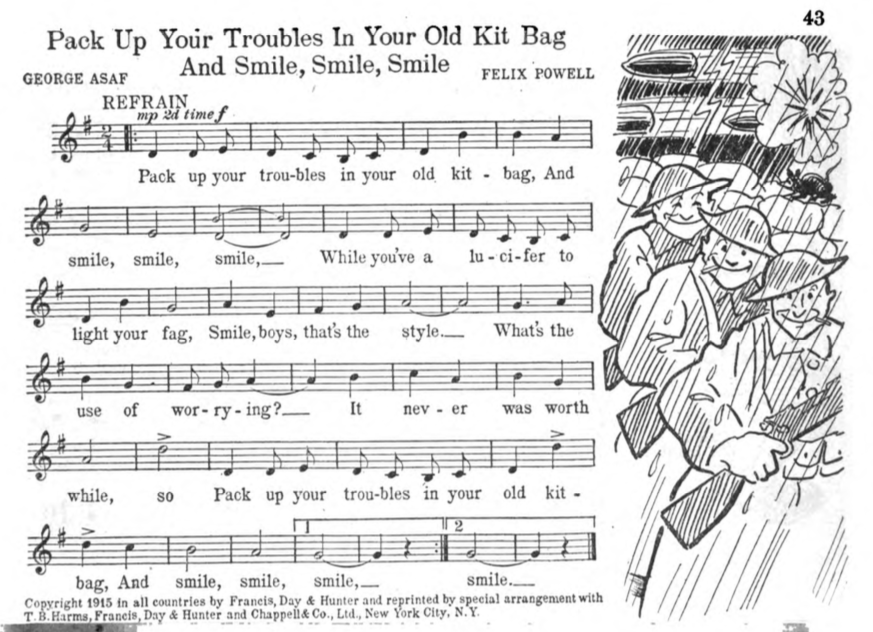
Pack up your troubles in your old kit bag,
And smile, smile, smile,
While you’ve a lucifer to light your fag,
Smile, boys, that’s the style.
What’s the use of worrying?
It never was worth while, so
Pack up your troubles in your old kit bag,
And smile, smile, smile,
Published in London as part of the music hall tradition in 1915, this World War I marching song was written by Welsh songwriter, George Henry Powell under the pseudonym George Asaf and set to music by his brother Felix Powell.
The Powell brothers wrote this marching song for a wartime music competition that became very popular in boosting British morale and recruiting forces. Given its similarity in structure to “It’s a Long Way to Tipperary,” the two songs were frequently sung one after the other.
Gareth Malone, choirmaster for the Military Wives’ Christmas choir, explains in an interview with the BBC on how the Powells came up with this song.
So one reason for the song's success is its simplicity. It's written in G major, which can be played on a wide range of instruments relatively easily...The first line of the song is very direct and familiar to people because it mentions a kit bag - every soldier in the country would have had a kit bag. The second line is about a Lucifer, which is a match which they would have used to light their cigarettes. So these are words that any regular Tommy would immediately connect with.
While George was a pacifist, his brother Felix signed-up as a staff sergeant in the British Army. However, it is said that Felix was horrified when he found out that his popular tune was used as propaganda. He went to war and accompanied the soldiers to their deaths.
In America, World War I propaganda cartoons included Snoopy singing this song with “It’s a Long, Long Way to Tipperary,” and “Over There.”
Malone, Gareth. "The Importance of WWI Songs". www.bbc.co.uk
https://www.bbc.com/news/uk-wales-25968407

http://www.library.ucsb.edu/OBJID/Cylinder7678
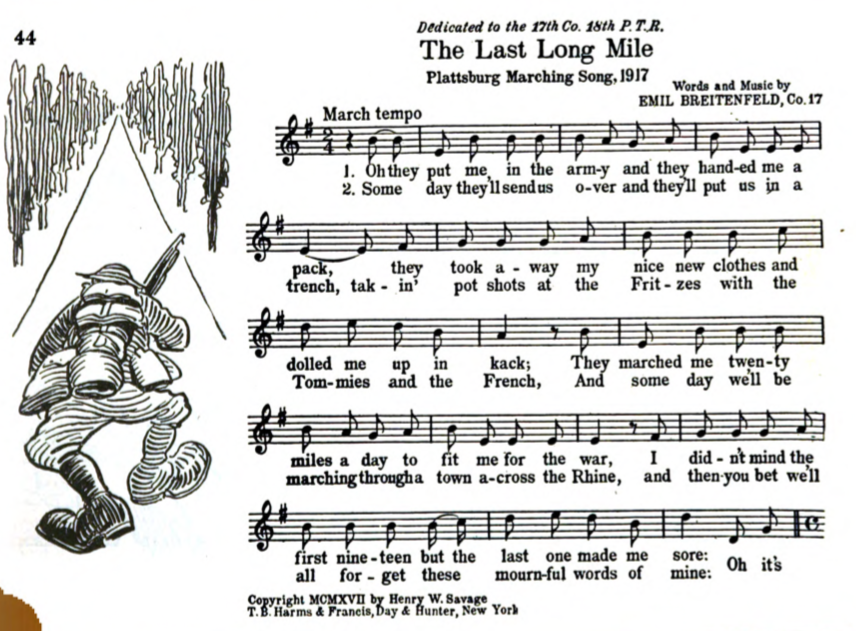
1. Oh, they put me in the Army
And they handed me a pack,
They took away my nice new clothes
And dolled me up in tack.
They marched me twenty miles a day
To fit me for the war;
I didn't mind the first nineteen,
But the last one made me sore!
(Chorus)
Oh, it's not the pack
That you carry on your back,
Nor the Springfield on your shoulder.
Nor the five inch crust
Of Clinton County dust
That makes you feel your limbs are growing older.
And it's not the hike
On the hard turnpike
That wipes away your smile,
Nor the socks of sisters
That raise the blooming blisters,
It's the last long mile!
2. Some day they'll send us over
And they'll put us in the trench,
Taking pop shots at the Fritzes
With the Tommies and the French,
And someday we'll be marching
Through a town across the Rhine,
And then, you bet, we'll all forget
These mournful words of mine!
(Chorus)
http://www.loc.gov/jukebox/recordings/detail/id/6855
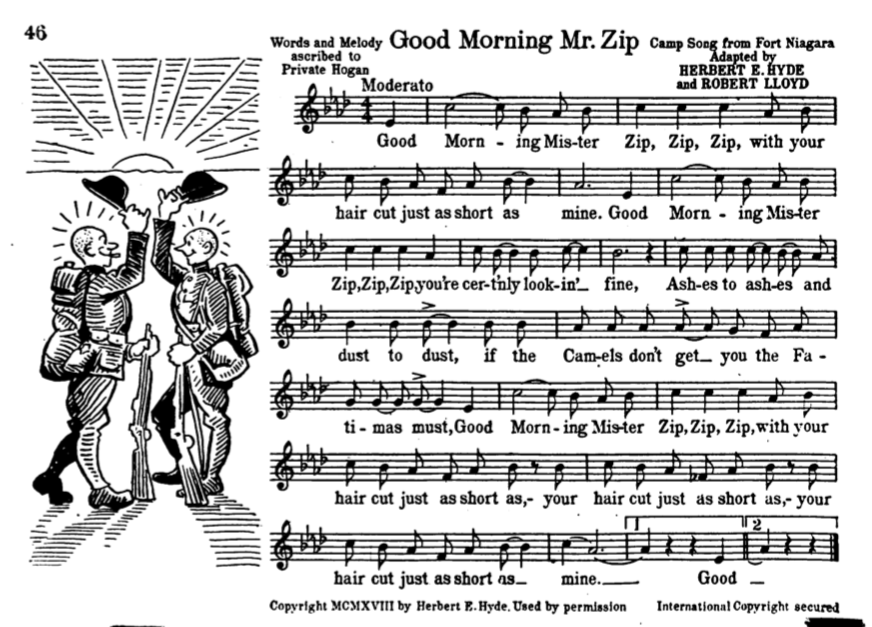
Good morning, Mister Zip-Zip-Zip,
With your hair cut just as short as mine,
Good morning, Mister Zip-Zip-Zip,
You're surely looking fine!
Ashes to ashes, and dust to dust,
If the Camels don't get you,
The Fatimas must,
Good morning, Mister Zip-Zip-Zip,
With your hair cut just as short as,
your hair cut just as short as,
your hair cut just as short as mine.