


































http://www.library.ucsb.edu/OBJID/Cylinder0238
I have always been a wand’rer,
Over land and sea,
Yet a moonbeam on the water
Casts a spell o’er me,
A vision fair I see,
Again I seem to be:
(Chorus)
Back home again in Indiana,
And it seems that I can see
The gleaming candle light still shining bright
Thru the sycamores for me,
The new mown hay sends all its fragrance
From the fields I used to roam,
When I dream about the moonlight on the Wabash,
Then I long for my Indiana home.
The song was introduced as a “Tin Pan Alley” pop song in January 1917 with a musical quotation from the official state song, “On the Banks of the Wabash, Far Away” which was already well known when “Indiana” was published. Given its popularity as an immediate hit, this song was selected by Columbia Records to be recorded by the Original Dixieland Jazz Band which later on became a jazz standard. Louis Armstrong would adopt this song in his succeeding career as his opening number in his performances.
James Hanley, the composer, who had served in World War I, is evidently “longing for my Indiana home.” The song’s fidelity to Indiana can be seen from repeated key words associated with the state: moonlight, candlelight, fields, new-mown hay, sycamores, and of course the Wabash River. The song continues to be a well-known song in Indiana.
Hanley’s other popular standard compositions are “Second Hand Rose” and “Zing! Went the Strings of My Heart” for Ziegfeld Follies.
https://indianapublicmedia.org/momentofindianahistory/home-indiana/

http://www.library.ucsb.edu/OBJID/Cylinder4076
Joan of Arc, Joan of Arc,
Do your eyes, from the skies, see the foe?
Don’t you see the drooping Fleur de lis?
Can’t you hear the tears of Normandy?
Joan of Arc, Joan of Arc,
Let your spirit guide us through;
Come lead you France to victory;
Joan of Arc, they are calling you.
“Joan of Arc, They are Calling You” is a song by for the war effort composed by Jack Wells and lyrics written by Al Bryan and Willie Weston. Although Joan of Arc was not canonized as a saint by the Catholic Church until 1920, it was common for French soldiers to carry an image of her for protection when going to battle. The lyrics seem to be a soldier's call for his heroine.
The image of Joan of Arc evoked both medieval chivalric values and suggested a critique of aristocratic authority. Joan of Arc's defiance against the papacy and the French monarchy led her to being burned at the stake in 1431. Her reputation was very popular in America prior to our involvement in the Great War. A sculpture of her was unveiled in New York at 93rd St. and Riverside Drive on December 6, 1915 with military bands playing and speeches rendered in her honor. Copies of the sculpture were also unveiled in San Francisco, Gloucester, Mass., and Blois, France. In an attempt to rouse people for the war effort, Haskell Coffin drew a fund-raising poster in 1917 depicting a fully armored Joan of Arc confronting the audience with the words “Joan of Arc Saved France, Women of America Save Your Country!” Her depiction appealed to both men and women. While women would have idolized her for displaying symbols of power, depicting a beautiful woman with open arms and a raised sword would have evoked a sense of erotic vulnerability to male audiences. Joan of Arc's heavily feminized portrayal played an important factor that incentivized young male soldiers to join the war. Was this the reason why this song was included in the songbook?
Visions of the Maid: Joan of Arc in American Film and Culture by Robin Blaetz

http://www.library.ucsb.edu/OBJID/Cylinder5732
1. Dear face that holds so sweet a smile for me,
Were you not mine how dark the world would be.
I know no light above that could replace,
Love’s radiant sunshine in your dear, dear face.
(Refrain)
Give me your smile,
The lovelight in your eyes,
Life could not hold a fairer Paradise!
Give me the right to love you all the while,
My world forever, the sunshine of your smile!
2. Shadows may fall upon the land and sea,
Sunshine from all the world may hidden be,
But I shall see no cloud across the sun,
Your smile shall light my life till life is done.
(Refrain)
The British songwriter and lyricist Leonard Cooke and composer Lilian Ray, wrote this song in 1913 just before World War I. The song became popular in America in 1916 after John McCormack recorded it for the Victor recording company.
The lyrics capture the feelings of separated sweethearts during the war. The first verse is formal and reserved: “Dear face that holds so sweet a smile for me, were you not mine, how dark the world would be.” The second verse is more free and expressive: “Shadows may fall upon the land and sea, Sunshine from all the world may hidden be, But I shall see no cloud across the sun, Your smile shall light my life, Till life is done.
Music of the First World War by Don Tyler p. 71 with recording
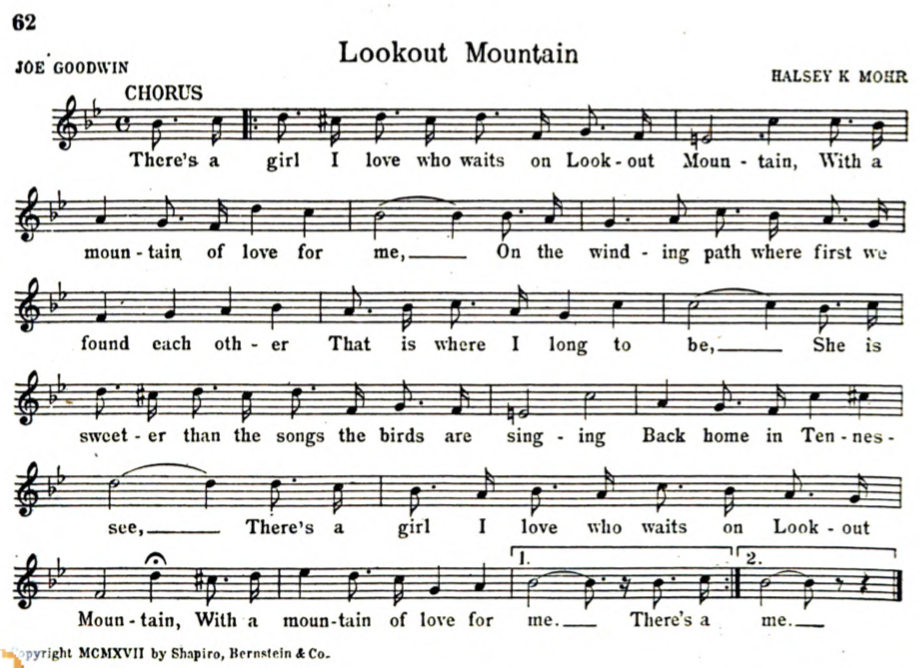
There’s a girl I love who waits on Lookout Mountain,
With a mountain of love for me,
On the winding path where first we found each other
That is where I long to be,
She is sweeter than the songs the birds are singing
Back home in Tennessee,
There’s a girl I love who waits on Lookout Mountain,
With a mountain of love for me.
Another love song from the songbook, this piece was composed by composer Halsey K. Mohr and lyricist Joe Goodwin. Soldiers from Tennessee would have appreciated this song about their home state.
http://www.loc.gov/jukebox/recordings/detail/id/6186
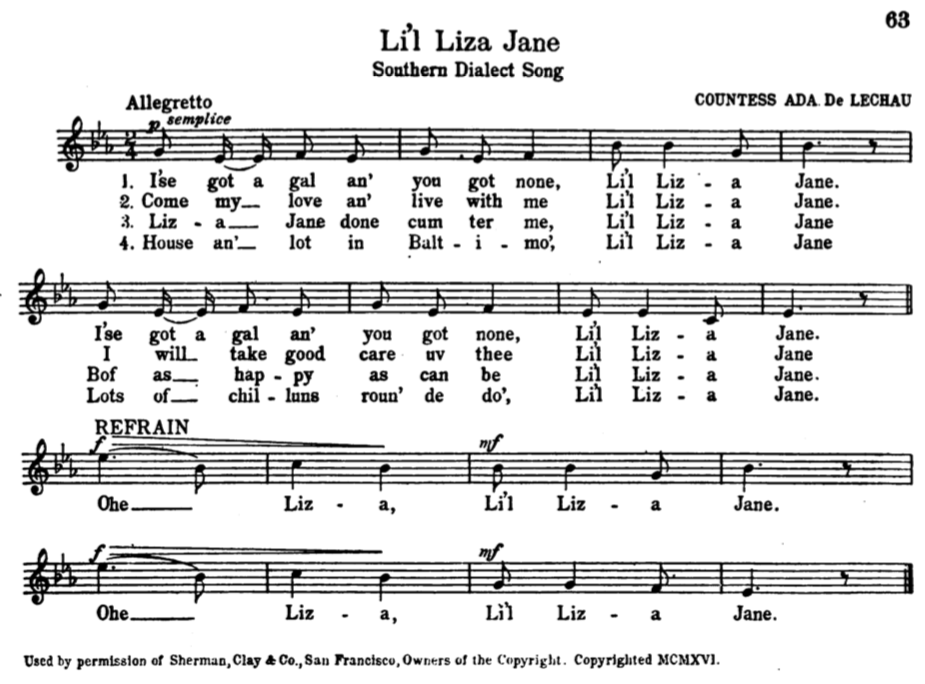
I’se got a gal an’ you got none,
Li’l Liza Jane.
I’se got a gal an’ you got none,
Li’l Liza Jane.
(Refrain)
Ohe Liza, Li’l Liza Jane.
Ohe Liza, Li’l Liza Jane.
Come my love an’ live with me
Li’l Liza Jane.
I will take good care uv thee
Li’l Liza Jane
(Refrain)
Liza Jane done cumter me,
Li’l Liza Jane
Bof as happt as can be
Li’l Liza Jane.
(Refrain)
House an’ lot in Baltimo’
Li’l Liza Jane
Lots of chilluns roun’ de do’
Li’l Liza Jane
(Refrain)
“Li’l Liza Jane” is a song that can be traced back to the early 1900s, but only published in 1916 in San Francisco as a composition by Countess Ada de Lachau. In Lucy Thurston’s interview, she remembers hearing slaves singing this tune in Covington, Louisiana before the Civil War. The song has been a standard in jazz, folk music, bluegrass, and rock and roll. It was also adopted by the New Orleans brass band tradition and featured in the 1916-1917 show “Come Out of the Kitchen.”
In September 1917, Earl Fuller’s Jazz Band, featuring Ted Lewis on clarinet, recorded an instrumental arrangement of this song for Victor Records. The recording sold well and established itself as a standard in early jazz repertory. A year later, Harry C Browne recorded the song with singing and banjo for Columbia Records. The recording was essential in popularizing the song to old time country music repertory.
“Lil’ Liza Jane” is a fairly unique song, having been covered in so many musical genres, from jazz to rock ‘n’ roll. There is a famous call-and-response section where the lead singer sings two bars of the melody, exclaiming, “Oh, Lil’ Liza!” and the band or audience responds, “Lil’ Liza Jane!” It is one of the most recognized songs in the world, which makes it a perfect sing-along.
Thurston, Lucy. "WPA Slave Narratives: Lucy Thurston Age 101". Mississippi Slave Narratives. Works Progress Administration.

http://www.library.ucsb.edu/OBJID/Cylinder6292
K-K-K-Katy, beautiful Katy,
You’re the only g-g-g-girl that I adore;
When the m-m-m-moon shines,
Over the cowshed,
I’ll be waiting at the k-k-k-kitchen door.
Canadian-American composer Geoffrey O’Hara composed this song in 1917 and published it in 1918. O’Hara was a song leader at Fort Oglethorpe, Georgia when he wrote this song. After its publication, the song became an instant hit and was especially popular with American, Canadian, and British servicemen. Billy Murray recorded this song in 1918 for the Victor company.
The song was advertised as “The Sensational Stammering Song Success Sung by the Soldiers and Sailors.” The lyrics tells us of a young soldier who stutters when he tries to speak to girls, but finally manages to talk to “beautiful Katy.” Although the song has an upbeat and happy feel to it, the line, “I’ll be waiting at the k-k-k-kitchen door,” clearly makes this a “goodbye” song. From the rhetorical aspect, the repeated letters may also imitate the rapid machine gun fire that awaited the soldiers.
https://www.collectionscanada.gc.ca/gramophone/028011-1021-e.html

http://www.library.ucsb.edu/OBJID/Cylinder1006
There’s a spot in me heart which no colleen may own,
There’s a depth in me soul never sounded or known;
There’s a place in my mem’ry, my life, that you fill,
No other can take it, no one ever will.
Sure, I love the dear silver that shines in your hair,
And the brow that’s all furrowed
And wrinkled with cure,
I kiss the dear fingers, so toilworn for me,
Oh, God bless you and keep you, Mother Machree!
An Irish-American song from 1910, “Mother Machree” was written by composer Ernest Ball and lyrics added by Rida Johnson Young and Chauncey Olcott for the show Barry of Ballymoore. Trying to bolster their Irish heritage, Rida Johnson Young also wrote a screenplay bearing the same name in 1928 that tells about a poor Irish immigrant in America. This ballad was a favorite among English-speaking troops. Writing years later, Lily McCormack, the wife of the popular Irish tenor John McCormack, wrote
“One summer in World War II we met General Victor Odlum … of the Canadian Army…. General Odlum told John he had taken his records Ave Maria and Mother Machree everywhere with him during World War I; and neither John nor I had dry eyes when he described what these records meant to him and to his men.”
The American Magazine - Volume 90 - Page 34; 1920

http://www.library.ucsb.edu/OBJID/Cylinder0615
Darling, I am growing old,
Silver threads among the gold
Shine upon my brow today,
Life is fading fast away;
But, my darling you will be, will be
Always young and fair to me,
Yes! my darling you will be
Always young and fair to me.
(Chorus)
Darling, I am growing, growing old,
Silver threads among the gold
Shine upon my brow today;
Life is fading fast away.
“Silver Threads Among the Gold” was first published in 1873 but remained popular through the early 20th century. Today, it is considered a standard in barbershop quartet singing. A New York Times article from October 1930 gives some background on the lyrics of the song:
"Silver Threads Song Traced to Poet’s ‘Re-Hash’ on Order"
Shiockton, Wis. (AP).—The love ballad, “Silver Threads Among the Gold,” which has stirred the hearts of more than one generation, was not the inspiration of an aging poet but a “re-hash” produced on order. The story developed after the unveiling of a monument here in honor of the author of the words, Eben E. Rexford, who died in 1916. Rexford made a living by writing verse and flower and garden articles for magazines. When he was 18, he wrote and sold for $3 some verses entitled “Growing Old.” Later, H. P. Danks, composer of the music for “Silver Threads,” wrote to him requesting words for a song. Rexford dug into his scrapbook and revised “Growing Old.”
During his lifetime, Rexford explained that he worked his way through writing it. Danks then sent him a request for lyrics. Further, he remembers that he first heard the melody from a company of Oneida Indians giving a concert in Shiocton, Wisconsin. The song proved to be a hit. Richard Jose recorded the song in 1903 and New York regiments sang it before being sent off to France in 1917. The popularity of the song can be seen by news stories which continued to reference it for many years after it was first published. In 1932, the song won a popularity poll conducted by WABC (AM) New York.
The New York Times, October 19, 1930, section 3, page 6

http://www.library.ucsb.edu/OBJID/Cylinder7047
Once in the dear, dead days beyond recall,
When on the world the mists began to fall,
Out of the dreams that rose in happy throng,
Low to our hearts Love sang an old sweet song;
And in the dusk where fell the firelight gleam,
Softly it wove itself into our dream.
(Chorus)
Just a song at twilight, when the lights are low,
And the flick’ring shadows softly come and go,
Tho’ the heart be weary, sad the day and long,
Still to us at twilight, comes Love’s old song,
Comes Love’s old sweet song.
In Derek B. Scott’s book, The Singing Bourgeois: Songs of the Victorian Drawing Room and Parlour, he comments that “Love’s Old Sweet Song” was a commercially successful ballad by Irish composer, James Molloy. It was first sung by American contralto Antoinette Sterling and was featured in James Joyce’s book, Ulysses. The song is also referenced in the 1917 British silent drama film “Love’s Old Sweet Song.”

http://www.library.ucsb.edu/OBJID/Cylinder0398
How dear to this heart are the scenes of my childhood,
When fond recollection presents them to view!
The orchard, the meadow, the deep tangled wildwood,
And ev’ry loved spot which my infancy knew.
The wide spreading pond, and the mill that stood by it,
The bridge and the rock where the cataract fell.
The cot of my father, the dairy house nigh it,
And e’en the rude bucket that hung in the well.
(Chorus)
The old oaken bucket, the ironbound bucket
The moss covered bucket that hung in the well.
The lyrics can be traced back to Samuel Woodworth’s 1826 poem and later set to music by Kiallmarck. This song has been sung by generations of American schoolchildren and would have been very familiar to the young American soldiers during the war. The song was first recorded in 1899 by The Haydn Quartet, the most famous barbershop quartet at the time, and released on the Berliner Gramophone. Thus, Germans would have also heard this song before encountering the Americans on the battlefield in 1917.
The song was later parodied by American soldiers by renaming it “The Old Company Tooth brush.” https://secondhandsongs.com/work/166631/all