


































Chemical Cocktails Were Made for Destruction
by Daniel Barr
Given the use of chemical cocktails designed to destroy enemy lives, minds, and territories, World War I is rightly known as the Chemists’ War.
The use of chemical agents in warfare dates to antiquity and includes stratagems like poison darts, toxic smoke, and incendiary munitions. The Hague Declaration of 1899 and the Hague Convention of 1907 prohibited projectiles whose sole purpose was to spread asphyxiating poisonous gases. Unfortunately, this term was not well-defined and the resulting ambiguity allowed for the deployment and escalation of chemical weapons during the Great War of the early 20th Century.
The French were the first to use chemical weapons in World War I, deploying grenades filled with tear gases in August 1914 followed by German artillery shells filled with similar tear gases in October. Neither side considered these gases a violation of the Hague Convention because tear gases were not believed to be lethal or “asphyxiating poisonous gases.”
By all accounts, the gases in these attacks were too diluted to have much effect, a problem that would persist throughout the war. The difference between the laboratory environment and the battlefield was greater than anyone expected. Supposedly non-lethal tear gases could become fatal in the close environment of the trenches. Yet at the same time, lethal gases like phosgene and mustard gas later in the war proved much less effective than expected due to the open environments and diffuse conditions of the open fields.
The first major lethal gas attack of the war occurred April 22, 1915, at Ypres, Belgium. Under the direction of meteorologists who were monitoring wind conditions, the Germans released more than 160 tons of chlorine gas across the battlefield toward the French lines.
It was argued that this attack did not violate the Hague Convention because the gas was not delivered in explosive canisters, but was simply released into the atmosphere. This distinction quickly became moot, as armies on both sides of the conflict began to develop gas-filled munitions.
Chemical warfare escalated quickly, with new gases (and new gas defenses) developed and deployed every few months. Gas masks evolved from urine soaked rags to the activated charcoal respirator that is still the basis for modern respiratory protection. Due to the quick development of countermeasures against chemical weapons, by the end of the war gas attacks were being seen as more of a nuisance than a true threat to human life.
For all the hype surrounding chemical warfare, the number of deaths due to chemical weapons in World War I was remarkably small – less than three percent of the total fatalities. Less than 100,000 people were estimated to have died as a result of gas attacks.
However, during the course of the war more than a million soldiers suffered some form of casualty from chemical attacks, and it is these wounds – both physical and psychological – that have had the most profound impact on the course of civilization in the aftermath of the war. Shell-shock has been a commonly-reported and much-characterized phenomenon resulting from the brutal nature of trench warfare; gas attacks served to add panic and, most importantly, an element of dehumanization to those conditions. A British office in 1916 wrote of the effect of the respirators that:
We gaze[d] at one another like goggle-eyed, imbecile frogs. The mask makes you feel only half a man. The air you breathe has been filtered of all save a few chemical substances. A man doesn’t live on what passes through the filter—he merely exists. He gets the mentality of a wide-awake vegetable.
Soldiers at the front spent many hours a day, sometimes days on end, wearing respirators. Those who suffered injuries or burns from the gas felt the effects long after the war. For many, their health was irretrievably ruined by damage to their lungs, eyes, or skin from the gas.
Within a relatively short time, just a year at the most, it became clear that chemical weapons would not realize the lethal power they were predicted to accomplish. But the psychological aspect of chemical weapons was exploited during the war for territory control. That continues to be their dominant use in the modern era.
During World War I, due to their high density and long persistence, these gases were tremendously effective at driving enemy soldiers out of particular territory and keeping them out as long as several weeks. Mustard gas, developed and deployed toward the end of the war, proved especially useful for this purpose and is still being used for this purpose against civilian populations in several parts of the world today.
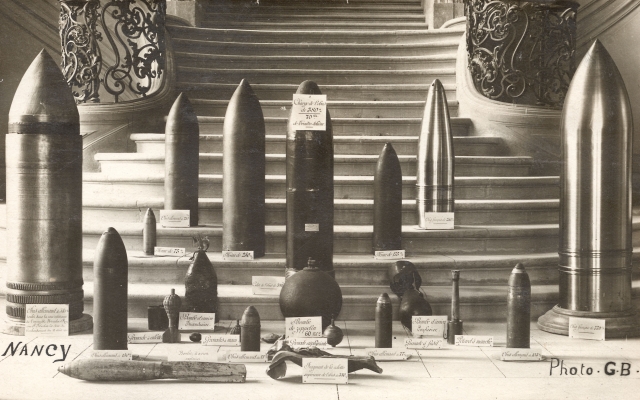
One of the surprising, disheartening, and disturbing results of the Chemist’s War is the legacy of unexploded ordnance left strewn throughout central Europe after the war. About 16 million acres in France (an area the size of Delaware) had to be cordoned off after the war because of unexploded chemical shells and damage from poison gases. Germany, Poland, Russia, and other European countries suffered similarly. It is believed that over 13 million shells were left behind in Europe, some still being discovered to this day.
(Daniel Barr is an associate professor of chemistry at the University of Mary in Bismarck.)