

































A Real Live Hornet’s Nest
Anton Peterson’s WWI War Diary
Edited by Susan Wefald
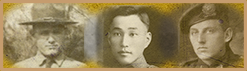
Excerpts from Corporal Anton Peterson’s diary while he was waiting to return home after WWI. Although most soldiers wrote home, letters were censored, containing little about their war experiences. Peterson’s diary, however, contains vivid accounts of battles, travel, and army food.
Peterson was 30 when he joined the National Guard in Fargo in 1917. He served overseas from December 1917, to July 1919 and. was recognized for gallantry in action and especially meritorious service.
The complete diary is in the State Historical Society Archives.
On Dec. 14 (1917), we got orders to sail for France. This is when the boys first began to think of home and the good times they used to have. We loaded on the Vaterland at twelve o’clock that day and sailed about seven o’clock on the morning of the 15th. We all yelled good bye to the Statue of Liberty and hoped that it would not be long before we would return to it.
Jan 3 [1918]--We entrained for La Courtine France. We were put in cattle cars, forty men in a car and the cars were about half as large as the ones in U.S. Of course it was not so bad, half of us could sit down and take a rest while the other half stood up and kicked their feet to keep warm.
After dark, Corporal Hamilton got out and stole a stove which we rigged up, and it sure helped us to keep warm. Of course, the ones next to the stove got all the heat. Cpl. H. also hooked a ten-gallon jug of whiskey. Benson and I got a box of chocolate containing 200 bars. We ate candy and drank whiskey until we were hardly able to take care of ourselves. We arrived in La Courtine on January 4, after a hard, disagreeable trip.
After travelling 4 days in a box car] we landed at Huddlecourt and we sure were a hungry bunch of boys. Shortly after we lit we got dinner and everybody ate until they could hardly walk. We shaved, washed, and brushed up. Well, we began to feel better now. The next day we were all ordered to have our hair cut… The first time we fell in, it was snap out of it, shape it up. You are not in the National Guard now, you are in the regular army.
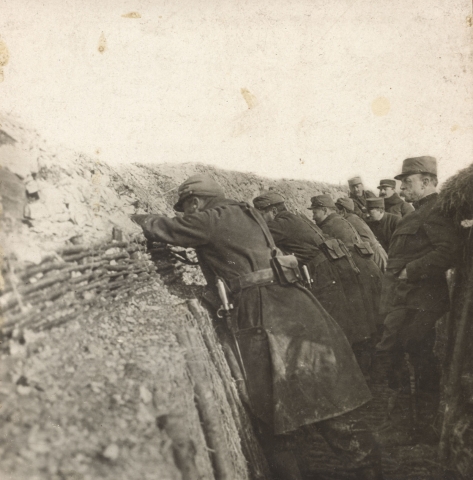
On the 15th we started for the trenches. We had two blankets, one suit of underwear, our toilet articles, reserve rations, and one hundred rounds of ammunition. We had some load. It rained and the roads were sleet. It was hard hiking and some of the boys had to be taken in on the ambulance. I was all in but the last five kilometers I hiked on my nerve.
[January 22—March 7 – Ansinville] Our company stayed in this town one week, we went up to the lines every nite and worked on the trenches. I saw Mervin Armstrong one day and he had the experience of sticking his head over the Parapet and letting a German sniper take a crack at it. The ball went thru his helmet but did not hurt him.
Our company went into the front lines one nite, and it sure was cold, wet, and disagreeable. We had to wade in water knee deep before we reached our position, and I tell you it was no fun to stand on post all nite soaked to the skin. Tobacco was very scarce, and the chow was worse.
About six o'clock that morning our artillery put over a barrage on the Germans. Pvt Fascena and I were on an outpost, and we were almost frozen stiff, but when the barrage quit, I was as warm as if I had been next to our big heater on a cold winter day. Leave it to me, there were a good many of the boys who [thought] the same as I did, and that was the world had come to an end. The heavens were all red from the flares of the guns, and our trenches and the German trenches were only seventy five yards apart… A few of the shells fell in our lines, but no one was killed.
We slept in barns and old houses which had been shot to pieces. We always got one day rest after being relieved from the lines. Some-times we would not get as far back as Ansenville after being relieved. We would have to stop at Scherprey, a small town all shot to pieces. Fritz [the Germans] would always throw over a few gas shells at nite in this town so that we could not sleep.
On the night of March the seventh we were relieved… We got paid a few days after we got here [Traveray] and eggs were quite plentiful here. L.D Johnson and I bought two dozen eggs, cheese, butter, bread and jam and went down to the creek and had a good big feed.
On the sixth of May Fritz put over a six-hour heavy gas attack. The casualties were very heavy in our battalion. C Co. casualties were about seventy-five percent…The next day a report came out that we were going to be relieved, as we did not have men enough to hold the lines. However, we were not relieved. We stayed on the front lines for twenty-one days without being relieved. We could not get enough water to shave with, and I guess that if the Germans had come over, we would not have needed to fire a single shot because we all looked so tough that we would have scared the devil.
June fourteenth we moved to the front lines at Grievennes. This is where a wealthy Frenchman had his park and chateau, but it did not look like a park now. It was all shot to pieces and the ground was covered with dead Germans… It stunk so that lots of the boys went to the hospital with influenza.
[July 18] On the second day we ran into a real live hornet's nest. We lost quite heavy here. Our Major gave us orders to retreat and we did. We fell back about four hundred yards and took up another position. About eleven o'clock we went forward again, but in vain. We did not fall back this time, but they held us so that we could not break their lines. Our tanks were all out of commission by this time so we had to depend on our hand grenades and rifles to do the work. We had advanced so fast that our artillery was of very little good. We flopped in the wheat which was waist high and took what little cover we could find. The squad I was in was still together and not a single one wounded. The seven of us lay down in a squad column about ten feet apart. The balls were dropping all around us…
[Early September 1918] They got us packed into box cars about thirty five strong in each car, threw in a box of hard bread and a case of corned beef in each car and started out. We were on the road five days and nites before we were unloaded. When we were unloaded that eve we had fifteen kilos to hike to reach battalion headquarters. Here we got some hot coffee and slept wherever we could find a place to flop.
The next morning was Sept. 6th. I found my company. They were camped in some woods close to Verdun. It was raining, and everybody had pitched pup-tents. I crawled in with L.D. Johnson and his squad. We stayed there for a few days and then we got orders to make another hit on the Huns. The nite of Sept. 11th we started for the lines. We hiked all nite in the rain and mud and got into position before day-break the next morning. We thought we were in position, but we were not because everybody was lost.
The 10th of November we started to hike towards the rear. We heard that the guns were to stop at eleven o’clock the next day, but we did not believe it. Everybody thought we were making a flank movement….We camped with our company that nite and occasionally there was a gun which would fire. When we would hear a gun fire everybody would say, “Now do you believe that peace has come?”
[November 13, 1918] We camped in some woods near Verdun and during the night there was a continual celebration…. All a fellow could see for miles that night was skyrockets being sent into the air, and all kinds of them. Of course this was stuff which had been captured from the Germans. Now we were allowed to smoke and built fires after dark, the first time since we came over here, that is when we were near the lines. It sure looked funny to see fires on every hill, in the woods and all over….
We learned that we were going to hike into Germany and form our lines there, stay there a short time, and then sail for the U.S. You can imagine how the boys of the 1st Division felt to hear this news because they had been the first over and wanted to be the first back.
Susan Wefald was the first woman to serve on the North Dakota Public Service Commission (1993-2008). Now retired, she has authored two books, plays violin in the Bismarck Mandan Symphony, and enjoys serving on non-profit boards.