



















Delivery of Medical Care on the Battlefield
Triage and the Field Hospital Section
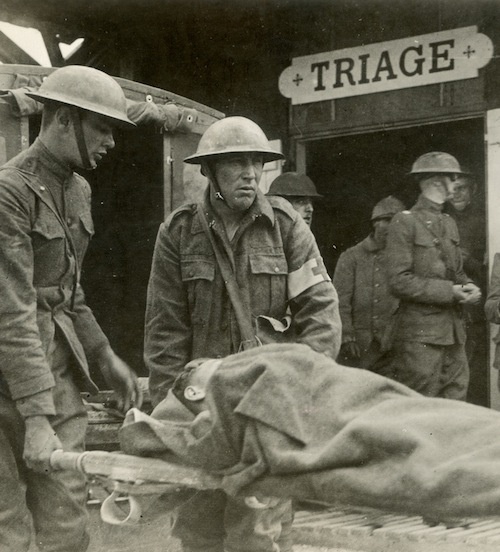 Triage, 42nd Division, near Sieppes
In 1918, the US adopted the French method of "triage". This was found to be an effective method to sort, classify, and distribute the sick and wounded during the first stage of the treatment and evacuation of soldiers from the battlefield. The decision to explore the French method meant it would have to be assigned to the field hospital section because it was the only unit in the sanitary train large enough to perform the task. This section, comprising four identical field hospitals, was staffed by a total of 25 officers and 337 men. Each hospital could accommodate 216 patients. All were equipped to be mobile so as to maintain contact with the forward medical units that they supported. In early to mid-1918 the static combat environment permitted these four hospitals to be grouped together for greater efficiency. They were placed at 2 to 4 miles on a road that linked them to the dressing sections of the ambulance sections, and to the next level medical treatment in the rear, the evacuation hospitals.
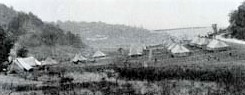 Field Hospitals, 314 and 316, 79 DivisionThe practice of deploying four hospitals to perform the same role changed in May 1918 when the 1st Infantry Division’s field hospital section at the Battle of Cantigny experimented with assigning a specific type of patient to three of their hospitals that they identified as:
- Wounded and gassed
- Sick
- Skin and venereal diseases
The fourth hospital was tasked to be the medical reserve and a convalescent camp. At the same time the concept of ‘triage’ was explored with the technique assigned to the hospital that received the wounded and gassed. The concept of designating a type of patient to each field hospital was quickly adopted by the other field hospitals operating with the infantry divisions. In practice, however, each division’s field hospital section was free to establish what classification worked best for them.
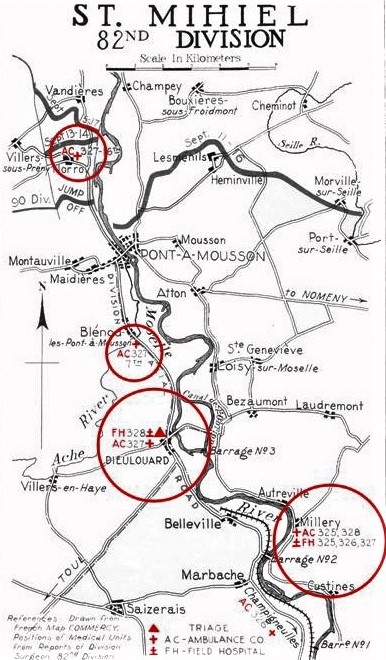 Just how "triage" operated with multiple field hospitals and ambulance companies is illustrated in the map, showing deployment of the 82nd Infantry Division’s Sanitary Train in September 1918 for the St. Mihiel offensive. At the start of the operation Field Hospital 328 was designated as the division’s ‘triage’ and was located at Dieulouard. It remained at that location throughout the battle. It began receiving casualties eight hours after the start of the offensive on September 12th. At Millery, further south, the 325th Field Hospital was designated to receive the sick, the 326th the gassed and the 327th the wounded. This illustration also indicates the preferred site for the division’s field hospitals. Although each had tents, the preferred location was in a village. Such a site was likely to have intact buildings that could provide better shelter, a water supply, sources of fuel and perhaps even electricity.
The field hospital section was the last point for a man to receive treatment from the division medical units. Arrival and treatment at one of these hospitals did not mean the patient would be evacuated to the next level of treatment, such as an evacuation hospital. If a patient did not require prolonged care and was likely to recover within 14 days he was retained at one of the field hospitals designated for his condition. This decision illustrates the value of ‘triage’ as a method to sort, classify and determine who should be evacuated and to where and who should not be transported to the next level of care. If a patient could recover within the specified days then his contribution to the infantry division was not lost.
An example that illustrates the diagnostic procedure for a man who was classified as a possible case of ‘war neurosis’. At "triage" this patient would be examined by the division psychiatrist to determine the cause and severity of his condition. This examination, classification and a recommended treatment led to 65% of the cases seen at the division level to be retained and 35% to be evacuated to a neurological hospital. The six possible diagnostic classifications he used were:
- Shell fright
- Gas fright
- Hysteria
- Mental and or physical fatigue
- Malingering
- Cowardice
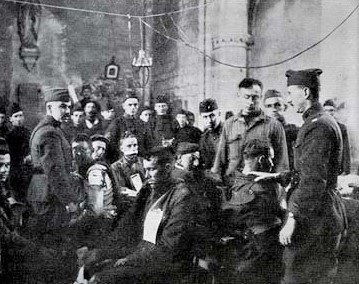 Triage station, 79th Division, MoutreullSorting, classification and distribution done at a "triage" station required a skilled team to determine who was transportable and who needed to be retained until they were ready to be moved. Ideally the team had a thorough knowledge of medicine, surgery and human nature, and was usually headed by a senior medical officer. Their evaluations had to be complete and unhurried but quick enough to prevent congestion caused by the arrival of new patients. Often, "complete" and "quick enough" were at odds, and the system could be overwhelmed by a large number of casualties.
The essential sorting and classifications at the "triage" focused on identifying those who were wounded, gassed or were medical cases, and who were transportable or not. In some "triage" units the mission was to sort and distribute to the nearest hospitals according to the medical diagnosis. In others there was a continuation of emergency medical care but with more sophisticated treatment as compared with the ambulance company dressing stations.
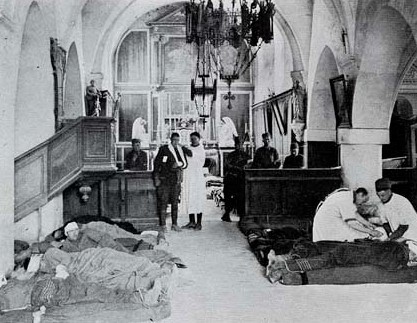 Field Hospital 1, 2nd Division, Benzu-leGueryThe treatment for shock was a top priority whether given at the "triage" or at the field hospital for the wounded and consisted of:
- Removal of wet clothing
- Warming through blankets, stoves and warming tables
- Hot drinks and food
- Morphine for pain
- Adjustment of splints and bandages to reduce pain
- Intravenous saline solution
- Blood transfusion from matched donors
Prior to receiving treatment for shock the patient would have been seen in the receiving department of the ‘triage’ or hospital for the wounded. His condition would determine whether he would be routed to the dressing, shock or operating departments. If treatment for shock was required he would be held there until his condition permitted either evacuation or treatment by the operating department’s team.
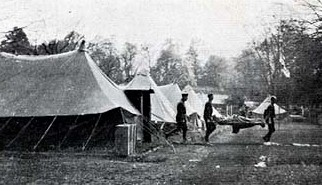 Field Hospital 13, Vendeuil-CapryThe operating teams focused on the control of hemorrhage and stabilization of broken bones. If time permitted, wound debridement including removal of foreign material could be done. All surgical work was intended to be life-saving rather than definitive. The intent was to prepare the patient for evacuation to a rear area hospital where more time-consuming and definitive operations could be done.
At the hospital designated for the treatment of gas injuries the patient’s clothes were removed and he was bathed to remove possible contamination. This was followed by an appropriate treatment for the cause of his injury, depending on the nature of the gas injury. Mustard gas, for example, produced serious skin blistering, while chlorine gas caused lung inflammation.
Medical treatment as described at this level of physician directed care was constrained by the reality that only essential emergency procedures could be performed. It was imperative that this lifesaving care be matched by the need to maintain the best patient management system possible. Therefore, the primary mission for the staff of the ambulance and field hospital sections was first to save lives and then to prepare patients for evacuation to the next level of treatment, either an evacuation hospital or a base hospital. 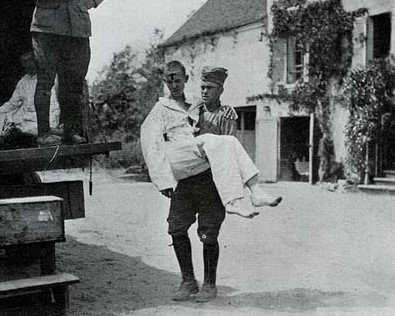 Evacuating a Patient, Field Hospital 14, Montreull
Sources
Jaffin, Colonel Jonathan H. Medical support for the American Expeditionary Forces in France during the First World War (Fort Leavenworth 1990)
Volume VIII, Field Operations, The Medical Department of the United States Army in the World War (Washington, 1925)
Volume XI, Section I, General Surgery, The Medical Department of the United States Army in the World War (Washington, 1925)