
































Avoiding Bloodshed on Sentry Duty
ST. NAZAIRE, FRANCE (March 18, 1918) -- Even when the troops of the American Expeditionary Force (A.E.F.) were hundreds of miles away from the enemy, sentry duty was serious business. Sentries had the right to stop and question anyone (including those who outranked them), and any infraction of the "General Orders" for sentries could result in serious punishments.
One dark night at Camp 1 in St. Nazaire, my grandfather 1st Lt. Joseph L. Bachus walked into a dispute between a group of military police (M.P.s) and the sentries guarding an entrance into the camp. The following document (recorded a few days later) is his explanation of what happened that night. It appears that his attempt to settle the dispute was misinterpreted by the M.P.s as interference in their efforts to execute their duties. Here's his response:
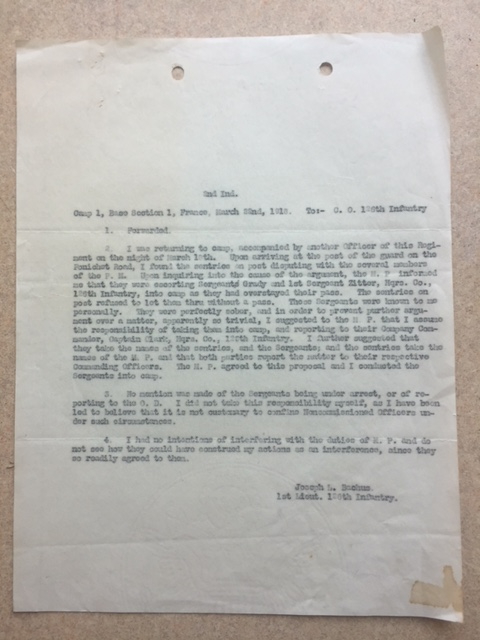
2nd Ind.
Camp 1, Base Section 1, France, March 22nd, 1918. To:- C.O. 126th Infantry
1. Forwarded
2. I was returning to camp, accompanied by another Officer of this Regiment on the night of March 18th. Upon arriving at the post of the guard on the Ponichet Road, I found the sentries on post disputing with the several members of the P. M. Upon inquiring in the cause of the argument, the M.P. informed me that they were escorting Sergeants Grady and 1st Sergeant Zitter, Hqrs. Co., 126th Infantry, into camp as they had overstayed their pass. The sentries on post refused to let them thru without a pass. These Sergeants were known to me personally. They were perfectly sober, and in order to prevent argument over the matter, apparently so trivial, I suggested to the M. P. that I assume the responsibility of taking them into camp, and reporting to their Company Commander, Captain Clark, Hqrs. Co., 126th Infantry. I further suggested that they take the names of the sentries, and the Sergeants; and the sentries take the names of the M. P. and that both parties report the matter to their respective Commanding Officers. The M. P. agreed to this proposal and I conducted the Sergeants into camp.
3. No mention was made of the Sergeants being under arrest, or of reporting to the O.D. I did not take this responsibility myself, as I have been led to believe that it is not customary to confine Noncommissioned Officers under such circumstances.
4. I had no intentions of interfering with the duties of M. P. and do not see how they could have construed my actions as an interference, since they so readily agreed to them.
Joseph L. Bachus
1st Lieut. 126th Infantry
I have no record of any further action taken by or against my grandfather following this dispute, but I do know that a couple of months later he was given a commendation and recommendation for promotion by Maj. Jay C. McCullough of 1st Battalion, so he must not have been doing anything too improper.
The document is a single-page, simple, typed sheet with a "Valley Paper Co." watermark of the seal of the United States. I have a couple of questions about it, though. 1. What does the title "2nd Ind." mean? 2. Who was the "To:-" addressed to? Did this actually go all the way up the chain of command to Col. Joseph B. Westnedge, the Regimental Commanding Officer, or did it only reach some lesser officer's desk? Perhaps some of you military historians out there can let me know.
While most of 126th Infantry Regiment was kept busy seven days a week with construction projects, hard labor, and guard duty for the Service of Supply, signs of the combat to come were always around them. News reached the camp of the Germans' long-expected Spring push, which began on March 21st. Men of the 126th who escorted supply convoys to the front returned with stories of the fighting, and the men saw their first "boche prisoners" in St. Nazaire.
NEXT TIME: Temporary Command of Company A