





























An Introduction to the System
The United States Army began to prepare for war in 1916. Their combat doctrine stressed that they should be prepared to fight a war of movement. It was expected that all combat and support units would be organized and equipped to operate within an ever-changing battlefield environment
This concept, however, was not feasible in 1917 when the Americans arrived in Europe. The Western Front consisted of complex and multiply-layered fortified lines that ran from the North Sea to Switzerland. However, the Americans and the Allies, as well as their German enemy, all expected that a war of movement could be achieved if these lines could be ruptured. This is exactly what happened in 1918, first to the Allies and then to the Germans.
In response to the realities of the Western Front, the Medical Department established a treatment and evacuation system that could function in both static and mobile environments. Based on their history of success in the American Civil War, and on the best practices of the French and British systems, the Department created specific units designed to provide a sequence of continuous care from the front line to the rear area in what they labelled the Theater of Operations.
Schematic Diagram of Hospitalization and Evacuation System
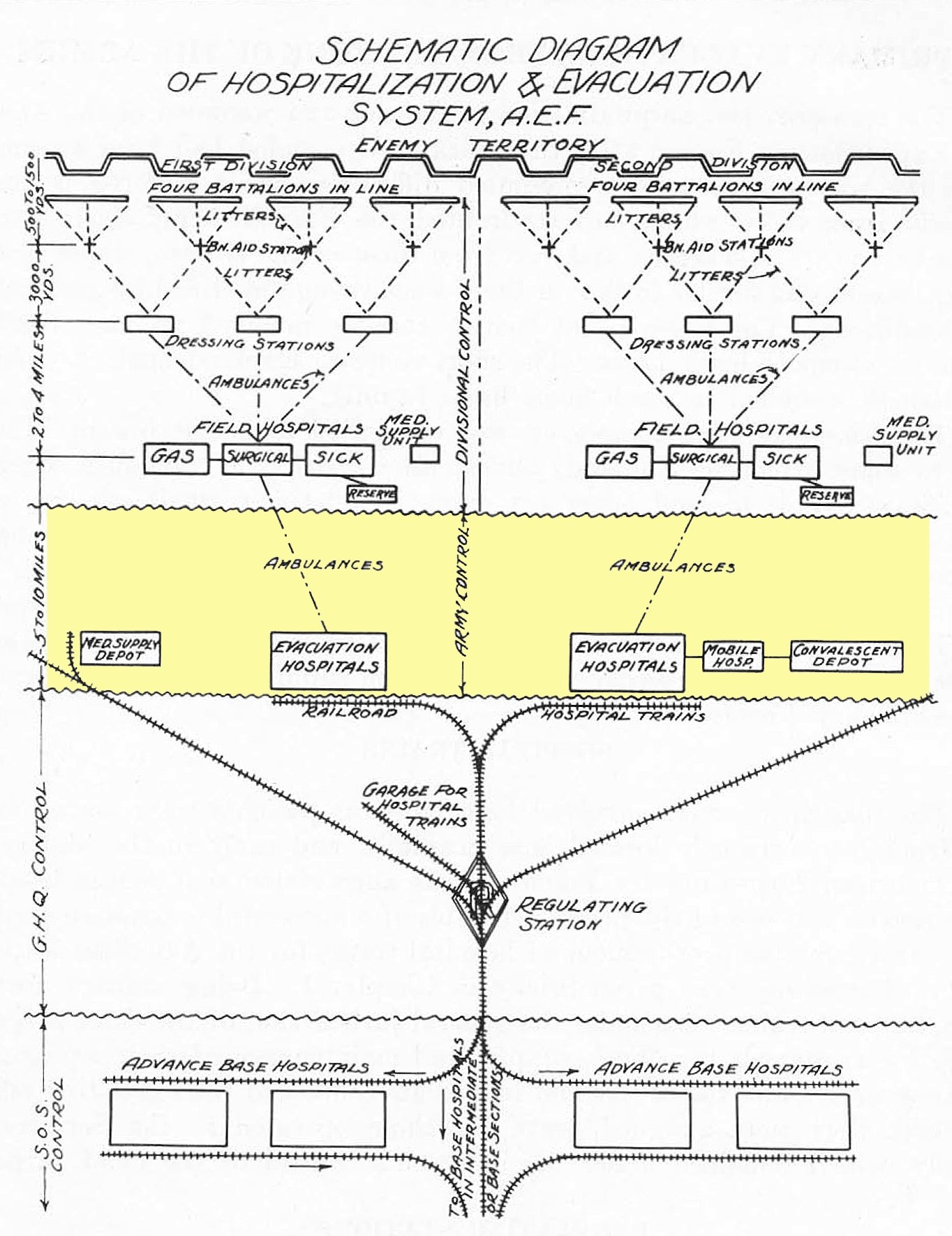
The Medical Department implemented their system by dividing the delivery of medical care into two commands, the Zone of the Armies and the Services of Supply. The accompanying diagram from the Medical Department’s official history illustrates the two commands. The diagram shows the Zone of the Armies was an area located up to 10 miles from enemy territory. All medical units in this area were exposed to enemy weapons and air attacks. The diagram also identifies the distances and names for medical units whose purpose was to provide the delivery of medical care that were under ‘Divisional Control’ and those that were under ‘Army Control’
At 500 to 1500 yards from the front line were the three Battalion Aid Stations of the Regimental Aid Station. At 300 yards from the Battalion Aid Stations were the Ambulance Section Dressing Stations, operated by the infantry division’s Sanitary Train. Next, at 2 to 4 miles from the dressing stations, were the four Field Hospitals of the Sanitary Train. These medical units varied in size, but all acted within a system that progressively treated and evacuated the sick and wounded.
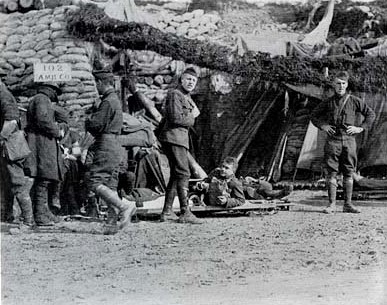
Dressing Station, 26th Division, near Samogueux, Muse, October 23, 1918
If it was determined by a physician that the sick or wounded solider must receive more care, then he would be transported from the divisional medical units via a motor or horse drawn ambulance to larger and more sophisticated medical units that operated under ‘Army Control’. These higher units, as the diagram shows, were the Evacuation Hospitals located between 5 to 10 miles from the Field Hospitals. These in turn were connected to the next level of care that was provided by the large Services of Supply base hospitals via Hospital Trains.
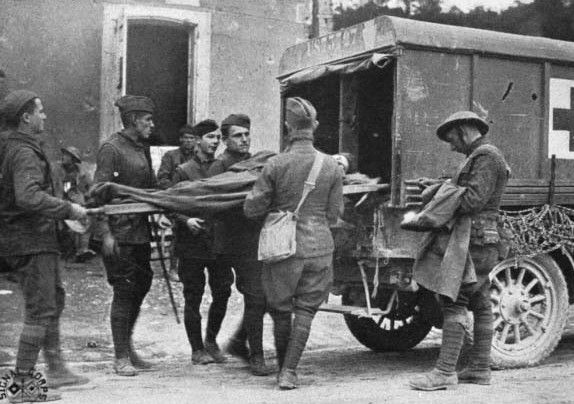
Unloading Wounded Patients at Field Hospital No. 28, Varennes, Muse, October 2, 1918
Sources
Gillett, Mary C. The Army Medical Department 1917-1941, Center of Military History United States Army (Washington, DC, 2009)
Jaffin, Jonathan H (Colonel). Medical Support for the American Expeditionary Forces in France during the First World War (Fort Leavenworth, 1990)
Field Operations. Volume VIII in The Medical Department of the United States Army in the World War (Washington, DC, 1925)
General Surgery, Volume XI, Section I, in The Medical Department of the United States Army in the World War (Washington, DC, 1925)