



























The 325th Field Signal Battalion:
Elite African American World War I Soldiers
By Paul LaRue, Ohio WWI Centennial Commemoration Committee
October 2, 2018
Nearly 400,000 African Americans served in World War I. One of the elite groups of African American Soldiers was the 325th Field Signal Battalion. Organized at Camp Sherman in Chillicothe, Ohio, the Battalion was composed of men from 35 states and the District of Columbia. Ohio was well represented, though Georgia had the most soldiers in the Battalion. Other states supplying significant numbers of men to the 325th included: Massachusetts, Texas, New York, Pennsylvania, and the District of Columbia. The 325th was considered to be one of the best educated battalions in the Army. Many soldiers in the 325th were graduates of the nation's best colleges and universities. On June 10, 1918, four hundred and forty-four members of the 325th sailed from Hoboken, New Jersey on the U.S. Navy Transport (U.S.N.T.) Orizaba for France.
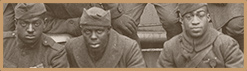
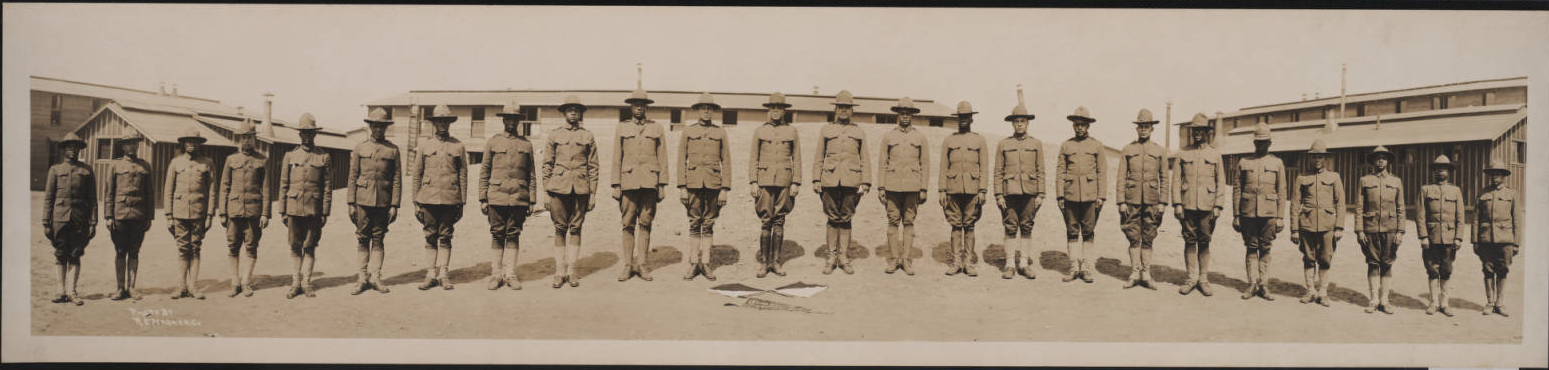 Panoramic photo of men belonging to the 325th Field Signal Battalion at Camp Sherman. In front of the group, semaphore flags are arranged to look like the Signal Corps emblem above a Cam Sherman pennant. Ohio Memory World War I Collection.
The Signal Corps was responsible for creating and maintaining communications for the Army. Advances in technology had created new communication methods such as the telephone, radio, and aerial mapping, but the Signal Corps still depended on traditional communication methods such as carrier pigeons and semaphore flags. The Field Signal Corps maintained communications between the front lines and the division headquarters. The 325th Field Signal Battalion was part of the 92nd Division. The 325th was divided into three companies: Co. A was the radio company, Co. B was the wire company, and Co. C was the outpost company. Collectively, the three companies worked to create and maintain lines of communication. Often this meant operating under enemy fire. The 325th functioned efficiently and bravely. By the end of the war, the 325th was the recipient of General Order Number 38 from Colonel Allen J. Greer, recognizing the exceptional bravery of two soldiers from the 325th.
Ohio's role in the 325th Field Signal Battalion was highlighted to me as I was researching this exceptional group of soldiers. I initially came across the name of Corporal Earl Belsinger, Co. A, 325th Field Signal Battalion, while researching World War I veterans buried in the Union Baptist Cemetery in Cincinnati. This piqued my curiosity about the names of other Ohioans that served in the 325th. A friend of mine, who is a much better genealogist than am I, showed me the records of the names of the men from 325th being transported on the Orizaba. This record listed the names and addresses of the men in the battalion. It was a pleasant surprise to read the name of Private John H. Burns, Co. C, from my hometown of Washington Court House, Ohio. I guess this reinforces the message that these forgotten heroes are literally in our own backyard! I hope the World War I Centennial encourages you to see what connections are in your community. The Ohio History Connection has just released a lesson plan on World War I and technology that includes information on the 325th Field Signal Battalion.
http://www.ohiohistoryhost.org/ohiomemory/wp-content/uploads/2018/11/TechnologyWWI_NEHLessonPlan.pdf
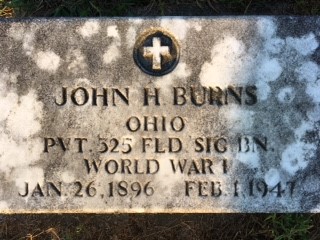 Grave marker of John Burns, who served with the 325th Field Signal Battalion
Sources used for this post
Books:
1.) Circuits of Victory by A. Lincoln Lavine
2.) Getting the Message Through by Rebecca Robbins Raines
3.) The American Negro in the World War by Emmett J. Scott
Newspapers:
The Camp Sherman News: January 10, 1919
Miscellaneous Documents:
1.) Passenger list USNT Orizaba June 9, 1918
2.) Washington Cemetery Records (email to/from Cemetery Supt.)
3.) The Official Roster of Ohio Soldiers, Sailors and Marines in the World War 1917 - 1918 (various volumes)