

































Delivery of Medical Care on the Battlefield
Corps and Army Levels
The sick and wounded who required more medical care, as identified by the physicians of the field hospitals, were transported to a hospital located at the next level of the Medical Department’s system for treatment and evacuation. As seen in the diagram below, this consisted of hospitals located within the command and control of the corps and armies. These facilities were located 5 to 10 miles from the field hospitals. Patients were generally transported by motor ambulances.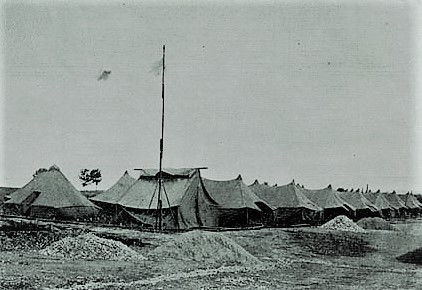 Evacuation Hospital No 1, Under Canvas
This level was the intersection between the forward area medical units and the rear area’s base hospitals that were reached via hospital trains. This level was one of the most complex layers of patient care in the system. It is here that the sick and wounded received more sophisticated treatment, including both life-saving and definitive surgery, that could not be performed by the division’s field hospitals.
The transition from the division-level medical units to the corps-army facilities, and subsequently on to the base hospitals, was carried out by a detailed and comprehensive medical plan. These plans were made in advance of an offensive operation and were situational, Medical units that were assembled were done so to meet the anticipated casualties. At the conclusion of the battle they were reassigned to a new location for the next offensive. The old mililtary adage still applied: "No plan survives contact with the enemy." At best, the plans served to bring all needed medical assets to bear in the area of the battle. But extensive adaptation and improvisation was always required.
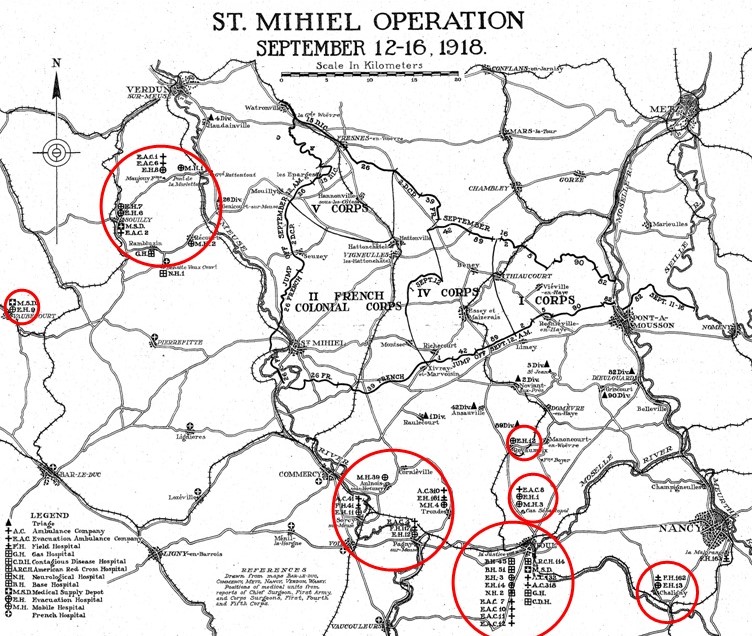 An illustration of plans for an operation was the one prepared by the First Army’s Chief Surgeon Colonel Alexander Stark for the St. Mihiel Operation from September 12-16, 1918. The accompanying map shows the medical units with their locations on the eve of the battle. For this offensive the units were at between 9 to 15 miles behind the front line and although out of range of all but long range guns, although they were vulnerable to attack from German aircraft. The figure shows placement of the following types of medical units:
- Evacuation ambulance companies: 9
- Corps level ambulance companies: 4
- Corps level field hospitals: 4
- Medical supply depots: 3
- Gas hospitals: 2
- Contagious disease hospital: 1
- Neurological hospitals: 2
- Mobile hospitals: 5
- American Red Cross hospital: 1
- Evacuation hospitals: 10
- Base hospitals: 2
This list also illustrates how by late 1918 the Medical Department was designating certain hospitals to receive specific patients, such as gas, contagious diseases and neurological cases. The department found that by establishing hospitals for one type of patient at this level they could concentrate specialists with experience in treating these cases and thus improve their delivery of care.
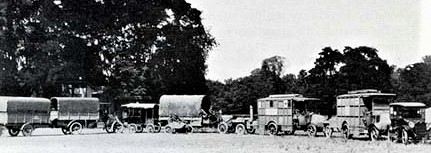
Mobil Hospital 2, Loaded on TrucksThe five mobile hospitals illustrates the department’s experimentation with a new type of unit. It was based on French Auto-chir and was designed to deliver lifesaving surgery close to the front. This small mobile hospital was a dedicated surgical unit that possessed specialized equipment and vehicles, so it could be rapidly deployed where needed. This new unit was not fully integrated into the system for delivering care on the battlefield and so by the end of the war the twelve units that were created treated only 1% of the wounded. In later wars, and currently, mobile hospitals and forward surgical teams are important components of the overall medical effort, with the difference that they are now fully integrated into the casualty care system..
By contrast, the ten evacuation hospitals were fully integrated. They were tasked to receive the majority of patients evacuated from the field hospitals. These units were so essential to the task of delivering life-saving surgery, and in such short supply, that base hospitals 45, 51 and a Red Cross hospital were designated to function as evacuation hospitals.
The map also shows where the units were placed. The largest clusters were at the rear of I and IV Corps, which were to carry the main attack. It was anticipated that this action would result in 33,000 casualties over four days. And because these hospitals were not designed to retain their patients for a full recovery, they were placed on rail lines, such as at Toul, so their patients could be evacuated within fourteen days to the next level and final stage of care at a base hospital in the rear area, under the command of Services and Supply..
Sources: Corps and Army Levels
Jaffin, Colonel Jonathan H. Medical support for the American Expeditionary Forces in France during the First World War (Fort Leavenworth 1990)
Volume VIII, Field Operations, The Medical Department of the United States Army in the World War (Washington, 1925)
Volume XI, Section I, General Surgery, The Medical Department of the United States Army in the World War (Washington, 1925)