|
|
|
|
|
|
'To Honor and Remember" state-level WWI Centennial Summit Meeting held at Pritzker Military Museum and Library in Chicago
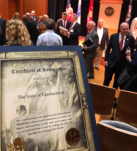
On October 1st, the Pritzker Military Museum and Library (PMML) and the U.S. World War I Centennial Commission (WW1CC) co-hosted a unique event in Chicago -- a summit meeting of the various State-level Centennial Committees from around the entire United States. Events were designed to recognize the contributions by each organization in honoring the centennial of World War I throughout the U.S. Over twenty state-level organizations were represented at the summit. The following day, Tuesday, October 2nd, was the U.S. World War I Centennial Commission's 19th Quarterly Commission Meeting. Click here to read more about this two-day centennial commemoration confab in Chicago.
|
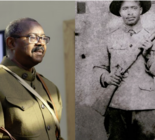
On October 13th at the U.S. Army Training Center (TRADOC), at Fort Jackson, in Columbia, SC Brigadier General Milford H. Beagle, Jr., Commanding General, will host a Purple Heart Presentation Ceremony in honor of Sergeant Perry Loyd, a deceased World War I Veteran. Sergeant Loyd never received his Purple Heart, which was secured a few years ago by his grandson, Perry James. Mr. James will accept the medal in honor of SGT Loyd. The saga of SGT Loyd, and of Perry James' research into his grandfather is a remarkable one. Click here to read the entire fascinating story.
|
"We gave him a few resources, and a few opportunities. Magician that he was, David Shuey spun them into gold."

For four years, David Shuey, "The History Teller," performed as the U.S. WWI Centennial Commission's "General Pershing" in over fifty events, all across the United States. He played in Kansas City at the National WWI Museum & Memorial, Chicago at the Pritzker Military Museum & Library, New York City for the Veterans Day Parade, and for the Camp Doughboy, Baltimore for their living history days, Atlanta, Wisconsin, North Dakota, and on and on. Washington DC -- for four more parades, and for a host of major official events, and conventions. Sadly, The General recently lost his own personal battle with cancer. Chris Isleib, the Centennial Commission's Director of Public Affairs, tells us more about a remarkable historian who made an indelible mark on his nation's commemoration of the Centennial of World War I.
|
From the World War I Centennial News Podcast
Spotlight On The Media:
Colonel Douglas Mastriano

In September 28th's WW1 Centennial News Podcast, Episode 91, host Theo Mayer spoke with veteran, military historian and author Colonel Douglas Mastriano about his new book, Thunder in the Argonne. The book explores the greatest battle in American history from a variety of perspectives and brings to light some of its more obscure heroes. Click here to read a transcript of the interview.
|

Episode #92
Highlights:October 1918 Overview
Host: Theo Mayer
October 1918 Overview Roundtable - Dr.Edward Legel & Katherine Akey | @03:55
Historians Corner: Lost Battalion - Ron Laplander | @20:00
Shifting sands and hard fighting - Mike Shuster | @26:40
Commission News: Honor & Remember in chicago - Host | @31:24
Commission News: Bells of Peace update - Host | @32:15
State Profile: Georgia - Dr. Tom Jackson | @33:40
Remembering Veterans: Story of John Foster - Mark Foster | @41:10
US Army CMH WWI Website - Dr. Erik Villard | @47:20
Spotlight On The Media 1: Dr. Edward Lengel | @52:40
Spotlight On The Media 2: Lost Battalion Documentary - Mark Fastoso & John King | @55:20
WWI War Tech: Pigeons - Host | @60:00
Articles & Posts: Weekly Dispatch - Host | @65:05
The Buzz: Selections from Social Media - Katherine Akey | @67:45
|
War, Not Allegory: WWI, Tolkien, and The Lord of the Rings
Why, in all the years since its publication in 1954, has J.R.R. Tolkien’s epic, The Lord of the Rings, never found its way onto any “Best-Of” lists of war literature? Why, in spite of the overwhelming number of parallels, has it never counted among the greatest novels to emerge from the events of World War I? Rachel Kambury, a publishing professional specializing in war and literature and military history, argues that The Lord of the Ringsis not allegory but war story in its own right. A WWI story. Read Kambury's enlightening post, "War, Not Allegory: WWI, Tolkien, andThe Lord of the Rings" at WWrite this week!
|
The legacy of "Denial"
What does Brian Turner's "Here, Bullet," written during the Iraq War, share with Rupert Brooke's "The Soldier" and the poem "Denial" written by a Scottish tank commander in WWI? Dr. Connie Ruzich discusses connections in the latest blog post from Behind Their Lines.
|
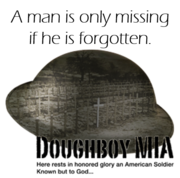
A man is only missing if he is forgotten.
Monday's MIA this week is Private Charles Bates Jeffries, born in Ohio on July 21st, 1892, where he was drafted on May 31st, 1918. He was a member of Battery C, 15th Field Artillery Replacement Draft out of Ft. Jackson, South Carolina and with them went to France on July 21st, 1918. ‘Over There’ he was assigned to Battery D, 305th Field Artillery, 77th Division. With them he served during the Vesle River campaign and then in the Meuse-Argonne. During the campaign in the Argonne, Jeffries was assigned runner duties as part of a three man artillery spotter mission that was sent forward to work with the 308th Infantry Regiment and with them was killed as a member of the famous ‘Lost Battalion’. During a mistaken barrage on the unit by American artillery on October 4th, 1918, Private Jeffries was observed by his commanding officer, Lt. John Tiechmoeller, running toward his funk hole as the shells crashed down around them. He was not seen afterwards that anyone could recall. Following the relief of the ‘Lost Battalion’ on October 8th, Lt. Tiechmoeller went looking for Jeffries, but all he found was his blown in funk hole, which had taken a direct hit by an artillery shell. Nothing further of Private Jeffries was ever found.
Would you like to help us solve this case? Give 'Ten For Them' to Doughboy MIA and help us make a full accounting of the 4,423 American service personnel still listed as missing in action from WW1. Make your tax deductible donation now, with our thanks.
|

An easy and inexpensive way to let the world know what year it is!
Featuring the iconic Doughboy silhouette flanked by barbed wire so prevalent during WWI, you can proudly display this poignant reminder of the sacrifices made by U.S. soldiers.
This and many other items are available as Official Merchandise of the United States World War One Centennial.
|

|
|
|
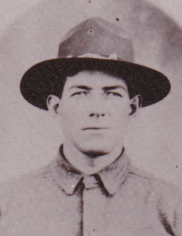
Submitted by: Eric Wiech {Great Grandson}
George Washington Willard born around 18 Dec. 1892, George Willard served in World War 1 with the United States Army. The enlistment was in 1917 and the service was completed in 1919.
Story of Service
Pvt. George Washington Willard was born on December 18, 1892, in Madison, SD. His mother died when he was six. Soon after, he and his younger brother were placed in the Sioux Falls children’s home. From there, he was sent to live with a family that was quite poor. He worked long hours at farm labor, was fed little, slept in a bed bug-infested bed, only had socks hired men threw away, and had little schooling for two years. When he was constantly late for the little schooling he received, his teacher asked him why. After he explained, the teacher contacted the children’s home, which sent two women to check on his conditions. They immediately removed him from the home. He was placed into another foster home and lived/worked there until he was 17.
Pvt. Willard was drafted into the Army on the 20th of September, 1917, when he was 24. On May 11, 1918, he would sail from New York, NY to Liverpool, England. Listed as his “in case of emergency” contact is a “friend” from Summit, SD, Miss Agnus Swanson.
|
|
|
|
|




























 Signature Events Major Moments
 Video Streaming video resources
 Publications Dispatch, Sync-Call and more