





























Songs for the Soldiers
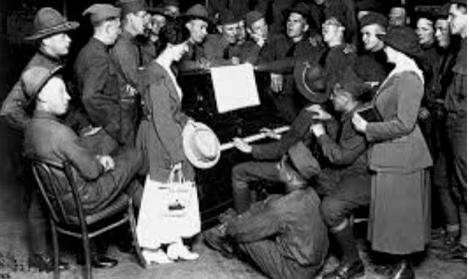
The National Committee was charged to publish an official songbook to be distributed to song leaders, officers, and soldiers. The purpose was to familiarize the soldiers with army songs and encourage their singing. Thus, the first song book was published in the fall of 1917. In this page, you will find all the songs in the songbook with descriptions on how they relate to the American war effort.
Initially entitled Songs of the Soldiers and Sailors U.S., the first edition was a collection based on those that “were then popular in the camps, together with others of sure appeal and true value.”15 The song leaders wanted more songs published with music notation since the first edition only included text.16 They asked Lee Hamner, leader of the military entertainment committee of CTCA, for a revised edition. In 1918, the second edition was published and was renamed Army Song Book. Songs were chosen in accordance with the song leader’s reports about a song's popularity. Songs chosen “endeavored to include a fair proportion of songs according to the following classification: national and patriotic songs, folk songs, popular songs of the day, and hymns.”17 Lyrics expressed six recurring themes: “patriotism, God and religion, love and women, rustic home and nostalgia, the soldier routine, and death.”18
Loosely bound in khaki colored paperback, this 3 ½” x 5” 100-page song book is small enough to fit in a soldier’s uniform pocket. There are eighty-two songs, seventy-nine of which are simple melodic lines with lyrics. “The Star-Spangled Banner” and “Under the Stripes and Stars” contain simple harmonizations while meter and key signatures are indicated for each selection. Style symbols are predominantly reserved for phrase markings. The songs are categorized into four types: 18 national and patriotic songs, 14 folk songs, 36 popular songs, and 14 hymns. Most songs were taught to the soldiers, but the following eight were selected that all men were to learn: “America,” “The Star-Spangled Banner,” “The Battle Hymn of the Republic,” “Old Black Joe,” “Swanee River,” “My Old Kentucky Home,” “Roll, Jordan, Roll” and “La Marseillaise,” the French national anthem.19 Including a foreign anthem represented the War Department’s goal of unifying soldiers from diverse backgrounds - fellow Americans with foreign heritage and the Allied forces. “La Marseillaise” was so popular that Music in the Camps published a phonetic spelling of the French text to help song leaders with the pronunciation.20
The subject of the songs clearly represented the objectives of the CTCA: to encourage men to fight efficiently.21 The CTCA wanted to create a singing crusade of soldiers and that America was sending soldiers to “a war against militarism, a war to redeem a barbarous Europe, a crusade.”22 America’s focus was to win the war. For the first time, the government recognized the importance of music as a medium for propaganda and as a tool for training. According to the Commission’s report, the soldiers were “grabbing” or “eating up” the songs in the book.23 Clearly, soldiers loved singing, but these reports were published by the National Committee that had an incentive to be biased since they wanted their programs to be successful and favored positive stories for publishing. What then did the soldiers sing?
To find out, ask a veteran. Check out John J. Niles' The Songs My Mother Never Taught Me.
Where applicable, click on the link below each score to access a recording of the song.
Notes:
15. Camp Music Division, p.12
16. Chang, p.35
17. Camp Music Division, p.42
18. Reed, p.118
19. Chang, p.38
20. Music in the Camps, Nos. 41 and 42
21. The initial reason for including singing and other CTCA activities into military training was to provide troops alternatives with constructive recreational activities and discourage them from enlisting the services of prostitutes. The effectiveness of this program is still under debate, but the significance of the singing program should not be underestimated. After all, veterans claimed in interviews after WWI that the singing experience was appreciated by many soldiers and there was no harm in encouraging them to sing.
For more information on camp music singing, this article by Morgan-Ellis discusses Warren Kimsey's career as the first song leader assigned to Camp Gordon, an army training camp. Morgan-Ellis, Esther M. "Warren Kimsey and Community Singing at Camp Gordon, 1917-1918." In Journal of Historical Research in Music Education Vol. 39, no. 2 (2018): 171-94.

http://www.library.ucsb.edu/OBJID/Cylinder8575
O say can you see, by the dawn's early light,
What so proudly we hailed at the twilight's last gleaming,
Whose broad stripes and bright stars through the perilous fight,
O'er the ramparts we watched, were so gallantly streaming?
And the rockets' red glare, the bombs bursting in air,
Gave proof through the night that our flag was still there;
O say does that star-spangled banner yet wave
O'er the land of the free and the home of the brave?
On the shore dimly seen through the mists of the deep,
Where the foe's haughty host in dread silence reposes,
What is that which the breeze, o'er the towering steep,
As it fitfully blows, half conceals, half discloses?
Now it catches the gleam of the morning's first beam,
In full glory reflected now shines in the stream:
'Tis the star-spangled banner, O long may it wave
O'er the land of the free and the home of the brave.
O thus be it ever, when freemen shall stand
Between their loved homes and the war's desolation.
Blest with vict'ry and peace, may the Heav'n rescued land
Praise the Power that hath made and preserved us a nation!
Then conquer we must, when our cause it is just,
And this be our motto: ‘In God is our trust’
And the star-spangled banner in triumph shall wave
O'er the land of the free and the home of the brave!
When the United States joined the war in 1917, the country did not have a national anthem. Congress only recognized the “Star Spangled Banner” as the national anthem in 1931. Written by Francis Scott Key during the War of 1812 while he was aboard the HMS Tonnant negotiating the release of three American prisoners, the "Star-Spangled Banner" was the product of Key's inspiration as he watched the British bombardment of Fort McHenry on the night of September 13 – 14, 1814. At dawn, when the bombardment stopped, Key saw the American flag still waving atop Fort McHenry and realized that the fort was still in American hands. He was inspired to write a poem describing his experience entitled, “Defense of Fort McHenry” that was published in Baltimore on September 17, 1814. Set to a popular tune of the day, “To Anacreon in Heaven,” Key used this same tune as the setting for his 1805 song “When the Warrior Returns” to celebrate the return of American soldiers from the First Barbary War.
Prior to America’s entry into World War I, H.C. Colles published an article in 1915, “National Anthems: Their Birth and Parentage” which discussed a compilation of national anthems from the Allied perspective. No part of the article, however, mentioned the “Star Spangled Banner” even in passing. America had yet to proclaim its official national anthem. With the rise of nationalism across the globe, the business of creating national tunes was becoming crucial for citizens to identify with. Indeed, Oscar Sonneck, the head librarian of the music division of the Library of Congress, issued an “Exhaustive Official Inquiry” regarding America’s national songs in 1909. This report was revised and issued again in 1914 entitled "The Star-Spangled Banner" and a review of the report was published in the Musical Times in March 1915 by Frank Kidson.
The song gained popularity throughout the 19th century and bands performed it during public patriotic events. A plaque at Fort Meade, South Dakota, claims that soldiers stationed at the fort began using the “The Star-Spangled Banner” as a national anthem during parade drill as early as 1892. In 1899, the U.S. Navy officially adopted the song as its fight song. In 1916, during a time of upsurge in patriotic song production, President Wilson signed an executive order designating “The Star-Spangled Banner” as the national song for all official military use.
Although many people called for the designation of a national anthem, there were people who objected the “Star Spangled Banner.” They argued that the tune was not suitable as a national anthem. One of the most vocal critics was Kitty Cheatham who privately published a pamphlet in 1918 entitled, Words and Music of “The Star-spangled Banner” Oppose the Spirit of Democracy Which the Declaration of Independence Embodies. She argues that the words were inappropriate in the present conflict because it was written at a time “when disruption threatened to separate nations and in which sentiments are opposed to the oneness we must finally attain, viz., the inseparable unity of Great Britain and America.” She further notes that the words were set to music originally used as a drinking-song. Published during a time when prohibiting the sale of alcohol was being debated (Wartime Prohibition Act and the 18th Amendment), this pamphlet would have resounded well to moralists who favored banning the sale of liquor. Her entire argument was concluded in one sentence, “This country will not be free until she expresses herself in her own anthem, which will be born of American high ideals."
Despite calls for deposing the “Star Spangled Banner” as a national anthem, the song enjoyed continued popularity throughout the war. This issue was heavily debated during the Harding and Hoover administrations and was officially recognized by Congress as the national anthem in 1931. As requested by the Commission on Training Camp Activities, Frederick Converse collaborated with John Alden Carpenter in completing an orchestral arrangement of the Star Spangled Banner. Carpenter also weighed in on the argument over authenticity when he explained to Carl Engel that the Committee on Army and Navy Camp Music ruled out “historic authenticity, for the simple reason that the American People have no interest whatever in ‘authenticity’ and will proceed to sing the song the way they are used to singing it regardless of every document that can be produced to the contrary.” Premiered by the Boston Symphony Orchestra on August 26, 1918, the arrangement by Converse and Carpenter was used also by other orchestras during the war and was still being used by the Boston Symphony as late as 1942.
http://www.library.ucsb.edu/OBJID/Cylinder0077
My country, ' tis of thee,
Sweet land of liberty, of thee I sing;
Land where my fathers died!
Land of the pilgrims' pride!
From ev'ry mountainside Let freedom ring!
My native country, thee,
Land of the noble free, Thy name I love;
I love thy rocks and rills,
Thy woods and templed hills;
My heart with rapture thrills, like that above.
Let music swell the breeze,
And ring from all the trees sweet freedom's song;
Let mortal tongues awake;
Let all that breathe partake;
Let rocks their silence break, the sound prolong.
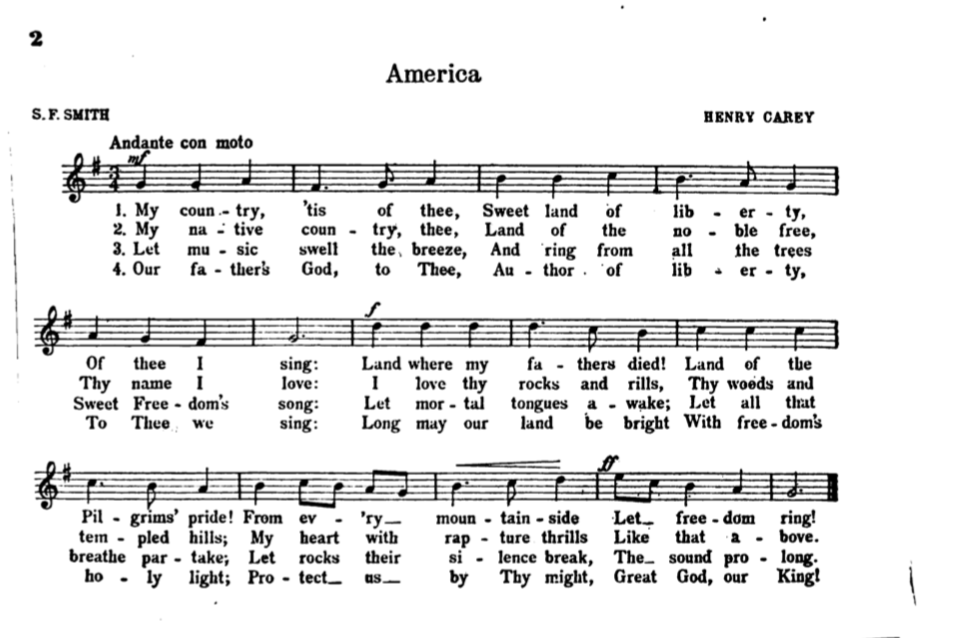
The lyrics for “America” or “My Country ‘Tis of Thee” was written by Reverend Samuel Francis Smith and set to a pre-existing tune in 1831. First published in 1832, the song was frequently played in the absence of a national anthem. The origin of the song’s melody is disputed, but it is commonly accepted that the tune originated from Europe. Before the melody made its way to the United States, it was already being played in England as early as 1744 as “God Save the King.” By the 1790s, the melody was being used as the Danish national anthem “A Song to be Sung by the Danish Subjects at the Fete of their King, to the Melody of the English Hymn.” The melody was also used as the national anthem in other countries including Prussia and Liechtenstein.
The first documentation of this song in the American British colonies dates from 1761 with the lyrics of “God Save the King” with slightly modified lyrics. It became known as “Whitefield’s Tune,” published in Urania, a collection of sacred songs compiled by James Lyon.
After independence from Britain, the melody was kept intact and the words were adapted for American patriotic use. As he arrived in New York City for his first inauguration in April 1789, George Washington was greeted by crowds singing this tune with different lyrics.
Hail, thou auspicious day!
For let America
Thy praise resound.
Joy to our native land!
Let every heart expand,
For Washington's at hand,
With glory crowned.
Thrice beloved Columbia, hail!
Behold before the gale
Your chief advance.
The matchless Hero's neigh;
Applaud him to the sky,
Who gave you liberty,
With gen'rous France.
In 1831, Samuel Francis Smith wrote the words, that eventually became a tradition to be recited in U.S. schools. His friend, Lowell Mason, had some German school music books that had this tune (Heil dir im Siegerkranz) and asked Smith to either translate the German or write a new text for it. Smith wrote the new lyrics and Mason debuted it at a children’s service at the Park Street Church in Boston, Massachusetts on July 4, 1831.
The tune for this song would have been familiar to both Allied and Central Powers during the war. The soldiers would have sung this song since childhood. It is interesting to note that there were no protests in singing this song or including it in the song book even though the Germans utilized it as well.
https://www.loc.gov/item/ihas.200000012
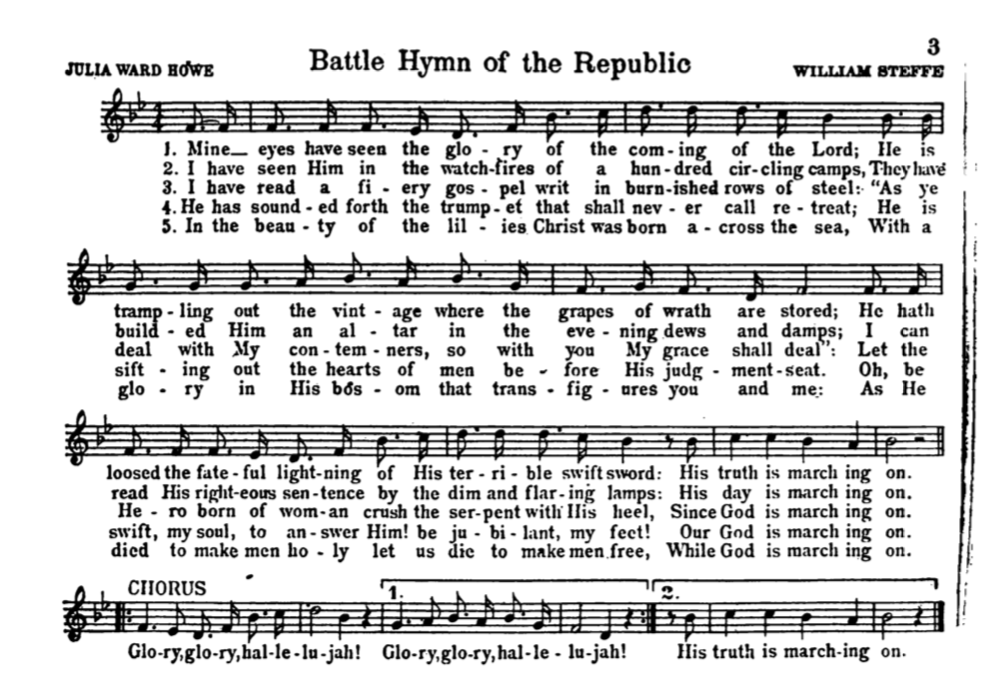
http://www.library.ucsb.edu/OBJID/Cylinder0587
Mine eyes have seen the glory of the coming of the Lord
He is trampling out the vintage where the grapes of wrath are stored
He hath loosed the fateful lightning of His terrible swift sword
His truth is marching on
(Chorus)
Glory, Glory, hallelujah!
Glory, glory, hallelujah!
Glory, glory, hallelujah!
His truth is marching on
I have seen Him in the watch-fires of a hundred circling camps
They have builded Him an altar in the evening dews and damps
I can read His righteous sentence by the dim and flaring lamps
His day is marching on.
(Chorus)
Glory, Glory, hallelujah!
Glory, glory, hallelujah!
Glory, glory, hallelujah!
His truth is marching on
I have read a fiery gospel writ in burnished rows of steel
"As ye deal with my contemners, so with you my grace shall deal"
Let the Hero, born of woman, crush the serpent with his heel
Since God is marching on
(Chorus)
Glory, Glory, hallelujah!
Glory, glory, hallelujah!
Glory, glory, hallelujah!
His truth is marching on
He has sounded forth the trumpet that shall never call retreat
He is sifting out the hearts of men before His judgment-seat
Oh, be swift, my soul, to answer Him! Be jubilant, my feet!
Our God is marching on
(Chorus)
Glory, Glory, hallelujah!
Glory, glory, hallelujah!
Glory, glory, hallelujah!
His truth is marching on
In the beauty of the lilies Christ was born across the sea
With a glory in His bosom that transfigures you and me
As He died to make men holy, let us die to make men free
While God is marching on
(Chorus)
Glory, Glory, hallelujah!
Glory, glory, hallelujah!
Glory, glory, hallelujah!
His truth is marching on
In November 1861, during a visit to a Union Army camp at Bailey’s Crossroads, Julia Ward Howe was inspired to write the lyrics of this song and set them to music after hearing “John Brown’s Body.” Written in 1856 during the Civil War, Steffe’s “John Brown’s Body” was also a transcription of a religious camp-meeting song that opened with “Say, brothers, will you meet us / on Canaan’s happy shore?” with the traditional refrain, “Glory Hallelujah”
On her visit to the camp, Howe was accompanied by her husband Samuel Gridley Howe and Rev. James Freeman Clarke when she first heard the soldiers singing "John Brown's Body." Clarke suggested that Howe adopt the song and write better lyrics for it. Howe relates in her memoir what happened the following morning:
“I went to bed that night as usual, and slept, according to my wont, quite soundly. I awoke in the gray of the morning twilight; and as I lay waiting for the dawn, the long lines of the desired poem began to twine themselves in my mind. Having thought out all the stanzas, I said to myself, "I must get up and write these verses down, lest I fall asleep again and forget them." So, with a sudden effort, I sprang out of bed, and found in the dimness an old stump of a pen which I remembered to have used the day before. I scrawled the verses almost without looking at the paper.” (Howe, p. 275.)
Little did she know that those words would be enshrined in American history.
The “Battle Hymn of the Republic” is a call to arms and vividly portrays how America fights wars. As a crusader’s cry, this song has been used in grave crises and crucial social movements. However, the song had the greatest resonance when used in wartime. During World War I, the song again reverberated around the nation and added the words: "We have heard the cry of anguish from the victims of the Hun." The “Battle Hymn of the Republic” is a mirror of American society.
(Howe, Julia Ward. Reminiscences: 1819–1899. Houghton, Mifflin: New York, 1899. p. 275.)
https://www.theatlantic.com/entertainment/archive/2010/11/the-battle-hymn-of-the-republic-americas-song-of-itself/66070/
https://www.washingtonpost.com/local/how-julia-ward-howe-wrote-battle-hymn-of-the-republic--despite-her-husband/2011/11/15/gIQAnQRaYN_story.html?utm_term=.6ebe5d8212e5
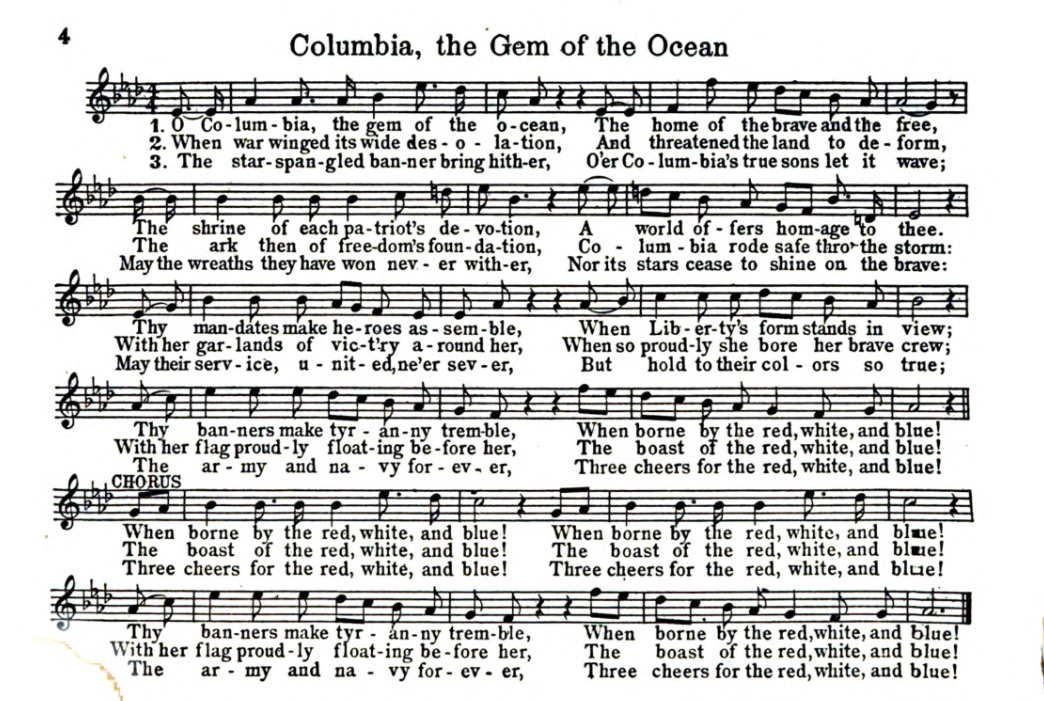
http://www.library.ucsb.edu/OBJID/Cylinder11041
O Columbia! the gem of the ocean,
The home of the brave and the free,
The shrine of each patriot's devotion,
A world offers homage to thee;
Thy mandates make heroes assemble,
When Liberty's form stands in view;
Thy banners make tyranny tremble,
(Chorus)
When borne by the red, white, and blue.
When borne by the red, white, and blue,
When borne by the red, white, and blue,
Thy banners make tyranny tremble,
When borne by the red, white and blue.
When war wing'd its wide desolation,
And threaten'd the land to deform,
The ark then of freedom's foundation,
Columbia rode safe thro' the storm;
With her garlands of vict'ry around her,
When so proudly she bore her brave crew;
With her flag proudly waving before her,
(Chorus)
When borne by the red, white, and blue.
When borne by the red, white, and blue,
When borne by the red, white, and blue,
Thy banners make tyranny tremble,
When borne by the red, white and blue.
The star-spangled banner bring hither,
O'er Columbia's true sons let it wave;
May the wreaths they have won never wither,
Nor its stars cease to shine on the brave.
May thy service united ne'er sever,
But hold to the colors so true;
The Army and Navy forever,
(Chorus)
Three cheers for the red, white, and blue!
Three cheers for the red, white, and blue!
Three cheers for the red, white, and blue!
The Army and Navy forever,
Three cheers for the red, white, and blue!
“Columbia, the Gem of the Ocean” was composed in 1843 and was long used as the unofficial American national anthem (Johnston, Arthur (May 1919). "America's National Songs". The High School Journal. 2 (5): 152) and reached extreme popularity during the Lincoln administration. The song was eventually adopted as the standard tune of the U.S. Marine Corps Band.
The originality of the song is debated. Although commonly credited to David T. Shaw, Thomas A’Beckett claimed to have rewritten Shaw’s lyrics before the song was copyrighted. In 1843, Shaw, a singer from Philadelphia, wrote a patriotic poem and commissioned A’Beckett, another musician, to put the words to music. A’Beckett disliked the poem and rewrote the words as he set them to music. Shaw premiered the song soon afterwards and was warmly received by audiences. However, he alone was credited as both composer and lyricist while A’Beckett only as the arranger. A’Beckett contested the authorship and published his own version afterwards.
While A’Beckett may have authored “Columbia, the Gem of the Ocean,” he was accused of plagiarizing Stephen Joseph Meany’s “Britannia, the Pride of the Ocean” Meany wrote “Britannia, the Pride of the Ocean” in 1842, but A’Beckett claimed that Meany plagiarized his song instead. Nonetheless, both songs bear similarity.
During World War I, this song was used by the Four-Minute Men, volunteers for the propaganda effort who brought messages of patriotism to people on the home front. This song was used as an interlude during public gatherings and in local theaters for audiences to actively participate. The Four-Minute Men stressed the effectiveness of group singing declaring that “the Singing Army, whether it be a fighting army or a working army, cannot be beaten.” This song was also quoted by Charles Ives in his Second Symphony, “A Symphony: New England Holidays,” and Piano Sonata No. 2. composed in 1915.
The United States in the First World War: An Encyclopedia p.236
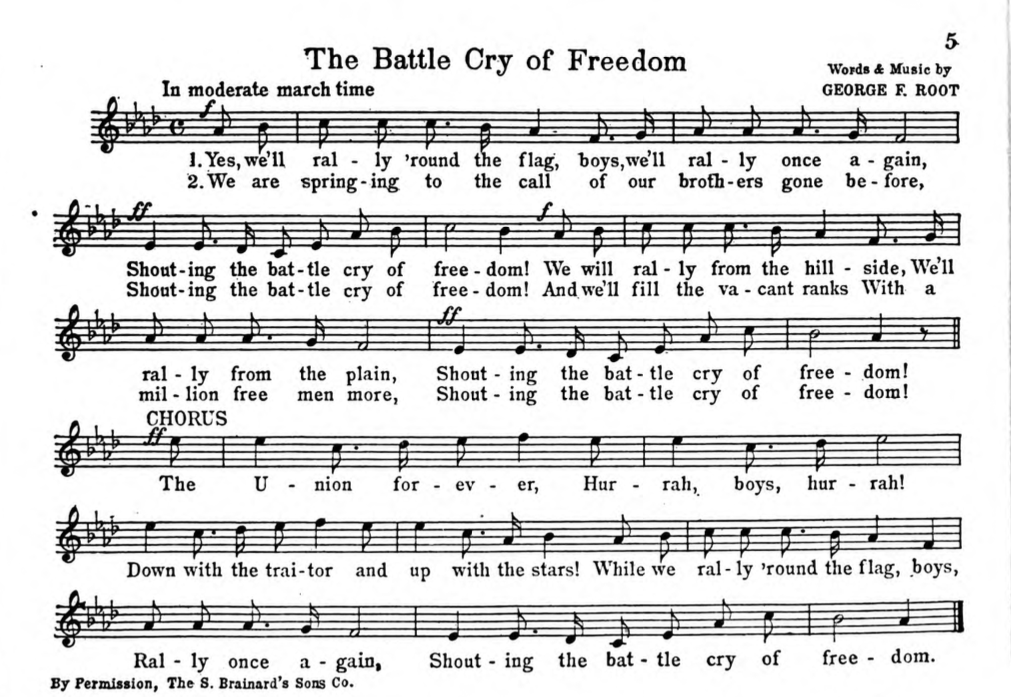
http://www.library.ucsb.edu/OBJID/Cylinder6576
Yes, we'll rally round the flag, boys, we'll rally once again
Shouting the battle cry of freedom
We will rally from the hillside, we'll gather from the plain
Shouting the battle cry of freedom!
(Chorus)
The Union forever! Hurrah, boys, hurrah!
Down with the traitors, up with the stars;
While we rally round the flag, boys, rally once again
Shouting the battle cry of freedom!
We are springing to the call of our brothers gone before
Shouting the battle cry of freedom!
And we'll fill our vacant ranks with a million freemen more
Shouting the battle cry of freedom!
(Chorus)
The Union forever! Hurrah, boys, hurrah!
Down with the traitors, up with the stars;
While we rally round the flag, boys, rally once again
Shouting the battle cry of freedom!
Popularly known as a Civil War era song, “The Battle Cry of Freedom” was written by George Frederick Root as a response to President Lincoln’s call for troops and to advocate the causes of the Union and abolitionism. Although intended for the Union, it was very popular that it was adapted by H.L. Schreiner and W.H. Barnes for the Confederacy. During its popularity, the song was used as a presidential campaign song starting with the Lincoln-Johnson ticket in the 1864 presidential election and after the Civil War.
Henry Stone, a Union war veteran, recalls in a report from 1887 how popular this song was among Union soldiers:
A glee club came down from Chicago, bringing with them the new song, "We'll rally 'round the flag, boys", and it ran through the camp like wildfire. The effect was little short of miraculous. It put as much spirit and cheer into the army as a victory. Day and night one could hear it by every camp fire and in every tent. I never shall forget how the men rolled out the line, "And although he may be poor, he shall never be a slave." I do not know whether Mr. Root knows what good work his song did for us there, but I hope so.
This song was also very popular with civilians and it is reported that Root and Cady, the most popular music publisher during the Civil War, had 14 printing presses running at the same time and could not keep up with the demand. It is estimated that around 700,000 copies were put into circulation by the end of the war.
With freedom as the main subject, this song would have resonated with many Americans during the World War I. Given its popularity before and during the war, many soldiers sent to the front would have been raised hearing this song and thus, very familiar with it.
Henry Stone, The Century Illustrated, "Memoranda on the Civil War: A Song in Camp" (1887)

http://www.library.ucsb.edu/OBJID/Cylinder16605
Allons enfants de la Patrie, Arise, children of the Fatherland,
Le jour de gloire est arrivé! The day of glory has arrived!
Contre nous de la tyrannie Against us, tyranny’s
L'étendard sanglant est levé, (bis) Bloody standard is raised, (repeat)
Entendez-vous dans les campagnes Do you hear, in the countryside,
Mugir ces féroces soldats? The roar of those ferocious soldiers?
Ils viennent jusque dans vos bras They’re coming right into your arms
Égorger vos fils, vos compagnes! To cut the throats of your sons, your women!
Aux armes, citoyens, To arms, citizens,
Formez vos bataillons, Form your battalions,
Marchons, marchons! Let’s march, let’s march!
Qu'un sang impur Let an impure blood
Abreuve nos sillons! Water our furrows!
Composed during the French Revolution by Claude-Joseph Rouget de Lisle, “La Marseillaise” secured its popularity in France and was recognized as the national anthem by the National Convention in 1795. After briefly losing its status during Napoleon’s reign, the song was reinstated as France’s national anthem in 1879.
The lyrics are clearly a call to arms and reflect the invasion of France by foreign adversaries, specifically Prussia and Austria. These countries were at war with France at the time the song was written. On the night of April 25, 1792, only a few days after France declared war on Austria, P.F. Dietrich, the mayor of Strasbourg, asked his guest Lisle to “write for us a song that will rally our soldiers from all over to defend their homeland that is under threat and you will have won the nation.” Lisle responded by writing “La Marseillaise.” Originally entitled “Chant de guerre de l’armée du Rhin” (War Song of the Army of the Rhine), the anthem came to be known as “La Marseillaise” because of its popularity with volunteer army units from Marseille. Indeed, Dietrich recognized that France needed a marching song that could raise the morale of the soldiers.
In the context of World War I, “La Marseillaise” was a rallying cry for cohesion. Prior to the war, the role of the song had a different function. “La Marseillaise” was used in the French Revolution as a political song, but prior to World War I, workers preferred “L’Internationale” composed in 1888. Changes were also observed from Russia. From February to November 1917, “La Marseillaise” was used as the official anthem of the Russian provisional government until the Bolsheviks replaced it with “Internationale.” With France facing increasing tensions from the Central Powers, the French education minister, Maurice-Louis Faure, made it compulsory for “La Marseillaise” to be taught in schools. The song became known as a pledge of French political unity against German aggression during the war. According to a report, the song was sung both in the trenches and civilian areas, café terraces, theaters, and official ceremonies. Intent on keeping this fervor, the ashes of Lisle were exhumed from the cemetery of Choisy-le-Roi, paraded across the streets of Paris, and eventually interred under the Dôme des Invalides in Paris following a formal ceremony on July 14, 1915.
https://www.britannica.com/topic/La-Marseillaise
"La Marseillaise" (in French). National Assembly of France. Archived from the original on 15 May 2012.
http://www.cheminsdememoire.gouv.fr/en/revue/la-marseillaise-past-and-present
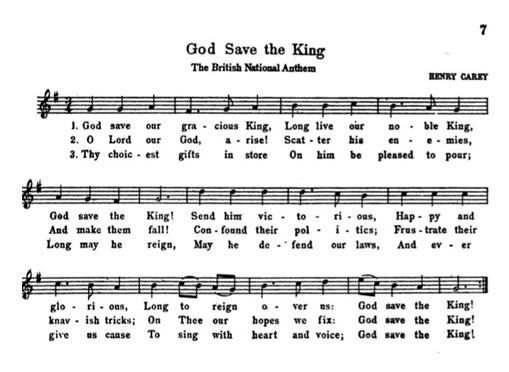
http://www.library.ucsb.edu/OBJID/Cylinder0469
God save our gracious King,
Long live our noble King,
God save the King!
Send him victorious,
Happy and glorious,
Long to reign over us:
God save the King!
O Lord our God arise,
Scatter his enemies,
And make them fall!
Confound their politics,
Frustrate their knavish tricks,
On Thee our hopes we fix:
God save the King!
Thy choicest gifts in store,
On him be pleased to pour;
Long may he reign,
May he defend our laws,
And ever give us cause,
To sing with heart and voice,
God save the King!
Arguably the most widespread national anthem in the world, the British National Anthem, “God Save the King” bears a stately rhythm and well-balanced harmony. Even Germany adopted the song for its own national use. During the war, British tommies singing this song were joined by American doughboys whose “My Country Tis of Thee” had the same tune and Germans had an identical tune with their own “Heil di rim Siegerkranz” (“Hail thee in victor’s crown”). Interestingly, during World War II, “Roll out the barrel” was similarly sung on both sides of the front. Although Nazis claimed it as a German folk song, the lyrics could be traced back to Tin Pan Alley.
The origins of this song are unclear, but it is known that the song was performed publicly in 1745 in two theaters in London. Given its rising popularity, Beethoven published seven variations of the theme in 1807 along with five variations of “Rule Britannia.” Thus, both British and German troops were familiar with the tune well before World War I. With its prayer-like quality, “God Save the King” gave the soldier a chance to reflect on his role of defending his cultural traditions, family, and country.
Nettl, Paul. National Anthems. 2d, Enl. ed. New York: Frederick Ungar Pub, 1967.
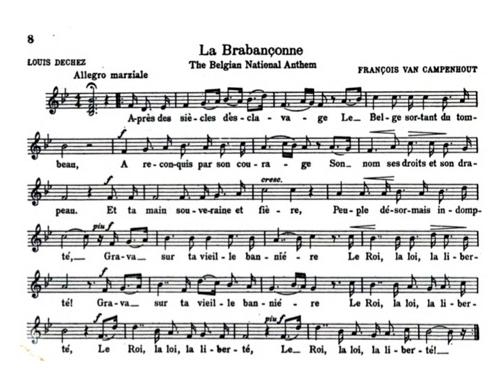
Après des siècles et des siècles d'esclavage,
Le Belge sortant du tombeau
A reconquis par sa force et son courage
Son nom, ses droits et son drapeau.
Et ta main souveraine et fière,
Désormais, peuple indompté,
Grava sur ta vieille bannière :
Le Roi, la Loi, la Liberté !
Grava sur ta vieille bannière :
Le Roi, la Loi, la Liberté !
http://www.library.ucsb.edu/OBJID/Cylinder0576
In 1830, the French comedian and poet Hippolyte Louis Alexandre Dechet or Jenneval came to Belgium to fight with the Belgian patriots. He was killed in action near Lierre but had written the first two versions of the song. The first version was sung on September 12, 1830 at the Theatre de la Monnaire in Brussels when Belgium was still part of the Kingdom of The Netherlands under the rule of the House of Orange and pledged loyalty to the King. The lyrics of the song included an imagery that portrayed Belgium as a ripening fruit on the tree of liberty. The second version was written during the street fighting in which Belgium won its independence. While keeping the imagery of the tree, the ruling House of Orange is severely criticized:
Off freedom’s tree Orange is hacked.
In 1860, the statesman Charles Rogier wrote a new text which omitted all references to Holland and replaced it with lyrics that focused on telling the glory of Belgium. At the end of every stanza, he wrote, “Le Roi, la loi, la liberte” (“For King and law and Liberty”). The melody written by Campenhout was retained and the anthem was officially recognized in this form. The version in the Army songbook is from 1860.
Nettl, Paul. National Anthems. 2d, Enl. ed. New York: Frederick Ungar Pub, 1967.
http://www.library.ucsb.edu/OBJID/Cylinder6732
Enrico Caruso also recorded this song for Victrola in 1918 (Victrola 515-A and B). The flip side of the recording is his well-known recording of George Cohan's "Over There."
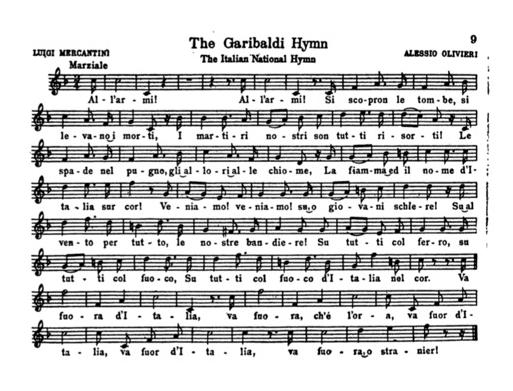
All'ármi! All'ármi!
Si sco pron le tombre, si le-vanoi morti,
I martiri mostri so tuti risorti!
Le spade nel pugno, gilgaalorialle chiome,
La fiammaed il nome d'Italia sul cor!
Ve nismo! veniamo suo griovani schiere!
Sual vento per tuto, le nostre bandiere!
Su tutti col ferror, su tutti col fuoco
Su tutti col fuco d'Itallia nel cor.
Va fuora d'Italia, va fuora, ch'é l'ora,
va fuord 'Italia, va fuord'Italia, va fuora stranier!
First sung by the volunteers of the Alpini corps, the popularity of the Garibaldi hymn can be traced back to the world-famous expedition of the one thousand Redshirts whom Garibaldi in 1860 led from Genoa to Marsala in Sicily, where he landed on May 11. Garibaldi proclaimed himself dictator and overthrew the Bourbons in Naples. Since then, the song has been known in Italy as the “Inno di Garibaldi.”
As opposed to the previous national anthems, the Garibaldi hymn was sung out of national fury. Foreign intruders were made well aware about the people’s determined opposition. Hurling the catchphrase of the song, “Va fuora d’Italia” (“Get out of Italy”) at the intruders, the fiery march was an important element to galvanize national unity against foreign invasions. The opening phrase, “All armi” (“To arms”) seems to help the overall message of collective military unity.
Nettl, Paul. National Anthems. 2d, Enl. ed. New York: Frederick Ungar Pub, 1967.
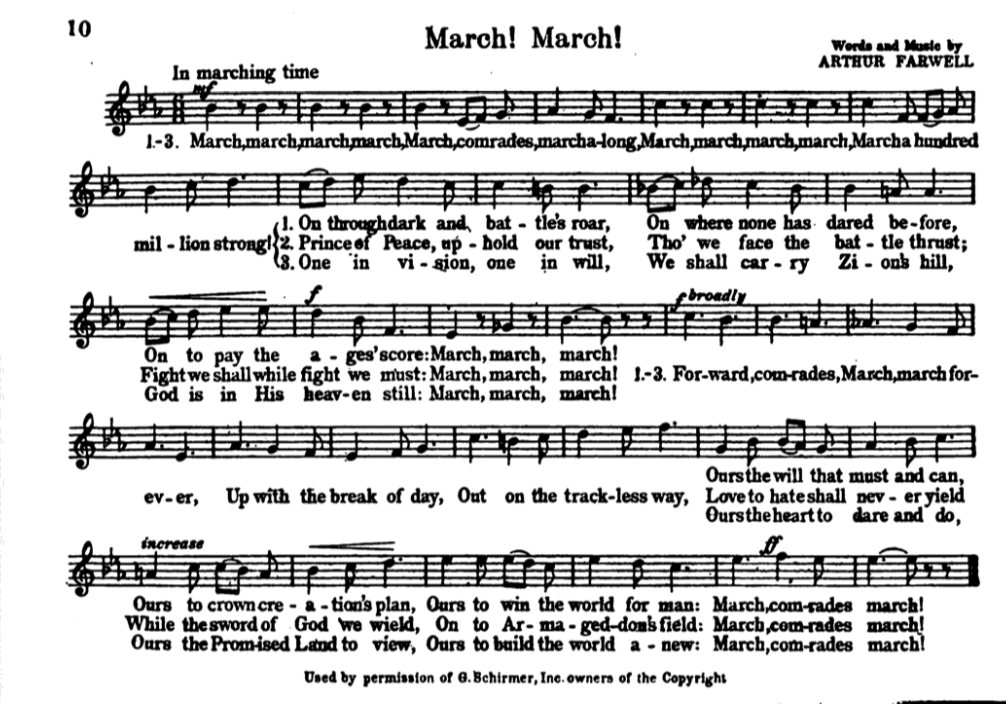
1-3 March, march,march,march, March, comrades, march along, March, march,march, march, March a hundred million strong!
1. On through dark and battles roar, On where none has dared before, On to pay the ages score: March, march, march!
2. Prince of Peace, uphold our trust, Tho' we face the battle thrust; Fight we shall while fight we must: March, march, march!
3. One in vision, one in will, We shall carry Zion's hill, God is in His heaven still: March, march, march!
1-3 Forward, comrades, March, march, forever, Up with the break of day, Out on the trackless way,
1. Ours the will that must and can, Ours to crown creation’s plan, Ours to win the world for man: March, comrades march!
2. Love to hate shall never yield, While the sword of God we wield, On to Armageddon’s field: March, comrades march!
3. Ours the heart to dare and do, Ours the Promised Land to view, Ours to build the world anew: March, comrades march!
Best known for his works based on Native American themes, African-American spirituals, and Spanish-Californian melodies, Arthur Farwell became known as one of America’s most influential composers. Farwell’s musical training was unorthodox, and he did not intend to make music as a career. However, while studying electrical engineering at the Massachusetts Institute of Technology in 1893, he became convinced that being a professional musician was his destiny. After graduation, Farwell studied music with George Whitefield Chadwick and Homer Norris and traveled to Europe to study with Engelbert Humperdinck and Hans Pfitzner in 1897. He later studied counterpoint with Alexandre Guilmant in Paris. In 1899, he returned home to America and was appointed as lecturer at Cornell University from 1899 to 1901. It was here that he encountered Alice Fletcher’s compilation of Indian Story and Song from North America. This book sparked his interest in Native American themes.
Although his early compositions contain traces of German Wagnerian styles, this was soon to change. He soon adopted a more personal style ranging from experimentation to using bold harmonies that led people to compare his compositions to that of Charles Ives. In 1901, he established the Wa-Wan Press, a self-publishing company, to publish his Native-American inspired compositions. As early as 1901, he hoped that publishing this genre would allow a classical music revolution to begin that would rebel against “German domination” of the nation’s music. He thought that the American public “saw everything through German glasses” and “a revolt against this domination was an absolute historical necessity.” Although Wa-Wan Press would eventually be acquired by G. Schirmer Music Publishing, it was with this anti-German spirit that led him to write “March, March” in 1916.
Farwell also served as the chief music critic for Musical America from 1909 to 1914 and was appointed in 1910 as Supervisor of Municipal Concerts by New York Mayor William J. Gaynor. During this time, he composed music for community pageants and outdoor events that reflected his idea of a new American art form. Surely, he was aware of the growing public opinion to support the war. The U.S. Army then hired Farwell during World War I to serve as the Army’s first consultant on group singing.
https://www.loc.gov/item/ihas.200035729/
Culbertson, Evelyn Davis (Summer 1987). "Arthur Farwell's Early Efforts on Behalf of American Music, 1889-1921". American Music, Vol. 5, No. 2. pp. 156-175.

Blazon the name that we now must uphold, Under the Stars and Stripes.
Vast in the past they have builded an arch Over which Freedom has lighted her torch,
Follow it! Follow it! Come let us march Under the Stars and Stripes!
(Chorus)
Under the Stars and Stripes! Under the Stars and Stripes!
Follow it, Follow it, Come let us march Under the Stars and Stripes!
Follow it, Follow it, Come let us march Under the Stars and Stripes!
We in whose bodies the blood of them runs, Under the Stars and Stripes,
We will acquit us as sons of their sons, Under the Stars and Stripes.
Ever for the justice, our heel upon wrong, We in the light of our vengeance thrice strong,
Rally together! Come tramping along, Under the Stars and Stripes!
(Chorus)
Under the Stars and Stripes! Under the Stars and Stripes!
Follow it, Follow it, Come let us march Under the Stars and Stripes!
Follow it, Follow it, Come let us march Under the Stars and Stripes!
Frederick Shepherd Converse, the composer of “Under the Stars and Stripes,” devoted his time and energy supporting the war on the home front. He joined the Massachusetts State Guard Company C on August 2, 1917 and was commissioned as second lieutenant. Eventually, he was transferred to the Thirteenth Infantry Regiment, Third Brigade where he was honorably discharged as captain.
In December 1917, Converse was called to New York to attend a meeting of the National Committee on Army and Navy Camp Music. He was appointed to serve on the committee in January 1918 and tasked to organize and encourage singing in the camps. He helped compile and publish the Army Song Book. He was active in issuing the weekly bulletin Music in the Camps and helped reorganized the military bands. Thus, he was instrumental in deciding what songs to include in this song book.
As requested by the Commission on Training Camp Activities, Converse collaborated with John Alden Carpenter in completing an orchestral arrangement of the Star Spangled Banner. Premiered by the Boston Symphony Orchestra on August 26, 1918, this arrangement was used also by other orchestras during the war and was still being used by the Boston Symphony as late as 1942. He also arranged an orchestral version of America for the Boston Pops Orchestra that was later recorded with Arthur Fiedler conducting.
While Converse composed several patriotic songs during the war, “Under the Stars and Stripes” and “The Service Stars Are Shining” remained the two most popular. As attested by Mrs. Converse’s diary entry on May 27, 1918 before the concert, Converse had “his ‘Stars and Stripes’ sung by a chorus of 100 at the Pops tonight and is to conduct it himself.”
Frederick Shepherd Converse (1871-1940): His Life and Music