
































Injuries in World War I
Wounds and Physical Injuries
A modern surgeon, magically transported 100 years ago, would find much that was familiar. The first principle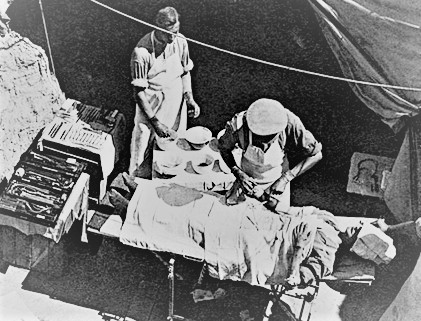 Wound Debridement in Improvised OR
of wound treatment is, and has been, debridement. This means cleaning the wound of all dirt and foreign matter, cutting out tissue which is too damaged to heal, and washing out the wound to remove dirt and debris too small to be seen. Today, the surgeon has an array of antibiotics, which are used to irrigate the wound, and given systemically, to prevent and treat infection. During the Great War, antibiotics were still 20 to 30 years in the future. The great advance of general anesthesia, however, was very well-established, permitting the surgeon to take enough time to properly clean and debride wounds. Further, aseptic surgery was well-accepted, and practiced even on the battlefield. This avoids putting new bacteria in the wound, to further complicate healing. Even irrigation fluids were (and are) sterile.
Lacking antibiotics, surgeons used the older doctrines of antisepsis. A number of local antiseptics were available, including various preparations of iodine, phenol, alcohols, and, ironically enough, chlorine. The problem was to use something which would kill bacteria, yet not damage tissue. The English-American chemist, Henry Drysdale Dakin, devised a solution of sodium hypochlorite, made initially by bubbling chlorine gas through a solution of sodium hydroxide or sodium carbonate. It was not harmful to tissues, and even would help to “float” dead cells free of the surrounding tissue. Working with the French-American surgeon Alexis Carrell, mentioned above, they developed the so-called Carrell-Dakin technique of wound irrigation. To this day, the solution is still available as Dakin’s solution. After the surgeon has debrided the wound, it is then irrigated with one or more liters of Dakin’s solution, some of which is left in the wound. Open wounds were then irrigated with Dakin’s solution every three or four hours, or left packed with Dakin’s-soaked gauze. Military surgeons have long learned that trying to close battlefield wounds frequently resulted in closed wound infections. Most battlefield wounds were left open for subsequent closure. Before the war, both Carrell and Dakin were in New York, and they may have developed the technique there. It was first used in early in the war, when Maj Carrell was serving in the French Medical Corps.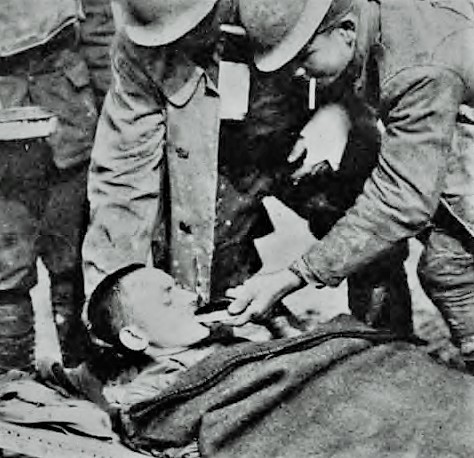 Treating Shock with Oral Fluids
What sort of wounds were commonly seen? While popular literature emphasizes machine guns, rifles and bayonets, the grim reality was that two-thirds of all casualties on the Western Front were produced by artillery shells. Machine guns and rifles used the same ammunition, and between them produced most of the rest. Bayonet wounds were so uncommon that they were tabulated under “miscellaneous wounds” in the hospital log books. Shrapnel from bursting artillery shells produces particularly ugly wounds, with a great deal of tissue damage and foreign material carried into the wound, including dirt from the trench environment. Frequently, the unfortunate soldier was also buried in the collapsed trench.
An important component of wound treatment was tetanus antiserum. As noted elsewhere (see “Diseases”), tetanus antiserum was routinely given to patients with wounds heavily contaminated with dirt. While the improved surgical techniques were at least as responsible, the use of antiserum was credited at the time with the virtual elimination of tetanus.