
































The Last Days of WW I from "The Diary of a Doughboy"
Excerpts from William Pommerening's WW I Diary
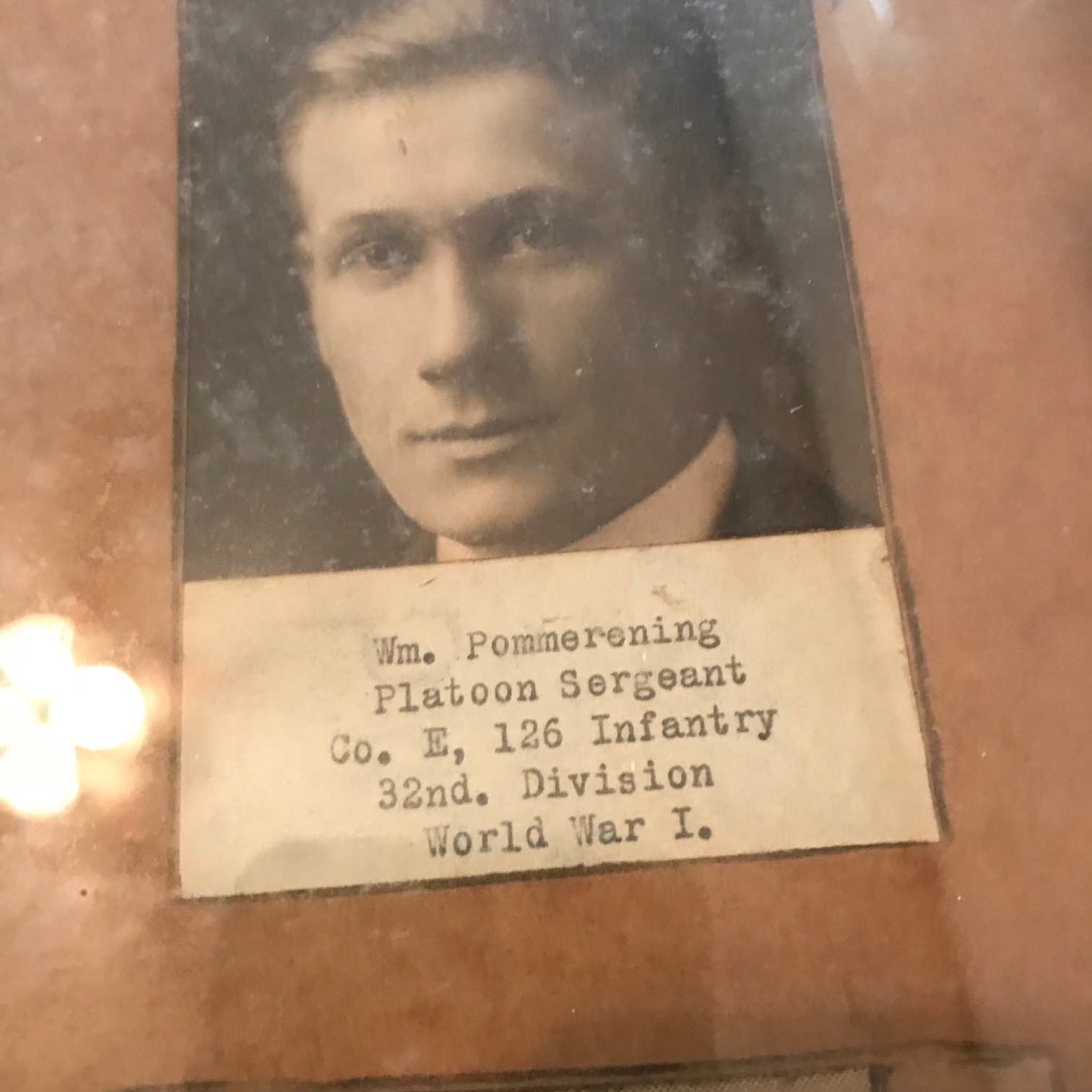
(Editor's Note: As Veterans' Day and the 100th anniversary of the end of World War I approached, I was at a bit of a loss of how I could honor my grandfather, Capt. Joseph L. Bachus, and the millions of men and women who put an end to one of the deadliest wars in history. I had already said most of what I had to say about WW I in my novel INTO NO MAN'S LAND, and I fell far short of telling the full story of the 126th Infantry Regiment of the 32nd Division here on the "Trench Commander" blog. Then it hit me. Let the WW I vets speak for themselves. The following is from "The Diary of a Doughboy" by William Pommerening, a Platoon Sergeant from Co. E of the 126th Infantry. "Bill" Pommerening was the kind of hands-on non-commissioned officer that made up the backbone of the American Expeditionary Force. He appears to have been a right-hand man for my grandfather, Joe Bachus, when Joe was commander of Co. E in the summer of 1918, and they remained friends for decades as fellow citizens of Ann Arbor, Michigan. While Joe was sent back to the States to fill the need for experienced, combat-tested instructors in late July 1918, Pommerening and the rest of his company went on to the Second Battle of the Marne and some of the hottest fighting that the Americans would experience in the Great War. He was wounded by a slug to his little finger on August 4th, and spent a couple of months in hospital recuperating. He returned to his unit in late October as they arrived in the Argonne Forest. Pommerening elided the names of his comrades in the version of his diary published by the Washtenaw County Veteran's Council. Warning: the following excerpt contains graphic battlefield descriptions.)
ARGONNE, FRANCE (October 21, 1918) -- Joined Co. E, 126th Inf. 32nd Division this A.M. in Argonne. Learn that Sgt. C___ was killed a few days ago. Also that G___ has been killed. Romagne is only a short ways from here. German planes dropped bombs tonight. No one injured. F___ is laid up with rheumatism.
October 22 -- Lieut. P___ S___ in command of E. Co. 1st Lieut., J___ S___; P___ W___, 1st Sgt. B___ O___ came in today. Troops of 89th Division passed us on the way to front.
October 23 -- Wednesday. We have several southerners in the Co. now. Some of them have only been in the army a few weeks.
October 24 -- Thursday. Had extended order drill today.
October 25 -- Friday. Went with E Co. today to Avocourt and received a complete new outfit of clothes and a good hot water bath with gasoline soap. It was tough on the cooties.
October 26 -- Saturday. Extended order drill today. An American aviator must have thought we were maneuvering in the front line for he signaled with his Very pistol to us the question, "Who are you?" We paid no attention to him.
October 27 -- Sunday. Received more replacements today.
October 28 -- Monday. Lieut. P___ S___ sick with fever. Transferred to hospital.
October 29 -- Tuesday. Had grenade throwing drill today using the former German front line trenches of the Hindenburg line.
October 30 -- Wednesday. It appears as though the war is about over. Hundreds of German troops give up and are captured here in the Meuse-Argonne sector.
October 31 -- Rumors are that we are to be ordered to advance.
November 1 -- Friday. Heavy American barrage of over 1500 guns started. Started moving towards the front.
November 2 -- Saturday. Marched through Montfaucon and Romagne. Bivouacked in woods Bois de Chauvignon. American artillery still keeping up heavy firing.
November 3 -- Sunday. Our artillery is still keeping up a heavy firing.
November 4 -- Monday. Our regiment moved to another woods called the Bois de Rappes. Full canteens of Schnapps are found on many of the German soldiers who have been killed by our artillery.
November 5 -- Tuesday. The firing of our artillery was so effective that hundreds of German troops were killed in it. The bodies are still unburied. There was literally hundreds of German machine guns scattered about. Our men could not resist trying them out. Found five gallon jar of schnapps.
November 6 -- Wednesday. Colonel J___ W___ of 126th Infantry is transferred sick to hospital.
November 7 -- Thursday. There are hundreds of German bodies scattered about. Saw one of our men pulling gold teeth out of corpse's mouths, -- said he wanted them for souvenirs.
November 8 -- Friday. One of our men has a belt full of gold watches which he has taken from the dead. None of the watches run. There are a pair of legs with pants and boots lying where I slept last night. There was also 3 dead horses and an ammunition wagon. A shell must have blown the upper part of the man's body away and killed the horses.
November 9 -- Saturday. Moved forward and crossed the Meuse river over partly completed bridge at Dun-sur-Meuse. Enemy bombing planes dropped bombs but without injuring us. Halted near Liny-devt-Dun.
November 10 -- Sunday. Moved ahead to Breheville and camped in Bois de Brandeville. Saw a white skull lying along the road. The nights are cold. Four of us made a sleeping bag and crawled in together to keep from freezing. French soldiers tell us that the Germans have asked for an armistice to take effect tomorrow.
November 11 -- Monday. Got out of our sleeping bags feeling kind of cold and stiff. It is a cool clear morning, frost on the ground. We have received orders to cease fighting at 11 A.M. today. Artillery and machine guns are still belching forth lead and steel. At 11 A.M. all firing ceases. It is so quiet it does not seem natural. There is no celebration among the troops at the front. Moved into town of Breheville and billet. Get hot food again.
November 12 -- Tuesday. Am billeted in what must have been a headquarters. There are bomb proof concrete rooms in the basement. Going over our records find there were 437 men in Co. E 126th Inf. who saw service in France. Of this number 222 were killed and wounded in battle. Several were also evacuated sick.
November 13 -- Wednesday. General H___ told us today that the 32nd Division will be one of three divisions to lead the march in Germany. We will go to the vicinity of Coblentz. German outposts are shooting up rockets at night.
(Photo and diary passages used by permission of the family of William Pommerening. Photo courtesy of Carolyn White.)
~~~