

































http://www.library.ucsb.edu/OBJID/Cylinder5397
1. O Genevieve,
I’d give the world
To live again the lovely past!
Thy rose of youth was dewimpearl’d
But now it withers in the blast.
I see thy face in ev’ry dream,
My waking thoughts are full of the;
Thy glance is in the starry beam
That falls along the Summer sea.
(Chorus)
O Genevieve, sweet Genevieve!
The days may come, the days may go,
But still the hands of mem’ry weave
The blissful dreams of long ago.
2. Fair Genevieve, my early love,
The years but make thee dearer far!
My heart shall never, never rove:
Thou art my only guiding star.
For me the past has no regret,
What e’er the years may bring to me;
I bless the hour when first we met
The hour that gave me love and thee!
The melancholic lyrics of this song were written by George Cooper who wrote this poem a short time after his wife died. Needing money, Cooper sold the poem to Henry Tucker who set the words to music. Later on, Cooper would produce the successful “Rose of Killarney” in 1876. Tucker composed “Weeping, Sad, and Lonely” with the alternate title “When This Cruel War is Over” around the same time. Due to the pessimism of Tucker’s “When This Cruel War is Over,” Union soldiers were forbidden to sing it.
This song was also included in Songs for the Rotary Club.
The Rotarian Dec 1945

http://www.loc.gov/jukebox/recordings/detail/id/1062
1. Sweet and low, sweet and low,
Wind of the western sea;
Low, low, breathe and blow,
Wind of the western sea;
Over the rolling waters go,
Come from the dying moon, and blow,
Blow him again to me,
While my little one, while pretty one sleeps.
2. Sleep and rest, sleep and rest,
Father will come to thee soon;
Rest, rest on mother’s breast,
Father will come to thee soon;
Father will come to his babe in the nest,
Silver sails all out of the west,
Under the silver moon.
Sleep my little one, sleep my pretty one sleep.
In 1863, Joseph Barnby set this 1849 poem by Alfred, Lord Tennyson to music. “Sweet and Low” has been set to music more than thirty times.
The lyrics picture a quiet evening perhaps by a window overlooking the sea, with the new moon above the rich glow of the sunset sky and distant ships approaching the shore. The scene is peaceful and quiet while the mother lulls the baby to sleep by the gentle lullaby of the song. Soldiers serving on the front would have remembered their childhood, home, and their own mothers.
Near the turn of the 20th century, a source reports that this song was played by brass instruments. Brass instruments have the versatility to express the soft tender passages and the loud passages as required by the song making them the perfect alternative to singing this piece.
The 1914 American silent short film, Sweet and Low, was based on this song and poem.
The Musical Times, Volume 33
The Grafonola in the Class Room: Graded Catalog of Educational Records

http://www.library.ucsb.edu/OBJID/Cylinder5045
In the evening when I sit alone a dreaming
Of days gone by love to me so dear,
There’s a picture that in fancy ‘oft appearing,
Brings back the time love when you were near;
It is then I wonder where you are my darling,
And if your heart to me is still the same,
For the sighing wind and nightingale a singing
Are breathing only your own sweet name.
(Chorus)
Sweet Adeline,
My Adeline
At night,
Dear heart
For you I pine,
In all my dreams
Your fair face beams,
You’re the flower of my heart,
Sweet Adeline
First published in 1903, “You’re the Flower of My Heart, Sweet Adeline” is a ballad and best known as a barbershop standard. The lyrics were written by Richard Gerard and set to music by Harry Armstrong from a melody he had written in 1896. According to a 1928 newspaper article, Gerard was inspired to write the lyrics after meeting “a girl who worked at the music counter of a New York department store.” The song was initially entitled, “You’re the Flower of My Heart, Sweet Rosalie” but Gerard changed it to its present title after failing to find a willing publisher. The song was well received after it was published and The Haydn Quartet first performed the song in 1904.
America's Songs II: Songs from the 1890s to the Post-War Years by Michael Lasser

http://www.library.ucsb.edu/OBJID/Cylinder0879
I’m coming back to you, my Hula Lou,
Beside the sea at Waikiki,
You’ll play for me.
And once again you’ll sway my heart your way,
With your yaaka hula hickey dula tune.
I’m coming.
First sung by Al Jolson in his show Robinson Crusoe, Jr. in February 1916, this Hawaiian love song is a product of the cultural appropriation of Tin Pan Alley in response to the surge of interest in exoticism. Hawaiian music captured the imagination of the American public. Indeed, Edison Phonograph Monthly of July 1916, announced that “the biggest popular hits of this season are all Hawaiian songs.” Further, “You’ve made our poorest of families/Dance to your beautiful melodies/Our millionaires are playing ukuleles too….Up in Boston where they eat those beans/They know what Yacki Hula means.”
Hawaiian musicians developed a unique style of combining of their native music and instruments brought by European travelers. Charles Hiroshi Garret described in his book, Struggling to Define a Nation: American Music and the Twentieth Century, how Hawaiian music influenced the mainland through Broadway musicals such as The Bird of Paradise that featured “the weirdly sensuous music of the island people.” Popularization of Hawaiian music began with the 1915 Panama-Pacific International Exposition in San Francisco where the Hawaiian delegation built a themed pavilion that “exceeded in beauty, interest, and educational value anything hitherto attempted by Hawaii.” The exposition featured the Royal Hawaiian Quartette led by steel guitarist George E.K. Awai. America’s encounter with Pacific exoticism seemed to parallel that of Debussy’s Javanese gamelan at the Paris Universal Exposition in 1889.
In an interview, Amy K. Stillman, an expert on Hawaiian songs, explains that during the 1915 Panama-Pacific International Exposition, “so many people saw it [the Royal Hawaiian Quartette], and they wanted to either buy a record, or buy a guitar and take lessons.” “That’s when Tin Pan Alley songwriters looked at this and saw money to be made, and started churning out all of these silly, nonsense songs.”

http://www.loc.gov/jukebox/recordings/detail/id/5950
Aloha oe,
Aloha oe,
E ke onaona noho i ka lipo
A fond embrace a hoi ae au
Until we meet again.
Farewell dear friend,
I love you so,
That to say goodbye brings grief no words can tell,
My love is yours for weal or woe,
Dear friend of mine farewell.
While “Yaaka Hula Hickey Dula” tells about a lover’s return to a beloved, “Aloha Oe” tells about a “farewell.” It is said that Queen Liliuokalani was inspired to write this song after witnessing James Boyd, a colonel from Honolulu, receive a lei and aloha from a young Hawaiian girl. There are numerous versions who the girl was but Helena G. Allen, author of The Betrayal of Liluokalani, Last Queen of Hawaii, claims that the girl was Liluokalani’s sister Princess Likelike.
While this song is about a separation of lovers, it may also be considered a lament for a lost country when Hawaii lost its independence in 1898 from the United States. This is often overlooked because Tin Pan Alley romanticized Hawaii as a romantic Eden as seen in the Hawaiian themed American compositions and often Hawaiian women were portrayed as amorously inclined to foreign visitors.
https://www.loc.gov/item/00694061/
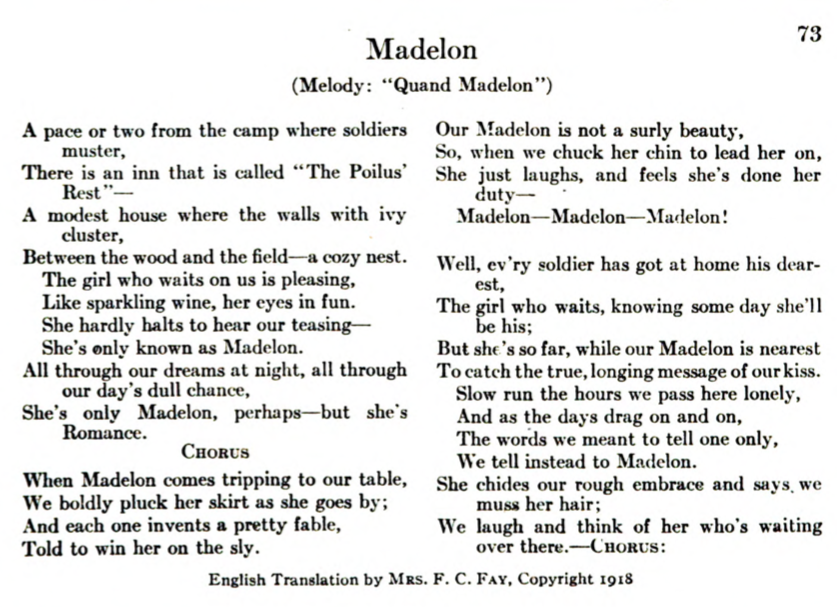
“Madelon” first graced the Parisian café concerts in early 1914 and from the lyrics, it seemed that the intended audience for this song was primarily for soldiers.
In the first three verses, soldiers tell of a nice young waitress serving them wine in a tavern. They always think of her while remembering their sweethearts back home. Soldiers on the frontlines criticized the nationalistic military songs that their military leaders wanted them to sing as propaganda. Although these love songs were not popular at first, "Madelon” became popular among French troops in 1916 and it became a hit in Paris the following summer and fall of 1917. Civilian audiences enjoyed “Madelon” and were able to identify with the mindset of a relic from a pre-World War I peacetime army. During a critical time in the war, the beloved waitress’ choice of placing her heart with the regiment rather than a single person such as marriage, suggests patriotic devotion and feminine independence. While the lyrics may initially have sensuous references, a closer look reveals that the lyrics contain patriotic overtones.
Over the years, “Madelon” inspired numerous parodies that remained with the public as the symbol of lightheartedness during the hardships of the war.

http://www.library.ucsb.edu/OBJID/Cylinder12181

http://www.library.ucsb.edu/OBJID/Cylinder0614
1. Abide with me; fast falls the eventide;
The darkness deepens; Lord with me abide.
When other helpers fail and comforts flee,
Help of the helpless, O abide with me.
2. Swift to its close ebbs out life's little day;
Earth's joys grow dim; its glories pass away;
Change and decay in all around I see;
O Thou who changest not, abide with me.
3. I need Thy presence ev’ry passing hour;
What but Thy grace can foil the tempter’s power?
Who, like Thyself, my guide and stay can be?
Through cloud and sunshine, Lord abide with me.
4. I fear no foe, with Thee at hand to bless;
Ills have no weight, and tears no bitterness.
Where is death's sting? Where, grave, thy victory?
I triumph still, if Thou abide with me.
5. Hold Thou Thy cross before my closing eyes;
Shine through the gloom and point me to the skies.
Heaven's morning breaks, and earth's vain shadows flee;
In life, in death, O Lord, abide with me.
A Christian hymn based on Luke 24:29 of the Bible, "Abide With Me" was composed and set to music by Scottish Anglican cleric Henry Francis Lyte. However, it is often sung to the melody of William Henry Monk’s “Eventide.” The hymn was popular in many Christian denominations and was said to be a favorite of King George V, the king of England during World War I. The song was also often used in funerals.
It is said that “Abide with Me” was very popular with soldiers serving in the trenches during the war and was sung by the British nurse Edith Cavell the night before Germans executed her for helping British soldiers escape occupied Belgium. While the words speak of comfort and consolation, the soldier singing this song implores God for help and protection against the horrors of trench warfare. Were soldiers really comforted with these words? Only faith can tell.
Trevor Beeson: In Tuneful Accord: The Church Musicians, SCM Press 2009, p. 37.
https://www.telegraph.co.uk/culture/music/3668058/The-story-behind-the-hymn.html

1. Come, Thou Almighty King.
Help us Thy name to sing,
Help us to praise!
Father all glorious,
O’er all victorious,
Come and reign over us,
Ancient of days!
2. Come, Thou Incarnate Word,
Gird on Thy mighty sword,
Our prayer attend!
Come, and Thy people bless,
And give Thy word success:
Spirit of holiness,
On us descend!
3. Come, Holy Comforter,
Thy sacred witness bear,
In this glad hour!
Thou, Who almighty art,
Now rule in ev’ry heart,
And ne’er from us depart,
Spirit of pow’r!
“Come, Thou Almighty King” remains a favorite with Methodists. Often attributed to Charles Wesley, the song was first sung with the same melody of the British national anthem, “God Save the King.” However, it was later set to the “Italian Hymn” by Felice de Giardini.
Following the idea of the Trinity, God the Father, God the Son, and God the Holy Spirit, this song seems to consolidate this idea by letting each verse describe the role of the Trinity while focusing on the Christian’s desire for God’s might and power to reign over His people. But further inspection reveals something interesting.
The first verse describes the “almighty King” that references God the Father. The second verse references the “incarnate Word” which is another name for Jesus Christ, the Son. The third verse tells of the “holy Comforter” which can be associated with the Holy Spirit as seen in John 14:26 of the Bible. However, the songbook omits the fourth verse which consolidates all Three Persons of the Trinity:
To Thee, great One in Three,
Eternal praises be
Hence evermore.
Thy sov’reign majesty
May we in glory see,
And to eternity
Love and adore.
Could this have been a deliberate omission by the CTCA who designed this book?

http://www.library.ucsb.edu/OBJID/Cylinder0278
1. Holy, holy, holy Lord God Almighty!
Early in the morning our song shall rise to Thee;
Holy, holy, holy, merciful and mighty,
God in Three Persons, blessed Trinity!
2. Holy, holy, holy, Lord God Almighty!
All Thy works shall praise Thy name, in earth, and sky, and sea;
Holy, holy, holy, merciful and mighty,
God in Three Persons, blessed Trinity!
“Holy, holy, holy” is another song that references the Trinity and has been specifically written for use on Trinity Sunday. Written by the Anglican Bishop, Reginald Heber, the song would be set to music later on by John Bacchus Dykes who composed the tune Nicaea for this hymn in 1861. Nicaea paid tribute to the First Council of Nicaea which formalized the doctrine of the Trinity in 325 A.D.
During the war, numerous hymn tunes including “Holy, holy, holy” were parodied by soldiers to express discontent. This may indicate that hymn tunes were very popular during that time. Soldiers transformed this hymn into:
Raining, raining, raining,
Always bloody well raining.
Raining in the morning,
And raining in the night.Marching, marching, marching,
Always bloody well marching;
Marching all the morning
And marching all the night.Grousing, grousing, grousing
Always bloody well grousing
Grousing at the rations,
And grousing at the pay.Marching, marching, marching
Always bloody well marching,
When the war is over,
We’ll damn well march no more.
Daily Telegraph Book of Hymns by Ian Bradley