
























The Polish Community's Contingent
World War I saw the deployment of three armies from the United States to “over there.” In addition to the American Expeditionary Force under Gen. John J. Pershing, the Polish and Czech communities sent separate contingents to fight on the Allied side, leading to the return of their homelands on the map of Europe following the war.
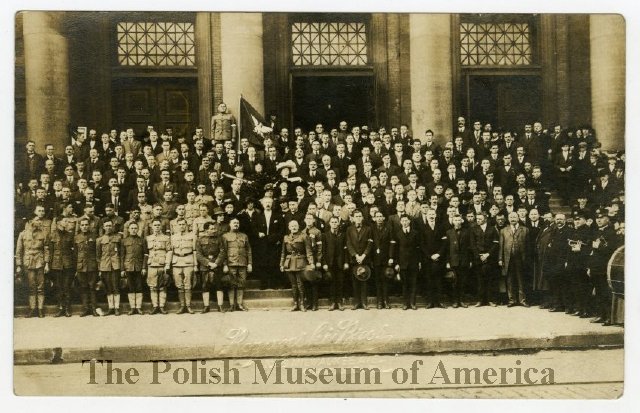
This photograph from the collections of the Polish Museum of America (PMA) shows a group of volunteers prior to their departure to the training camp, Camp Kosciuszko, located in the Canadian Militia training site at Niagara-on-the-Lake, Ontario. While the US was still neutral in 1916, the Polish Falcons, a gymnastic and paramilitary group, made arrangements for the Canadian military to train officers for a future Polish Army. The training took place at York University (now, University of Toronto), and starting in January 1917, the first group of volunteers received Canadian commissions and returned to the United States after the declaration of war against Germany in April 1917.
On June 14, 1917, the French government pledged to organize an autonomous Polish Army after the first Russian Revolution in February allowed Poles and Czechs to form their own units. A military mission was sent over to organize the large Polish community in the US and to obtain American permission.
Recruitment began in October 1917, coinciding with the centennial of Polish and American Revolutionary War hero, Brigadier General Tadeusz Kosciuszko. Polish-Canadian cooperation continued, and volunteers went to train at Niagara, as well as Camp Borden in Northern Ontario.
The photo shows the departure of one such group. The volunteers are standing on the steps of Holy Trinity Roman Catholic Church, located at 1118 N. Noble St., Chicago. The central figure is Maestro Ignacy Jan Paderewski, flanked by his wife, Helena, and Father Kazimierz Sztuczko. At the bottom of the stairs wearing a Canadian Officer’s Uniform and Sam Browne belt is Lieutenant Starzynski, a veteran of the US Army. The stout fellow in the lighter suit near the band is John Smulski, a former Chicago alderman, Illinois treasurer, banker, and head of the committee for an independent Poland. The uniformed group to the left are not doughboys, but volunteers wearing their Falcon Field uniforms, which were surplus US Army. The rest are wearing civilian dress and the red and white arm bands to show their status as volunteers. The flag at the top of the stairs is one of many used for the recruiting effort. Since there was no Poland, people were free to design their own flags. The PMA has many examples with crowned eagles, crownless eagles, looking left or right.
The Polish Museum of America is proud to partner with the Pritzker Military Museum and Library (PMML) and the US WWI Centennial Commission in presenting information on this important contribution to the Allied War effort. Future postings will tell the story of the armed effort of the Polonian community in raising two armies and aiding two war efforts.