





















America Goes to War
By Tom Isern
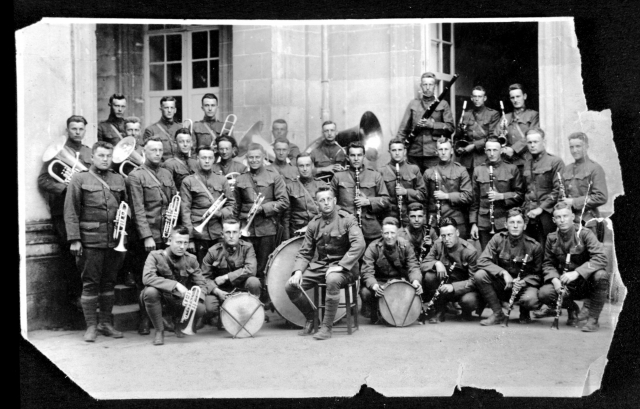
The night before North Dakota troops shipped out in 1917, they got a rousing send-off into the grand adventure and unknown peril of the Great War. Citizens gathered in Bismarck’s Belle Mehus Auditorium, completed just that January. A rousing concert by the Second North Dakota Regiment Band -- musicians from Harvey directed by Harold Bachman -- stirred patriotic enthusiasm. Bachman’s band was a great favorite; people said those boys could play anything.
They were equally confident their boys could handle any situation and defeat the German enemy. Nevertheless, there was a dissonant undertone. The appearance and remarks of Gov. Lynn Frazier drew criticism. His faction of the Republican Party, the Nonpartisan League, had been less than full-voiced in support of the war, and Frazier could not resist warning against “profiteering” by opportunistic capitalists.
The United States entered the Great War with mixed motives but a great deal of enthusiasm. The zeal of North Dakotans for war matched that of the nation at large, suppressing divisions and dissent.
Triggering the catastrophic war was the act of a young Serbian nationalist, Gavrilo Princip. On June 28, 1914, he shot to death the heir to the Austria-Hungarian throne, Archduke Franz Ferdinand, and his wife, Sophie, the Duchess of Hohenberg. That inflamed rivalries between Austria-Hungary and Russia, leading to ultimatums, the involvement of allies of the antagonists, and swiftly, in the words of historian Barbara Tuchman, the “guns of August.”
After Great Britain entered the conflict because of German violation of Belgian neutrality, essentially all of Europe was at war: the Allies, comprising France, Britain, Belgium, Italy, Serbia, and Russia (which dropped out after the Bolshevik Revolution) opposing the Central Powers, comprising Austria-Hungary, Germany, Bulgaria, and Turkey.
President Wilson issued a proclamation of neutrality calling on Americans to remain “impartial in thought as well as in action.” Most Americans agreed, hoping to stay on the sidelines of what shaped up as a bloody, costly war of mass armies and fearful armaments. Neutrality became difficult, however, as the war dragged on.
In the first place, Americans were never “impartial in thought.” Ties of language, culture, and history made them sympathetic to Britain and France. In North Dakota (with its large population of Germans from Russia) and elsewhere in America, substantial minorities sympathized with Germany and spoke fondly of Kaiser Bill (one North Dakota farmer naming a prize bull after him), but they were minorities. Britain organized skillful propaganda campaigns, depicting Germans as “Huns” committing terrible atrocities, to keep Americans siding with the Allies.
The issue of neutral rights, especially rights to trade with nations at war, was an ongoing aggravation as Germany sought to quarantine its enemies against the receipt of arms and even the essential goods of life. The longer the war continued, the more severe and violent became the German quarantine, relying on submarines, U-boats, for enforcement. This led to considerable loss of life as submarines torpedoed Allied and, eventually, American vessels plying the Atlantic.
Most famously, a submarine sank the British liner Lusitania. More than 1,200 died, including some 120 Americans. North Dakotans took satisfaction reading of the heroism of Park River physician Andrew Foss, a passenger who saved victims bobbing at sea, but the nation was outraged. Urgent diplomacy managed to keep the United States out of war for a while. President Wilson was re-elected in 1916 with the slogan, “He kept us out of war.”
In the end, German heavy-handedness provoked America to war. Exhibit A: the Zimmerman Note. In January 1917 German Foreign Minister Arthur Zimmermann cabled the German minister in Mexico with an astonishing, calculated scheme -- that if the U.S. entered the war, Mexico should declare war against the United States in order to win back territory lost in 1848. British intelligence decoded the note. Newspapers screamed headlines of German perfidy. The disclosure resonated with North Dakotans because their own national guardsmen recently had protected the Mexican border.
The Zimmerman Note’s impact was the greater because January 31, in a high-stakes risk, Germany began unrestricted submarine warfare, meaning submarines were authorized to sink American vessels. When they commenced doing so, President Wilson called for war, and Congress declared it April 4, 1917.
“There are, it may be, many months of fiery trial and sacrifice ahead of us,” the president intoned. “It is a fearful thing to lead this great peaceful people into war, into the most terrible and disastrous of all wars, civilization itself seeming to be in the balance. But the right is more precious than peace, and we shall fight for the things which we have always carried nearest our hearts—for democracy, for the right of those who submit to authority to have a voice in their own governments, for the rights and liberties of small nations, for a universal dominion of right by such a concert of free peoples as shall bring peace and safety to all nations and make the world itself at last free.”
Wilson struck an idealistic tone that inspired action. North Dakotans, therefore, joined a monumental war effort that turned the tide in favor of the Allies and defeated Germany.
Tom Isern is a Great Plains historian and professor of history at North Dakota State University in Fargo.