

































Horses and Mules
The core, the central focus of these Brooke USA Horse Heroes pages is the animals themselves, the horses and mules who lived and died on the battlefield. In this section those animals will again come alive, as we remember them and appreciate how much their sacrifices meant to the outcome of the war.
"Concerning the war I say nothing...the only thing that wrings my heart and soul is the thought of the horses...oh! my beloved animals...the men...and armies can go to hell but my horses: I walk round and round this room cursing God for allowing dumb brutes to be tortured...let him kill his human beings but...how can he? Oh my horses." (Sir Edward Elgar, August 25, 1914)1
Horses and mules provided the overwhelming majority of the power used to move men and machines – the true “horsepower” of the war effort. They served in a wide variety of roles, including being ridden, as draft animals pulling vehicles and guns, and as pack animals.
Scroll down to learn about Horses and Mules and how they served. Go to The Mission to learn more about their work as Officer's Chargers, Cavalry Mounts, and while Pulling and Packing. In all their roles, they were essential to the war effort.
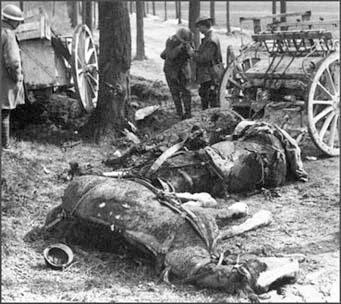 A driver grieves his dead Clydesdales.
Sending animals to war seems, today, somehow even more awful than sending people to war. But in 1914, there was little room for that sentiment. Animals were absolutely essential to the war effort, and they had to be sent - millions and millions of them, by the time the war was over. Most were horses and mules, though dogs, pigeons, camels, and even water buffalo and elephants were also found in some theatres of the war.
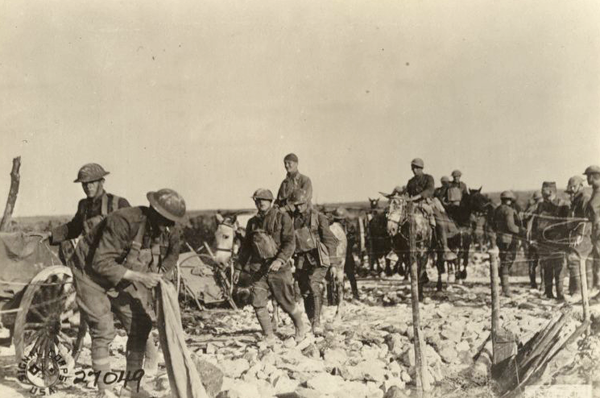 A U.S. Army machine gun company on the way to front, 1918.
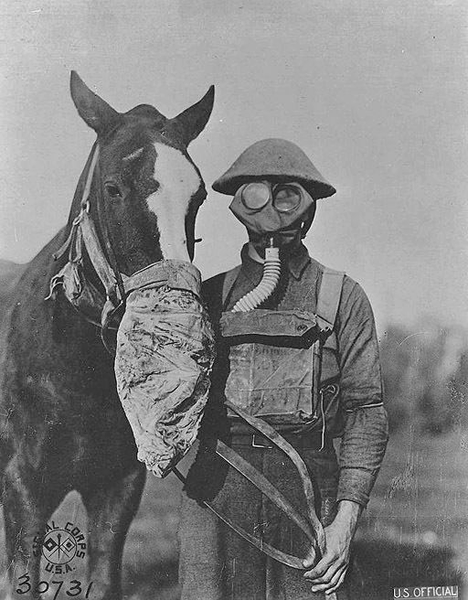 A U.S. soldier and his horse wearing their gas masks.
Sources:
- Galtrey, Sidney, Capt., The Horse and The War. Country Life, Tavistock, 1918, p. 35.
- The Tennessean, Nashville, TN, Sunday Sept 12, 1915, p. 49.
- Ibid, Galtrey, p. 43.
- The Quartermaster Review, March/April 1946
- For details on numbers of animals, see By the Numbers
- The Quartermaster Review, September-October 1921, 74, reprinted from The Christian Science Monitor, May 6, 1921, p. 3
- Ibid., Galtrey, p. 43
- Essin, Emmitt M., Shavetails and Bell Sharps, (Lincoln: University of Nebraska Press, 1997), p. 153
- ibid., Essin, p. 96
- Notes on Horse Management In the Field, Prepared in the Veterinary Department for General Staff, War Office, 1919 (British War Office publication)
- The Quartermaster Review, September-October 1921, p. 74.