































Ohio’s Connections to the 322nd Field Artillery
By Cyrus Moore III, Ohio WWI Centennial Committee
August 27, 2018
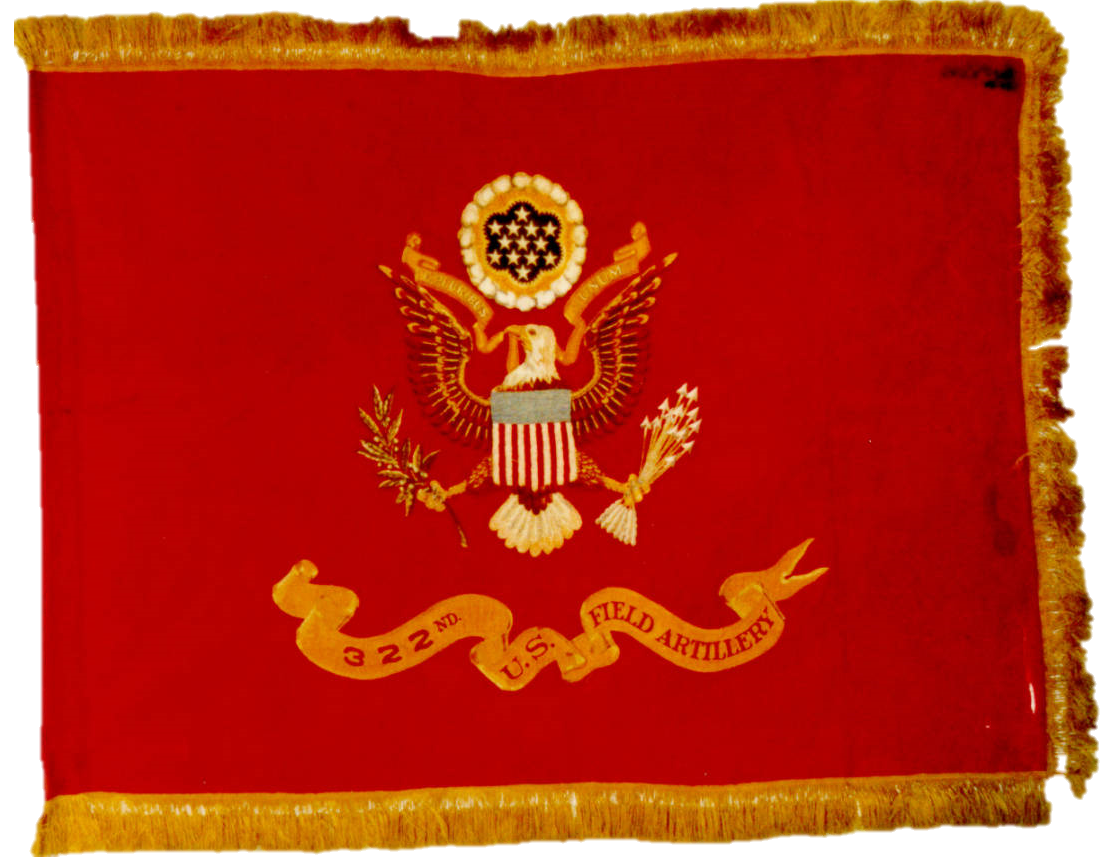
The story of the 322nd United States Field Artillery Regiment began in the summer of 1917 at Fort Benjamin Harrison, outside of Indianapolis, Indiana. There, as part of the officer training program, future officers trained intensively in all aspects of modern war, including artillery. When the men finished their program in August and commissioned as lieutenants, many were sent to Camp Sherman, outside of Chillicothe, Ohio, where a training camp for Ohioans drafted under the Selective Service Act of 1917 would soon be ready. On September 5, 1917, the first draftees arrived at Camp Sherman.
More and more men arrived at Camp Sherman throughout the Autumn of 1917, filling the ranks of the 322nd Field Artillery and other regiments then taking shape. In Camp Sherman the men, until recently civilians, grew accustomed to military life and learned skills necessary for war. They trained on artillery pieces, learned how to measure trajectory of shots, and practiced firing in the hills south of Chillicothe. By the end of May of 1918, the 322nd Field Artillery was ready to leave for France; by June 4, the entire regiment was on its way.
At Camp Sherman the 322nd had trained with and been part of a single division, the 83rd “Ohio” Division. The division travelled to France as a group, but once in France, General Pershing and the American Expeditionary Force decided to break apart the 83rd. Three infantry regiments were converted to depot regiments and trained replacements for combat divisions. The War Department sent one regiment, the 332nd, to Italy to bolster the Italians in their fight against Austria. The 83rd Engineers and Signal Troops were attached in time to the III Corps and did not serve in a division. The 83rd Division’s artillery brigade, including the 322nd, remained in tact and served their role as combat artillery on the Western Front, though attached to different divisions. When they arrived in July their artillery training continued.
By September of 1918, the 322nd was ready for service on the Western Front. Recently, General Pershing had formed his US divisions into a field army and was preparing to open an offensive, which would be known as the Meuse-Argonne. On September 26, the 322nd Field Artillery, attached to the 32nd Division and in support of the 37th, 79th and 91st Divisions, opened fire on German positions near Montfaucon. The 322nd continued to support divisions around the Montfaucon area as infantry took ground from the Germans. The artillerymen continued until October 3, when they received orders to relocate.
Taken out of action only temporarily to rest and resupply, the 322nd was soon again fighting on the western Front in support of US troops advancing in the Meuse-Argonne. Though each US division had on paper its own artillery brigade, in practice artillery was slower to move and resupply, and was often detached from the infantry. The 322nd was able to fight in support of many divisions during the Meuse-Argonne, including at times the 37th “Buckeye” Division, which consisted of Ohio National Guard soldiers. By the end of October, the 322nd found itself again attached to and supporting the 32nd Division. It served with the 32nd until the Armistice went into effect on November 11, 1918.
The Imperial German Army laid down its weapons on November 11, 1918. The soldiers, disarmed, demobilized and returned to their homes. A formal treaty ending the war was still a long way off, however. The War Department thus created the US Third Army to continue to serve in Europe and keep the Germans from re-entering the war before they signed a peace treaty. The Third Army became the US Army of Occupation and entered Germany in December of 1918, then quickly went into garrison in and around the city of Koblenz.
The 322nd Field Artillery, still nominally attached to the 32nd Division, became part of the Army of Occupation. Batteries of the regiment were stationed in small towns that surrounded Koblenz. The men wintered in Germany, taking the opportunity to visit sites and capture pictures of the countryside. Spirits were high among the victorious soldiers, but as Spring approached the men yearned to return to the United States. Facing pressure from congress to demobilize, and with the Treaty of Versailles under negotiation, the War Department began bringing US regiments home. The Army of Occupation dwindled to a token force of a few hundred by the summer of 1919.
The return journey for the 322nd Field Artillery began in March of 1919. The 322nd’s brigade was detached from the 32nd Division (which caused the men to give their brigade the nickname “The Lost Brigade” as they never seemed to have a permanent home with any division during their time in Europe) and, though quickly reattached, in April the brigade boarded trains destined for French ports. After an uneventful crossing, the men disembarked in New Jersey and continued to Camp Sherman. On May 27, 1919, after training, traveling to France, fighting on the Western Front, and occupying Germany all in the span of less than two years, the men of the 322nd received their Honorable Discharges and returned to civilian life.
Taken mostly from:
History of the 322nd Field Artillery. Yale University Press. New Haven, Connecticut. 1920.