






























Practice of Medicine
State of American medicine in World War I
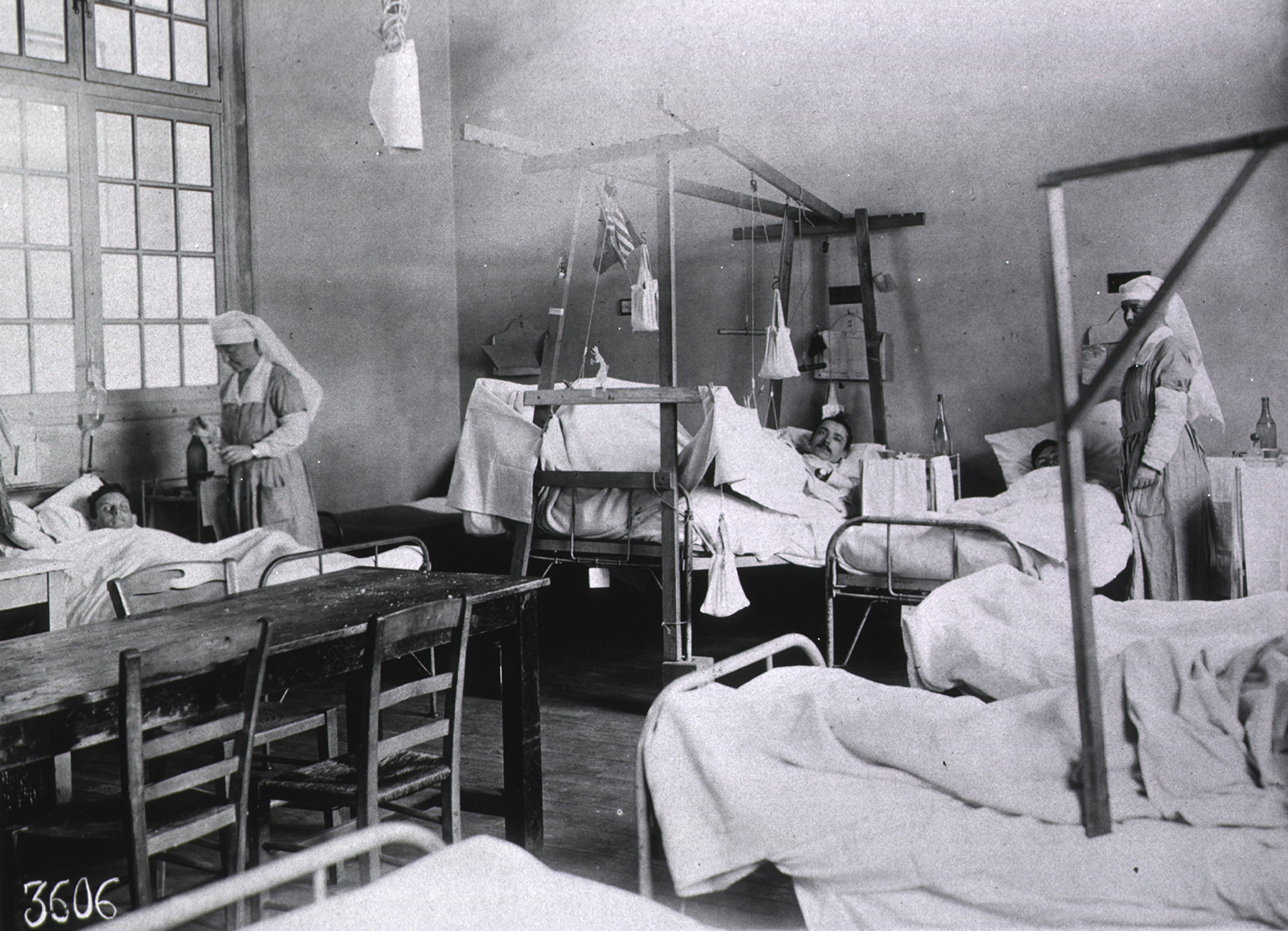
American Red Cross Hospital
We think of medicine 100 years ago as relatively primitive when compared with today's. But medical science had in fact progressed rapidly over the previous half-century. This section will review the state of medical practice in 1917, with particular attention to those areas relevant to military medicine.
Medical education, the foundation of all medical practice, was undergoing a revolution. The Flexner Report was published in 1910, condemning most proprietary schools and holding up as examples university-based schools such as Johns Hopkins and Case Western Reserve. Today, all schools adhere to Flexner’s standards. In 1917, the newer and better schools, such as Johns Hopkins, were active in supporting the military medical effort. Base hospitals were sent to Europe staffed by Johns Hopkins, Harvard, Western Reserve, Washington University, Duke University, and the Universities of Kansas and Michigan. Leading organizations, in particular the American Medical Association and the American College of Surgeons, strongly supported the effort. Still, the Army had to provide additional training for most physicians, to enable them to practice in the military environment, and to educate them about such threats as gas warfare (see Mobilization of American Medicine).
Surgical techniques were relatively sophisticated. Antisepsis, and the newer practice of aseptic surgery, was universal. The bacteriologic origin of wound infections has been proved for decades. Surgical instruments were routinely cleaned and sterilized before use. Instruments were similar to today, although there were none of the motorized drills and saws used in today’s orthopedic surgery. Anesthesia depended on ether or ethylene oxide, usually combined with nitrous oxide, and was given by mask or an open drop technique. Surgeons could effectively operate upon most parts of the body. Surgery of the extremities, while much less sophisticated than today, was quite adequate to deal with broken bones, joint injuries, and soft tissue trauma. Abdominal surgery was well-developed. Most abdominal injuries could be treated surgically, assuming the patient could be evacuated quickly. Thoracic surgery was, however, in its infancy. Operations on the chest were difficult and hazardous, in large part because endotracheal anesthesia, while known, was not generally used. Chest tubes for drainage of injuries and air were also known, but not widely used. Empyema, or infection of the chest following injury, was a difficult problem, with a 30% mortality in base hospitals. An Empyema Commission was established in 1918 to make recommendations, but it came too late to make much difference.
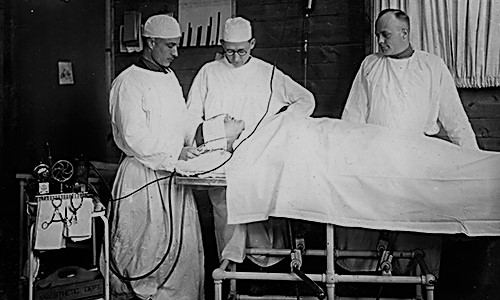 Operating Room, Base Hospital 28, Limoges
Medical techniques were also relatively modern. During the previous decades, immunization had become available for tetanus and typhoid fever, and both were universally given to soldiers. Smallpox vaccination was universal. Prophylaxis for malaria was known and available. On the therapeutic side, intravenous fluid therapy was available. It was used both for medical diseases such as diarrhea, and surgical diseases such as hemorrhagic shock. Blood transfusions were available and were used by 1917, thanks to pioneering British and American physicians. They were not very common, and blood banking was yet in the future. Treatment of sepsis and shock were not very advanced, but the importance of supportive care was recognized. Nutrition as a factor in preventing and treating illness was recognized. Army rations had advanced far beyond the “hardtack and bacon” of earlier wars.
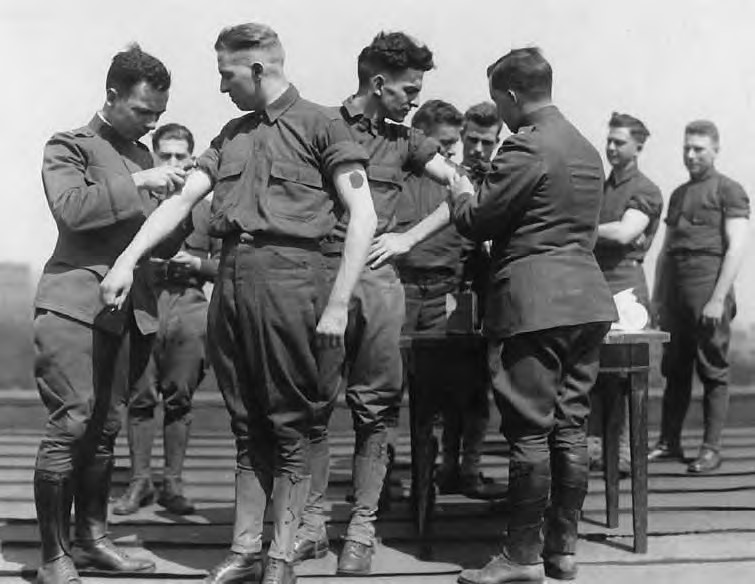 Mandatory Typhoid ImmunizationsCommunicable diseases were well known. Such techniques as quarantine, control of the water supplies, and basic hygiene limited the spread of epidemics which had formerly ravaged Army camps. Nonetheless, some 57,000 American soldiers died of disease, at least half from the epidemic of H1N1 influenza of 1918-20. Aside from the flu, discussed below, the most common cause of illness and death was pneumonia (“camp fever”), but gastroenteritis, measles, mumps, and meningitis were also common. A major limitation was the lack of effective treatment for infectious disease. Antibiotics were still 20 years in the future. Diseases like pneumonia, empyema (see above), and tuberculosis, still were lethal. Much could be done by screening soldiers on admission for communicable disease, by isolating camps from one another, and by moving ill soldiers to quarantined quarters. But the crowded training camps and troopships remained ideal incubators for epidemics, and the techniques of the day were simply not adequate. Disease actually killed more Americans than did injuries, although by a small margin. Still, considering that disease killed twice as many soldiers as injuries in the Civil War, and five times as many in the Spanish-American War, considerable improvement was evident.
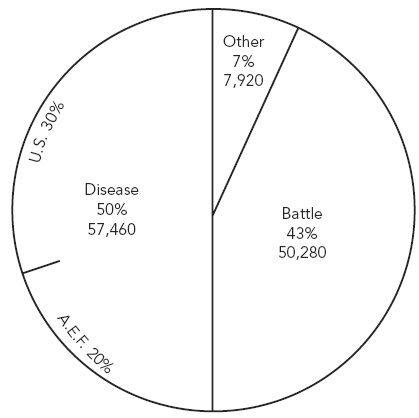 U.S. Casualties 1917-1919
Control of venereal diseases was primarily prevention. There were treatments for syphilis, but these involved mercury compounds, toxic in themselves. Gonorrhea could be treated with local antiseptics, a process best left un-described. Antibiotic treatments. which have today relegated these scourges to mere annoyances, didn’t exist. Treatment was primarily a matter of waiting for them to heal. These were also a serious discipline problem, which meant that the medical system became involved with the Army judicial system.
Psychiatry had been well established for a half-century or longer in the US. But Army psychiatric care was not up to dealing with the cases of shell shock which began to appear. While this was not nearly as great a problem for the AEF as it was for the British and French, care of these casualties was difficult. There was no consensus on the appropriate treatment. Unlike the British and French, American practice was to give soldiers a rest for a day or two, feed them and clean them up, and then get them back to their units if at all possible. Only severe cases were evacuated. Probably, this resulted in a lower rate of disability and later post-traumatic stress disorder. But no one will ever really know.
Alcoholism was a major problem. The tradition of heavy drinking among soldiers was long-established. Then too, young men away from home for the first time have a tendency to binge drinking. The appropriate role of alcohol in society was undergoing a great revolution at this time. Prohibition was enacted in November, 1918, after a long campaign by the “drys” to outlaw drinking. Alcohol was banned from Navy ships around this time, because Josephus Daniels, Secretary of the Navy, was a strict prohibitionist. Newton Baker, Secretary of War, was a “dry”, as well. The Selective Service Act of May, 1918, banned alcohol on or around all military bases. These regulations simply drove drinking underground, and the medical service was often left to pick up the pieces.
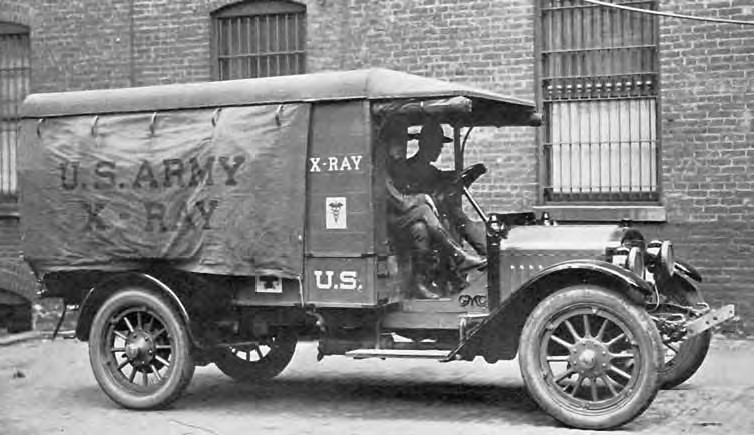 X-ray TruckRadiology was in its beginnings. Roentgen rays had only been discovered 20 years earlier, yet their use in medical diagnosis had become well-established. However, only the largest Army hospitals had this equipment. Its use in bony injuries and in trauma in general was obvious. Even the early equipment of the day provided a great advantage in being able to see fractures and foreign bodies such as bullets. But the equipment was complex and bulky. “Portable” x-ray machines required a small truck. A Division of Radiology was established in 1918, to facilitate training and equipping units with x-ray machines. Equipment remained in short supply until the end of the war.
American medicine in the second decade of the 20th century was surprisingly capable. Few injuries were beyond the reach of the surgeon’s care, excepting brain injuries and chest wounds, Even these could often be treated effectively. Communicable disease remained a constant problem, but sanitation, water treatment, and hygiene were far advanced from the previous century. Psychiatry was still developing, and the effective treatment of “shell shock” and combat fatigue in general remained controversial and uncertain. But the picture overall was still encouraging. Wounded soldiers who were able to reach care survived at a rate over 95%. Deaths from disease were half the rate of earlier wars. Immunizations could prevent some of the most troublesome diseases. For all of the haste and inevitable confusion of moving large numbers of medical personnel and equipment across the Atlantic and setting up in the field, American medicine was able to meet the challenge of the Great War.