


































Injuries in World War I
Psychological Injuries
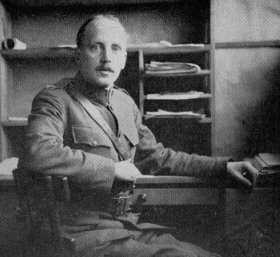 Dr. Thomas W. Salmon, Pioneer in Treating Combat Stress Disorders
Soldiers have been returning from battle with psychologic damage for millennia. Ancient Egyptian texts described it 4000 years ago. The Greek historian Herodotus wrote about it 2500 years ago. More recently, we now know that soldiers in the American Civil War often exhibited what we now call post traumatic stress disorder. For example, Dr. William Chester Minor, who served with the Union army for three years, became paranoid and delusional after the war. In 1872, he shot and killed a man in London, England, in the belief that he was an enemy soldier. He died in England, in an insane asylum.
Yet the psychological toll of the Great War was without precedent. Soldiers who had endured the awful conditions of trench warfare, especially those who experienced the terrible artillery barrages seen in the war, sometimes developed a neuropsychiatric syndrome known by various names, but most commonly as “shell shock”. First described by a British physician, Charles Myers, it consisted of an array of symptoms. These included uncontrollable trembling, headache, tinnitus, dizziness, inability to concentrate, memory loss, confusion, and sleep disorders. Some patients were barely able to walk, or had partial paralysis, or stammered uncontrollably, or were unable to talk.
The disorder we now know as Post Traumatic Stress Disorder (PTSD) bears a strong relationship to shell shock. However, there is a great deal of evidence that the disease as seen in World War 1 had a strong neurologic component. Many of these patients may have had traumatic brain injury, to at least some degree, as well as PTSD. The more recent research into chronic traumatic encephalopathy is highly suggestive that frequent “minor” head trauma can indeed produce long-term changes in the brain. This line of thinking is, of course, speculative.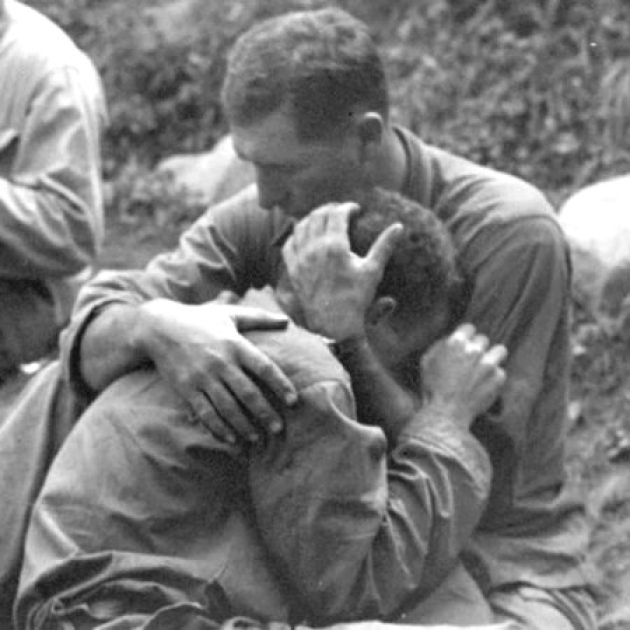 A Soldier Comforting Another, in a Later War
Thomas W. Salmon, AEF consultant in psychiatry, formulated the treatment used throughout the AEF. It was based on treatment as far forward as posssible. There were five principles. Immediacy meant beginning treatment early. Proximity meant treating close to the soldier’s unit. Expectancy was the universal expectation by caregivers and soldiers that the episode would be short-lived, and the soldier would return to duty. Simplicity meant using simple treatments, such as food, rest, sleep, and behavioral psychology. In later jargon, that would be “three hots and a cot”. Centrality meant consistency in the treatment of psychologic casualties.
Dr. Salmon set up a psychiatric unit in 1918, at a base hospital. His methods, including early intervention as near to the front lines as possible, appear to have been successful, and were adopted widely in the American Army. These five principles were then promptly forgotten after the war. They were re-discovered independently during World War II, and remain today the philosophy of treatment for combat stress disorders.
Source: Psychological Injuries
Crocq MA, Crocq L. From Shell Shock and War Neurosis to Posttraumatic Stress Disorder: A History of Psychotraumatology. Dialogues in Clinical Neuroscience 2:47-55, 2000.
Volume X, Neuropsychiatry. The Medical Department of the United States Army in the World War (Washington, 1925)