





























Ohio Women in World War I
By Shannon Kupfer, Digital Initiatives Librarian, State Library of Ohio
April 3, 2018
Women have served in every United States war since before the country had a name. Sometimes they served in secret, dressing in men’s garb and hiding their identity. Those who wished to serve openly sometimes did so as nurses, an occupation that was crucial to the war effort but which relegated them to a role more “appropriate” for females. Others served through efforts such as growing victory gardens, knitting warm woolens for American troops, or working in other domestic wartime efforts.
Then came World War I and the Naval Act of 1916. Signed into law by Woodrow Wilson, the Naval Act of 1916 – also called the Big Navy Act – was designed to increase the Navy’s size, with a goal of making it the largest in the world. To that end, recruitment was a high priority, and it was through a loophole in the recruitment language that women gained entry into the armed services. Specifically, the language said that “all persons who may be capable of performing special useful service for coastal defense” were eligible to enlist, but made no mention of limiting recruitment to men. According to Prologue Magazine, “After reviewing the act, Secretary of the Navy Josephus Daniels and the Bureau of Navigation (the forerunner to the Bureau of Personnel) concluded that the language did not prohibit women from enlisting in the reserves. The act gave the Navy a previously untapped resource that allowed administrative operations to be carried out by naval personnel and freed able-bodied men to serve aboard ships.” The women would be given the title Yeoman (F); “F” stood for “female,” though the women quickly became known as “yeomanettes.” Initially, their duties were largely clerical and administrative, but expanded to include mechanical work, cryptography, making of munitions, and other duties. By the end of the war, thousands of women had enlisted in the armed services.
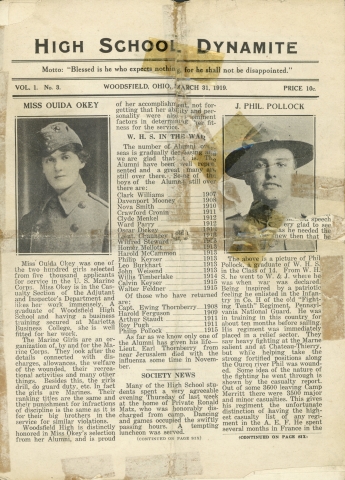 Woodsfield High School newspaper article on Okey, an alumna of the school, via Ohio Memory.
Ouida Mabel Okey, of Graysville, Ohio, enlisted in the Marines on October 22, 1918 – two months after Opha Mae Johnson became the first woman to enlist in the Marines – and continued her service through July 31, 1919. Ms. Okey was one of three women from Ohio to serve in the Marine Reserves, the other two being Mildred A. Cowell of Marietta and Mary A. Williams of Youngstown. According to the Woodsfield High School Dynamite, Ms. Okey’s alma mater’s newspaper, she was one of two hundred women chosen from a pool of five thousand applicants, and served in the Casualty Section of the Adjutant and Inspector’s Department of the Marines. She, and other women like her “look[ed] after the details connected with discharges, allowances, the welfare of the wounded, their recreational activities and many other things…Besides this, the girls drill, do guard duty, etc. In fact the girls are Marines. Their ranking titles are the same and their punishment for infractions of discipline is the same as it is for their big brothers in the service for similar violations.” Remarkably, at least for the time, the women also received the same wages as men, assuming they were also able to rise to the same rank.
Though women were now allowed to enlist, other avenues for supporting the war effort still existed for them. Many thousands chose nursing as a way to provide needed medical expertise, as well as comfort, to soldiers in need. One such woman was Clara Edith Work Ayres.
Ms. Work Ayres was born in Attica, Ohio, in 1880. At the age of twenty-three, she married Wayland Ayres, but her marriage was short-lived; in 1906, Mr. Ayres injured his hand and died three days later after contracting tetanus. After her husband’s death, Ms. Ayres moved to Chicago, graduating from nursing school in 1913. Not long after, just prior to America’s entry into the war, Ms. Ayres volunteered as a nurse for the Red Cross and was assigned to work in France. Unfortunately, however, Ms. Ayres never arrived; while awaiting departure from New York, she was killed on her ship during a practice firing of weapons. Incidentally, Ms. Ayres is considered to be the first American civilian to die in World War I, though this is debatable. According to historian Marjorie Waterfield, the 128 Americans that drowned as a result of the sinking of the Lusitania in 1915 were actually the first American civilians to die in the war, but Ms. Ayres was the first to be killed after America’s entry into the war.
For women at home, the war offered opportunities that were not generally available to women during peacetime. Women were often called upon to work in factories, holding jobs that were typically occupied by men. Others worked with the Young Women’s Christian Association (Y.W.C.A.) to provide activities to men residing at Camp Sherman or other training camps, based inside or outside the U.S. The Y.W.C.A. also facilitated relationships between American women and non-English speaking women residing in the U.S.: “Multitudes of foreign born women ignorant not only of the language of our country, but also of its laws and customs are left helpless when their men are summoned to the service…” The Y.W.C.A. responded to this need by opening centers where “foreign-tongued women may find friends at all times.” The Y.W.C.A. warned of the perils of war for women who were unoccupied in productive efforts, including “blurring high ideals…letting down personal restraint…permitting loose social relationships.” The war, on the other hand, “has opened to women a variety of employments hitherto regarded exclusively as men’s work,” making women the nation’s “second line of defense.”
Those who chose not to, or were unable to, work outside the home or serve in the Navy or Marines still found ways to contribute to the war effort. The Wagner Park Nursery Company of Sidney, Ohio, produced a pamphlet which advised women that “It is not only a patriotic duty to do your share in making your own ground bring forth needed vegetables but it is a privilege that yields rich dividends to you both in pleasure and health.” Meanwhile, organizations like the Red Cross made knitting for soldiers a popular method of showing one’s support for soldiers; with the rallying cry of “knit for Sammie!” – “Sammie” being a nickname for soldiers fighting for Uncle Sam – women across Ohio and America knit a variety of clothing and accessories, often using patterns issued freely by the Red Cross themselves.
In September, 1918, just one month after the first woman enlisted in the Marines, President Woodrow Wilson expressed his support for a federal amendment to give women the right to vote. How could the United States fight for liberty around the world when half of its citizens were denied the fundamental right of suffrage? The companion argument, however, was based on sacrifices, such as those made by Ouida Okey, Clara Ayres, and the countless unnamed women who contributed to the war effort at home. Their contributions entitled them to equal protection and equal rights, and those contributions, and the rights they gained, continue to inspire women a century later.
Sources:
HistoryLink: Knitting for Victory – World War I, accessed 3/29/2018
National Archives: Prologue Magazine, “The Story of Female Yeomen During the First World War;” accessed 3/28/2018
National Parks Service: Women’s Suffrage and World War I, accessed 3/29/2018
Red Cross Knitwear, accessed 3/29/2018
Smithsonian Magazine, “During World War I, Many Women Served and Some Got Equal Pay,” accessed 3/28/2018
Smithsonian National Museum of American History, Women in World War I, accessed 3/29/2018
Toledo Blade: “Historian Tells Story of Nurse Who Died at Start of World War I,” accessed 3/28/2018
United States Army: Women in the Army, accessed 3/28/2018
Sources from Ohio Memory:
YWCA Pamphlet: War Work for Women, accessed 3/28/2018
YWCA Pamphlet: One Year with the War Work Council of the Y.W.C.A., accessed 3/28/2018
Seeds for your War Garden brochure, accessed 3/28/2018
Ohio Memory Blog: “Camp Sherman: ‘Ohio’s Soldier Factory,’” accessed 3/29/2018
Ohio Memory Blog: “Ohio Memory Madness 2014: Ouida Okey, the Girl Marine,” accessed 3/28/2018