































Diseases in World War I
The Great Influenza Epidemic
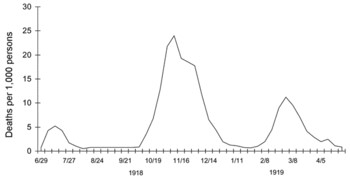 Three Waves of the Great Influenza Epidemic
At the end of the war, a new horror swept across the battlefields, and the entire world. The “Spanish flu” was named such because Spain wasn’t in the war, and therefore had no press censorship. The first big outbreaks were reported in the Spanish press, hence the name. This was a classic case of shooting the messenger. The true origin may not ever be clearly known, but was not in Spain. In the US it first appeared at Camp Funston, on Fort Riley, near Manhattan, Kansas, in the spring of 1918. Other theories of origin blame the British Army camps in northeastern France, or the importation of large numbers of Chinese laborers. Whatever its ultimate origin, it spread rapidly to other training camps. More importantly, it swept the world in 1918 to 1920.
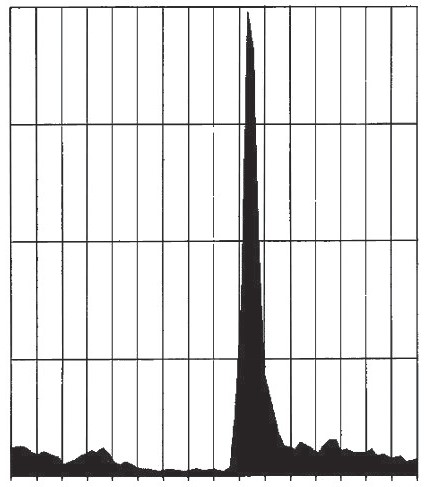 Influenza Deaths in the ArmyInfluenza usually carries a mortality of rate of less than 1 in a thousand, largely from secondary pneumonia. During the fall of 1917, there were cases recorded among troops in Europe, with some deaths from secondary pneumonia. But in 1918, a new strain appeared. It was apparently capable of causing death not just by secondary pneumonia, but also by primary lung consolidation and failure. This new strain killed more than 2.5% of cases, and in some populations as high as 10%. Moreover, while influenza usually causes deaths only in the very young or the old, this strain caused mortality in young people of 20 to 35 years, the age of most soldiers. It attacked in three waves: spring of 1918, fall of 1918, and winter of 1918-19. The second wave was the most lethal of the three, and caused civilian deaths throughout the US, as well as around the world. In the AEF, cases peaked in the week of September 15-22, with 5-10% going on to develop pneumonia. Totals for the AEF were recorded at 192,000 cases of influenza, 29,000 of pneumonia, and a total of 13,000 deaths. By War Department estimate, 25% of the Army, over 1 million men, fell ill. Army-wide, influenza and pneumonia accounted for nearly 30,000 deaths, more than half the 52,000 non-combat deaths during the war.
Influenza is caused by a virus, a micro-organism twenty times smaller than a bacterium. In 1918, medical scientists had barely discovered viruses, and had little or no idea how to combat them. The best microscopes of the day couldn't see them. Today, we know that the "Spanish Flu" was the H1N1 strain of influenza. We can even see the virus with an electron microscope. We can immunize 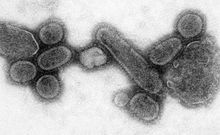 against it, and all of the other strains of influenza. We can give antibiotics for the secondary pneumonia. And we can support patients with ventilators if their lungs fail. But in 1918, all physicians could do was to support the patient, quarantine as best they could, and ride out the epidemic.
Navy personnel, serving on crowded ships, were particularly vulnerable. The Navy recorded 100,000 hospital admissions, with 5,000 deaths. This was out of a total of 600,000 men, a 17% infection rate. Other evidence suggested that the incidence was more like 40%, as light cases went unhospitalized and unrecorded.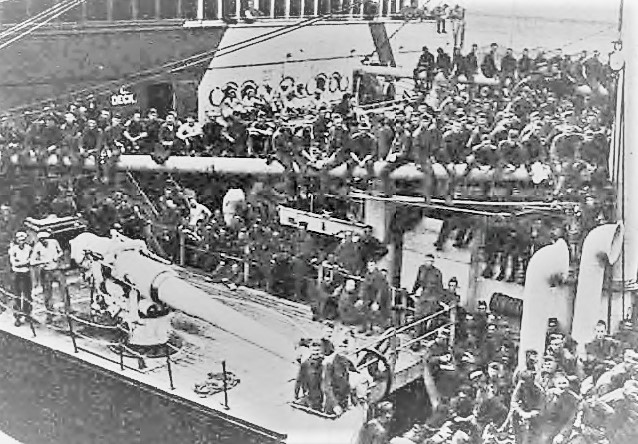 Troops Crowded onto the Leviathan, a German Liner Converted to American Troopship
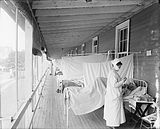 Flu Ward, Walter Reed Army Hospital, Washington, DC
Other allied armies were equally affected, as were the Germans and Austrians. One of the causes that has been cited for the failure of the German spring offensive is that widespread illness blunted the offensive power of the German army. We still don’t know whether the Germans were more affected than the allies. But given that Germans were starving on the home front, and that German front line troops were poorly fed and often malnourished, it is definitely possible.
The effects on the civilian population were far more serious. About a quarter of the US population fell ill. Even President Wilson caught the flu, while he was in Paris in early 1919. Perhaps one-third of the world population were stricken. India, as an example, had 50 deaths per 1000 people who fell ill. The total number of deaths is not accurately known. The death toll was thought at the time to be 20-30 million. Recent studies have revised this upwards, to 50 million deaths throughout the world, with a possible upper limit of 100 million. The epidemic killed many more than the war itself. Was the war responsible? Perhaps, it was. Current studies on recovered samples of the virus indicate that it was a mutated version of an older, less lethal virus. Clearly, the war was not the cause of the mutation. But the conditions of the war, with soldiers and civilians moving about the world, as combatants and as refugees, almost certainly contributed to its rapid spread, and probably to the death toll.
Current References on the Great Influenza Epidemic
Laura Spinney. Pale Rider: The Spanish Flu of 1918 and How it Changed the World. Public Affairs, New York. 2017
John M. Barrey. The Great Influenza. The Epic Story of the Deadliest Plague in History. Penguin Books, New York, 2005.
Gina Bari Kolata. Flu: The Story of the Great Influenza Pandemic of 1918 and the Search for the Virus That Caused It. Farrar Straus Giroux, 1999.