

























Flu Pandemic Raged in ND and Worldwide
By Stephen McDonough
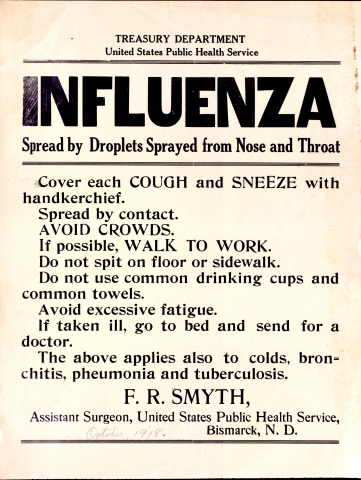
Without a doubt, the most tragic acute infectious disease epidemic ever to hit North Dakota was the Influenza Pandemic of 1918.
The Pandemic raged worldwide during the last year of World War I and came at a time when many physicians and nurses were out of state in military service. The epidemic struck with such devastating force that the entire health care system was rapidly overwhelmed.
Many examples of courage and self-sacrifice occurred as North Dakotans attempted to care for thousands of severely ill friends and neighbors.
The strain of virus causing the outbreak is thought to be one called H1N1. It was identified years later when it was recovered from an Alaskan who died in 1918 and whose corpse was preserved when it was buried in permafrost. This strain has the ability to rapidly infect lung tissue which results in overwhelming inflammation and pneumonia. Young adults were especially susceptible, and many children became orphans when one or both of their parents died suddenly.
The epidemic was called “The Spanish Flu” although the pandemic did not start in Spain. But it received considerable notoriety when Spain was one of the early countries affected.
North Dakota reported 1,378 deaths although the true number was likely between 3,000 and 5,000.
Adding to the misery was the fact that the state led the nation with the greatest percentage of nurses (20 percent) enrolled in military service. In addition, nearly one in three North Dakota physicians also served. That meant there weren’t enough health care providers to care for the sick.
These providers were not immune from the virus -- two doctors and four nurses died from it in military service, and three doctors and 14 nurses died in the state. Florence Kimball, a 1913 graduate of Lisbon High School and a registered nurse serving overseas with the military, died of influenza at age 24 on Oct. 20, 1918, and is buried in France. The Lisbon American Legion Post is named in her honor.
Many young North Dakota men enlisted during the war and the Student Army Training Corps in Grand Forks was home to 423 men. Influenza infected two-thirds of the cadets with 29 dying, six on one terribly day. Dr. James Grassick, North Dakota’s most famed physician, was called on to assist with their care which he did at age 68.
A review of the state’s newspapers of the time shows some of the horror produced by Spanish Flu. The Fargo Forum reported on Oct. 26, 1918, that “Ten days ago the family of A.J. Anderson was happy and in the bloom of health. Today the mother and two sons lie side-by-side in Riverside Cemetery, and the third son lies still in death, all victims of the Spanish Influenza. Ester, aged 11 years, who is still in the hospital with the disease, and the father survive.”
Bill Krueger, Sr., of Plymouth Township in Grand Forks County was one who escaped infection. He served his neighbors well, carrying groceries in his Model A Ford from the town of Niagara to those out in the township. His brother, Fred, and nephew, Freddie, were not so lucky. Both died the same day. Since so many of his neighbors were bedridden, it became necessary for Bill to ready the bodies of his brother and nephew for their burial. “I never did anything so hard in all my life,” he said, “as to prepare my own brother for his final departure.”
Business and life, in general, slowed to a halt during the epidemic’s peak. Schools and theaters closed and streets were deserted. As the outbreak waned, activity returned to normal, but many families were forever altered with children and parents in mourning.
Today, the world is periodically challenged with influenza pandemics, and the potential remains for the emergence of a new and deadly strain. Every year, vaccine manufacturers race to prepare the right influenza vaccine just in time to prepare for the annual fall outbreak. Hopefully, North Dakota will never have to experience an epidemic anything close to the one at the end of World War One.
Dr. Stephen McDonough is a pediatrician at Sanford Medical Center in Bismarck and is formerly the chief medical officer at the North Dakota Health Department.