
































http://www.library.ucsb.edu/OBJID/Cylinder16885
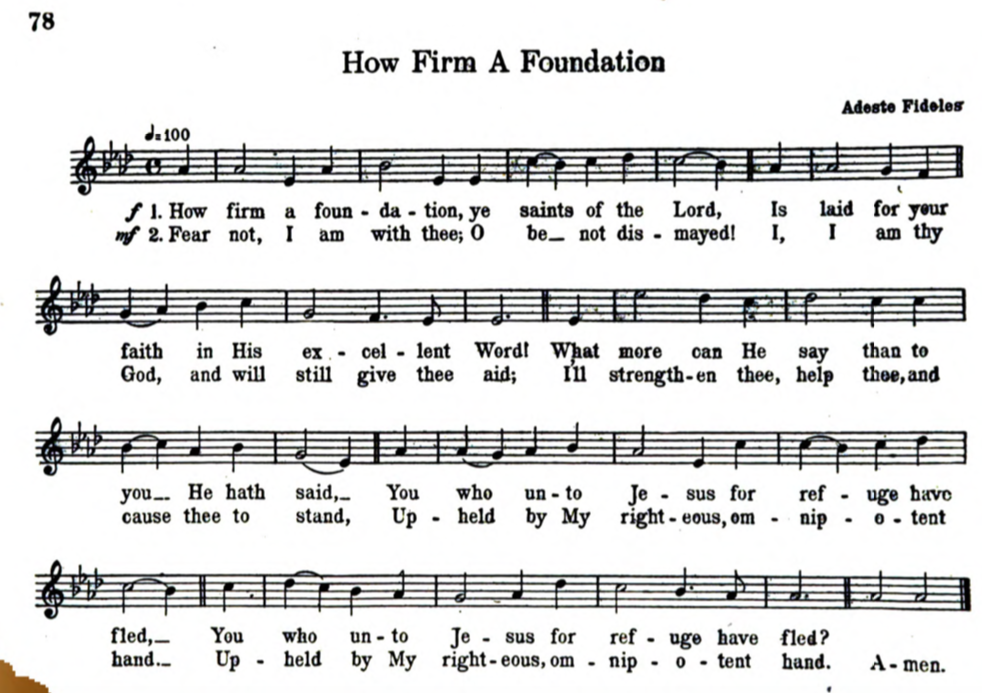
1. How firm a foundation, ye Saints of the Lord,
Is laid for your faith in his excellent Word!
What more can He say than to you He hath said,
You who unto Jesus for refuge have fled,
You who unto Jesus for refuge have fled?
2. Fear not, I am with thee; O, be not dismayed!
I, I am thy God, and will still give thee aid;
I’ll strengthen thee, help thee, and cause thee to stand,
Upheld by My righteous, omnipotent hand.
Upheld by My righteous, omnipotent hand. Amen.

http://www.library.ucsb.edu/OBJID/Cylinder10606
1. Nearer, my God to Thee,
Nearer to Thee,
E’en tho’ it be a cross
That raiseth me;
Still all my song shall be,
Nearer, my God, to Thee,
Nearer, my God, to Thee
Nearer to Thee. Amen
2. Through like a wanderer,
Weary and lone,
Darkness comes over me,
My rest a stone;
Yet in my dreams I’d be
Nearer, my God, to Thee,
Nearer, my God to Thee,
Nearer to Thee. Amen
3. Or if on joyful wing,
Cleaving the sky,
Sun, moon and stars forgot.
Upward I fly;
Still all my song shall be,
Nearer, my God, to Thee,
Nearer, my God, to Thee,
Nearer to Thee. Amen
A popular 19th-century Christian hymn written by Sarah Flower Adams, "Nearer, My God, to Thee" recounts the story of Jacob’s dream in Genesis 28:11-12. Although sung to the hymn tune “Horbury” in the United Kingdom, Americans usually associate this hymn to 1856 tune “Bethany” by Lowell Mason. Some Methodists also prefer setting the text to “Propior Deo” written by Gilbert and Sullivan in 1872. This hymn continues to be popular in the Methodist Church and is included in the United Methodist Hymnal.
“Nearer, My God, to Thee” is also associated with the sinking of the Titanic. As the vessel sank, survivors reported that the ship’s music ensemble continued playing and chose this hymn as their last piece while attempting to calm down the panic-stricken passengers. It is said that the ensemble chose this hymn because it was one that appealed to all. This hymn was also sung on the battlefield by the retreating Confederate soldiers during Pickett’s Charge in the Civil War.
Bradley, Ian. (2005). Daily Telegraph book of hymns, London: Bloomsbury Academic, p. 294 (2006 paperback ed.)
Turner, Steve (2011). The Band that Played On. Nashville, TN: Thomas Nelson., p. 194
http://www.loc.gov/jukebox/recordings/detail/id/8828
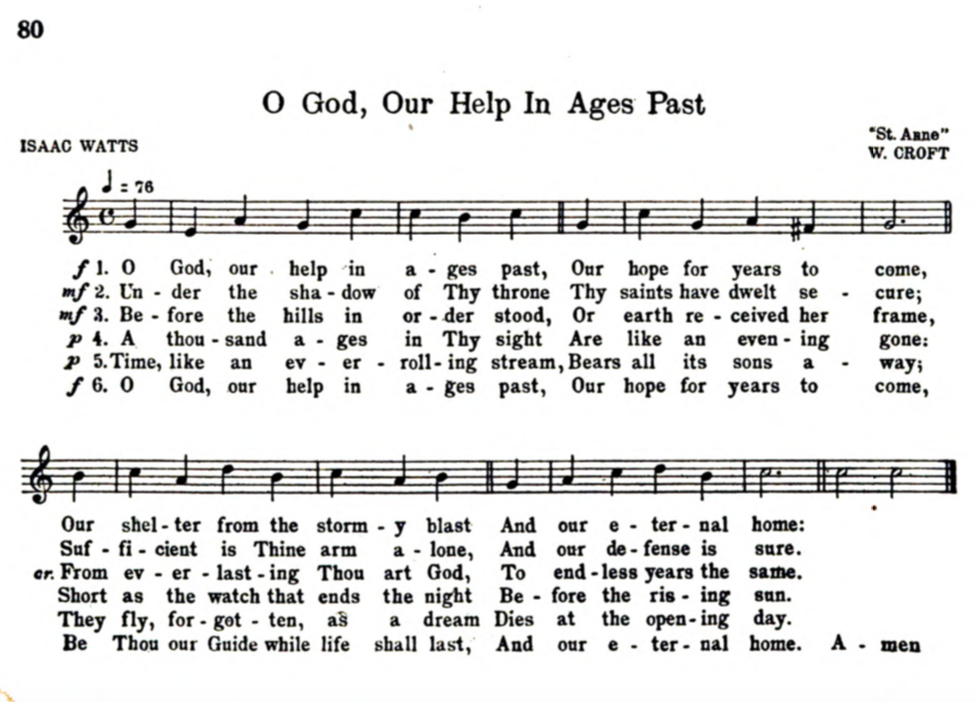
1. O God, our help in ages past,
Our hope for years to come,
Our shelter from the stormy blast,
And our eternal home:
2. Under the shadow of Thy throne
Thy saints have dwelt secure;
Sufficient is Thine arm alone,
And our defense is sure.
3. Before the hills in order stood,
Or earth received her frame,
From everlasting Thou art God,
To endless years the same.
4. A thousand ages in Thy sight
Are like an evening gone;
Short as the watch that ends the night
Before the rising sun.
5. Time, like an ever-rolling stream,
Bears all its sons away;
They fly forgotten, as a dream
Dies at the opening day.
6. O God, our help in ages past,
Our hope for years to come,
Be Thou our guard while life shall last,
And our eternal home. Amen
Published in 1719 as part of The Psalms of David Imitated in the Language of the New Testament, “Our God, Our Help in Ages Past” is a hymn by Isaac Watts that paraphrases the 90th Psalm of the Book of Psalms. It is often paired with the hymn tune “St. Anne” composed by William Croft in 1708.
Popular among British and Canadian soldiers, it is often sung as part of the Remembrance Day service in Canada as well as festive occasions in England. Its popularity led Baroque composers such as Handel and Bach and modern composers such as Sullivan and Ruggles to incorporate the melody in their own works.
http://www.library.ucsb.edu/OBJID/Cylinder8167
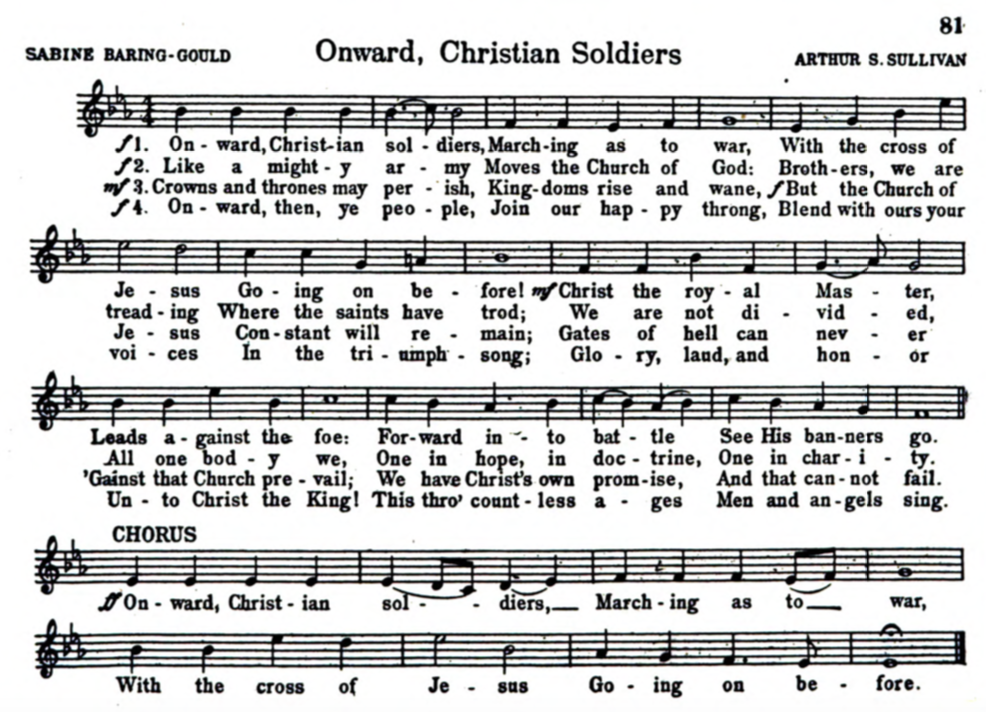
1. Onward Christian soldiers!
Marching as to war,
With the cross of Jesus
Going on before!
Christ, the royal Master,
Leads against the foe;
Forward into battle,
See, His banners go.
(Chorus)
Onward, Christian soldiers!
Marching as to war,
With the cross of Jesus,
Going on before.
2. Like a mighty army
Moves the Church of God:
Brothers, we are treading
Where the saints have trod;
We are not divided,
All one body we,
One in hope, in doctrine,
One in charity.
(Chorus)
3. Crowns and thrones may perish,
Kingdoms rise and wane,
But the Church of Jesus
Constant will remain;
Gates of hell can never
‘Gainst that Church prevail;
We have Christ’s own promise,
And that cannot fail.
(Chorus)
4. Onward, then, ye people,
Join our happy throng,
Blend with ours your voices
In the triumph song;
Glory, land, and honor
Unto Christ the King!
This thro’ countless ages
Men and angels sing.
(Chorus)
“Onward, Christian Soldiers” is an English hymn written by Sabine Baring-Gould in 1865 for children marching to one village to another in observance of Whitmonday. Arthur Sullivan composed the music in 1871 and initially named the tune “St. Gertrude” after composing the song in the home of his hostess, Gertrude Ker-Seymers. The hymn’s theme is based on 2 Timothy 2:3 that discusses the qualities of a soldier for Christ. First published in December, 1874, “Onward, Christian Soldiers" became Sullivan’s most popular hymn among his collection of seventy hymns. The Salvation Army adopted the hymn as its processional.
Later on, the hymn was used as a battle song for Roosevelt’s Progressive campaign in 1912, Billy Sunday's Tabernacle Meetings, and General Feng Yu-Hsiang’s Eleventh Division of Chinese Christian soldiers as they advanced on Peking in May 1922.
While this Christian hymn contains lyrics contrary to its teachings, song leaders may have used this hymn to remind soldiers that Scripture itself contained plenty of warfare imagery such as the Armor of God in the Book of Timothy. Both church and state exhorted Christians to view their duty to the state as a fight for the faith. This idea runs parallel to the concept of leading a crusade for democracy.
http://gasdisc.oakapplepress.com/sullsongs-dtl.htm
https://reasonabletheology.org/hymn-story-onward-christian-soldiers/

1. Rise, crown’d with light, imperial Salem, rise
Exalt thy towering head and lift thine eyes!
See heaven its sparkling portals wide display,
And break upon thee in a flood of day.
2. See a long race thy spacious courts adorn:
See future sons, and daughters yet unborn,
In crowding ranks on every side arise,
Demanding life, impatient for the skies.
3. See barbarous nations at thy gates attend,
Walk in thy light, and in thy temple bend:
See thy bright altars thronged with prostrate kings,
While every land its joyous its joyous tribute brings.
4. The seas shall waste, the skies to smoke decay,
Rocks fall to dust, and mountain melt away;
But fixed His word, His saving power remains
Thy realms shall last, thy own Messiah reigns. Amen
Alexander Pope wrote the words for “Rise, Crowned with Light, Imperial Salem, Rise” based on Isaiah 60:1 as part of his longer poem “Messiah.” The words were later set to the well-known "Russian Hymn" by Alexei Lvov. This hymn was popular during the war and was also included in several school and Christian hymn books.

http://www.library.ucsb.edu/OBJID/Cylinder10563
“The Song of God Goes Forth to War” is a hymn written by Reginald Heber in 1812 based on Zecharaiah 14:3. It is often sung to Henry Stephen Cutler’s 1872 melody “All Saints New.” The hymn was popular near the turn of the 20th century.
The English writer, Juliana Horatia Ewing, writes in her book Story of a Short Life, that the hymn was a favorite in the barracks and soldiers later called it a “tug of war” hymn. In John Telford’s book, he gives an explanation for why this hymn was called a “tug of war.” “The officer’s son, who had been crippled for life by an accident, begs just before his death that the soldiers sing it again. They go under his window, and when in the midst of the verse, ‘A noble army, men and boys,’ a hand is seen at the window pulling down the blind. The brave sufferer is gone. The story made the hymn widely popular among children as the ‘tug of war’ hymn.”
The reference to the Christian soldier would have reminded American soldiers about John Bunyan’s allegory, Pilgrim’s Progress, a staple in American classrooms in the early 20th century. In the story, Christian, the protagonist, is armed with Piety, Prudence, Charity, and all necessary weapons to defeat the devil. Young soldiers serving on the front would have been familiar with this story.
Telford, John. The Methodist Hymn-Book Illustrated, fourth edition. London: William Clowes and Sons, Limited, 1924. P. 410
The Cambridge Companion to War Writing

https://www.loc.gov/item/ihas.100010557/
1. Eternal Father! strong to save,
Whose arm hath bound the restless wave,
Who bidd’st the mighty ocean deep
Its own appointed limits keep:
O hear us when we cry to Thee
For those in peril on the sea.
2. O Christ! Whose voice the waters heard
And hush’d their raging at Thy word,
Who walkedst on the foaming deep,
And calm amidst its rage didst sleep;
O hear us when we cry to Thee
For those in peril on the sea.
3. Most Holy Spirit! Who didst brood,
Upon the chaos dark and rude,
And bid its angry tumult cease,
And give, for wild confusion, peace;
O hear us when we cry to Thee
For those in peril on the sea.
4. O Trinity of love and pow’r!
Our brethren shield in danger’s hour;
From rock and tempest, fire and foe,
Protect them wheresoe’er they go,
Thus evermore shall rise to Thee,
Glad hymns of praise from land and sea. Amen.
This hymn is traditionally associated with seafarers. It was first adopted by the British maritime armed services and later followed by the U.S. Coast Guard, U.S. Navy, and the French navy in the late 19th century. The author, William Whiting was inspired to write this poem by envisioning the dangers of sea travel in Psalm 107. Whiting grew up near the sea and survived a violent storm at sea that almost wrecked the ship that he was traveling on. As a result, Whiting wrote this hymn to “anchor his faith.” Perhaps soldiers on land also felt this “anchor” to their faith while they endure the harsh conditions in the trenches and sailors would have tried to comfort themselves with this hymn. In 1861, another English clergyman, John B. Dykes who originally wrote the music as “Melita” (ancient name for the island of Malta), set the words to music.
The verses again reference the Trinity ideology. The first verse refers to God the Father forbidding the waters to flood the earth as in Psalm 104. The second verse refers to Jesus’ miracles of calming the storm in the Sea of Galilee. The third verse references the Holy Spirit’s role in creating the world as described in Genesis. The final verse refers back to Psalm 107 and unites the Trinity.
In 1879, the hymn was adopted by the U.S. Navy for use in worship services and benedictions. Lieutenant Commander Charles Jackson Train, a navigation instructor at the U.S. Naval Academy at Annapolis and master of the Midshipman Choir began the practice of singing the hymn every Sunday after Divine Services. This practice eventually became a tradition in the academy and became later known as the Navy Hymn. The hymn has also been used in funeral services of naval service members.
"Eternal Father, Strong to Save". Center for Church Music.
https://web.archive.org/web/19970709142521/http://www.history.navy.mil/faqs/faq53-1.htm

http://www.library.ucsb.edu/OBJID/Cylinder2841
1. I need Thee ev’ry hour,
Most gracious Lord;
No tender voice like Thine
Can peace afford.
(Refrain)
I need Thee, O I need Thee,
Ev’ry hour I need Thee;
O bless me now, my Savior,
I come to Thee! Amen.
2. I need Thee ev’ry hour;
Stay Thou nearby;
Temptations lose their pow’r
When Thou art nigh.
(Refrain)
3. I need Thee ev’ry hour;
In joy or pain;
Come quickly and abide.
Or life is vain.
(Refrain)
4. I need Thee ev’ry hour;
Teach me Thy will;
And Thy rich promises
In me fulfil.
(Refrain)
5. I need Thee ev’ry hour,
Most Holy One;
O make me Thine indeed.
Thou blessed Son!
(Refrain)
This hymn by Annie Sherwood Hawks portrays an intimate dialogue between the singer and the Savior. Robert Lowry, Hawk's pastor at Hanson Place Baptist Church in Brooklyn, New York, encouraged her to pursue her talent in poetry. Lowry added a refrain when Hawks finished setting the hymn to music.
Hawks’ personal account recounts how she composed this hymn. She writes, "One day as a young wife and mother of 37 years of age, I was busy with my regular household tasks during a bright June morning [in 1872]. Suddenly, I became so filled with the sense of nearness to the Master that, wondering how one could live without Him, either in joy or pain, these words were ushered into my mind, the thought at once taking full possession of me -- 'I Need Thee Every Hour. . . .'"
https://www.umcdiscipleship.org/resources/history-of-hymns-i-need-thee-every-hour

http://www.library.ucsb.edu/OBJID/Cylinder1775
1. Lead, kindly Light, amid th’en circling gloom,
Lead Thou me on:
The night is dark and I am far from home,
Lead Thou me on!
Keep Thou my feet! I do not ask to see
The distant scene; one step enough for me.
2. I was not ever thus, nor prayed that Thou
Shouldst lead me on;
I loved to choose and see my path; but now
Lead Thou me on!
I loved the garnish day; and, spite of fears,
Pride ruled my will: remember not past years.
3. So long Thy pow’r hath blest me, sure it still
Will lead me on
O’er moor and fen, o’er crag and torrent, till
The night is gone;
And with the morn those angel faces smile,
Which I have loved long since, and lost awhile. Amen.
Written in 1833 by John Henry Newman as a poem entitled, “The Pillar and the Cloud,” this hymn is based on Exodus 13:21-22 and usually sung to the melody of “Lux Benigna” composed by John Bacchus Dykes in 1865. Newman recalls in his memoir how he began composing this hymn while suffering from fever and homesickness during his travels in the Mediterranean.
“Before starting from my inn, I sat down on my bed and began to sob bitterly. My servant, who had acted as my nurse, asked what ailed me. I could only answer, 'I have a work to do in England.' I was aching to get home, yet for want of a vessel I was kept at Palermo for three weeks. I began to visit the churches, and they calmed my impatience, though I did not attend any services. At last I got off in an orange boat, bound for Marseilles. We were becalmed for whole week in the Straits of Bonifacio, and it was there that I wrote the lines, Lead, Kindly Light, which have since become so well known.”
The hymn seeks comfort and guidance from God. It was an anthem of comfort for the British soldiers in World War I and their goal was to create a feeling of renewed hope after calling upon God for strength.
Characteristics from the Writings of John Henry Newman: Being Selections ...
By John Henry Newman p. 26

http://www.library.ucsb.edu/OBJID/Cylinder0698
1. Rock of Ages, cleft for me!
Let me hide myself in Thee;
Let the water and the blood,
From Thy side, a healing flood
Be of sin the double cure,
Save from wrath, and make me pure.
2. Should my tears for ever flow,
Should my zeal no languor know,
All for sin could not atone,
Thou must save, and Thou alone;
In my hand no price I bring,
Simply to Thy Cross I cling.
3. While I draw this fleeting breath,
When mine eyelids close in death.
When I rise to worlds unknown.
And behold Thee on Thy throne,
Rock of Ages, cleft for me,
Let me hide myself in Thee. Amen.
A popular Christian hymn by Rev. Augustus Toplady, “Rock of Ages” was written in 1763 with its first publication in The Gospel Magazine in 1775. The hymn is most typically set to Thomas Hastings’ “Toplady” in the United States and Richard Redhead’s “Redhead 76” in the United Kingdom.
Although Reverend Toplady was a Calvinist, the words “Be of sin the double cure, Save from wrath, and make me pure” subscribes to the Methodist teaching that taught “double cure” - the idea where a sinner is saved by the atonement of Christ, and cleansed from sin by the infilling of the Holy Spirit. Including a hymn in the songbook that explicitly describes a Methodist teaching seems to run parallel to the underlying theme of Methodist hymns in the Army Songbook.
The “Rock of Ages” refers to Christ. The word play in the first verse compares a smitten rock with the word cleft, a reference to Moses splitting the rock in the Sinai Desert to provide water for the Israelites, and Jesus’ smitten body, a reference to how Jesus’ body was broken for His people’s sins. Both references point to the idea of salvation or relief from hardships, elements the soldiers would have been more than happy to have.
The hymn was very popular during World War I. In one of the British soldier’s memoir, he recalls that
There was no necessity to have an accompaniment, for everybody knew the tunes. Once or twice a band was present, and now and then a small harmonium was used, but as a rule the hymns were sung unaccompanied, except by the thunder of the guns.
Maas, Johannes, "Comments on lyrics"
True Stories of World War 1, Complete: The World War

http://www.library.ucsb.edu/OBJID/Cylinder6958
1. All hail the power of Jesus’ Name!
Let angels prostrate fall;
Bring forth the royal diadem,
And crown Him Lord of all;
Bring forth the royal diadem,
And crown Him Lord of all.
2. Sinners, whose love can ne’er forget
The wormwood and the gall,
Go, spread your trophies at His feet,
And crown Him Lord of all!
Go spread your trophies at His feet,
And crown Him Lord of all.
3. Let ev’ry kindred, ev’ry tribe,
Before Him prostrate fall!
To Him all majesty ascribe,
And crown Him Lord of all!
To Him all majesty ascribe,
And crown Him Lord of all. Amen.
Popular among many Christian denominations, “All Hail the Power of Jesus’ Name” is also known as the “National Anthem of Christendom.” Written by Edward Perronet while serving as a missionary in India, the lyrics first appeared in the November 1779 issue of the Gospel Magazine edited by Augustus Toplady. The lyrics were set to music by Oliver Holden in 1793 and named the melody “Coronation.” The Unitarian Church altered the hymn extensively to fit their doctrine and renamed it, “All Hail the Power of Truth to Save from Error’s Binding Thrall.” The numerous revisions of this hymn revealed the concept of freedom of worship which is central to American religious life.
On the day of the Armistice, November 11, 1918, the front page of the Roanoke Times read, “Peace on Earth” that prompted locals to turn their attention to celebrating the end of the war. There were public gatherings, prayer and thanksgiving services in Elmwood Park while ministers preached. The band, Hobbie Brothers, supplied the crowd with three thousand songbooks and the crowd sang hymns and patriotic songs. They then concluded their celebration by singing “All Hail the Power of Jesus’ Name.”
Edward Perronet; Christian History Institute
Hidden History of Roanoke: Star City Stories
By Nelson Harris