
































Society of Automotive Engineers on the Western Front
S.A.E. Mobility History Committee
By Lindsay Brooke
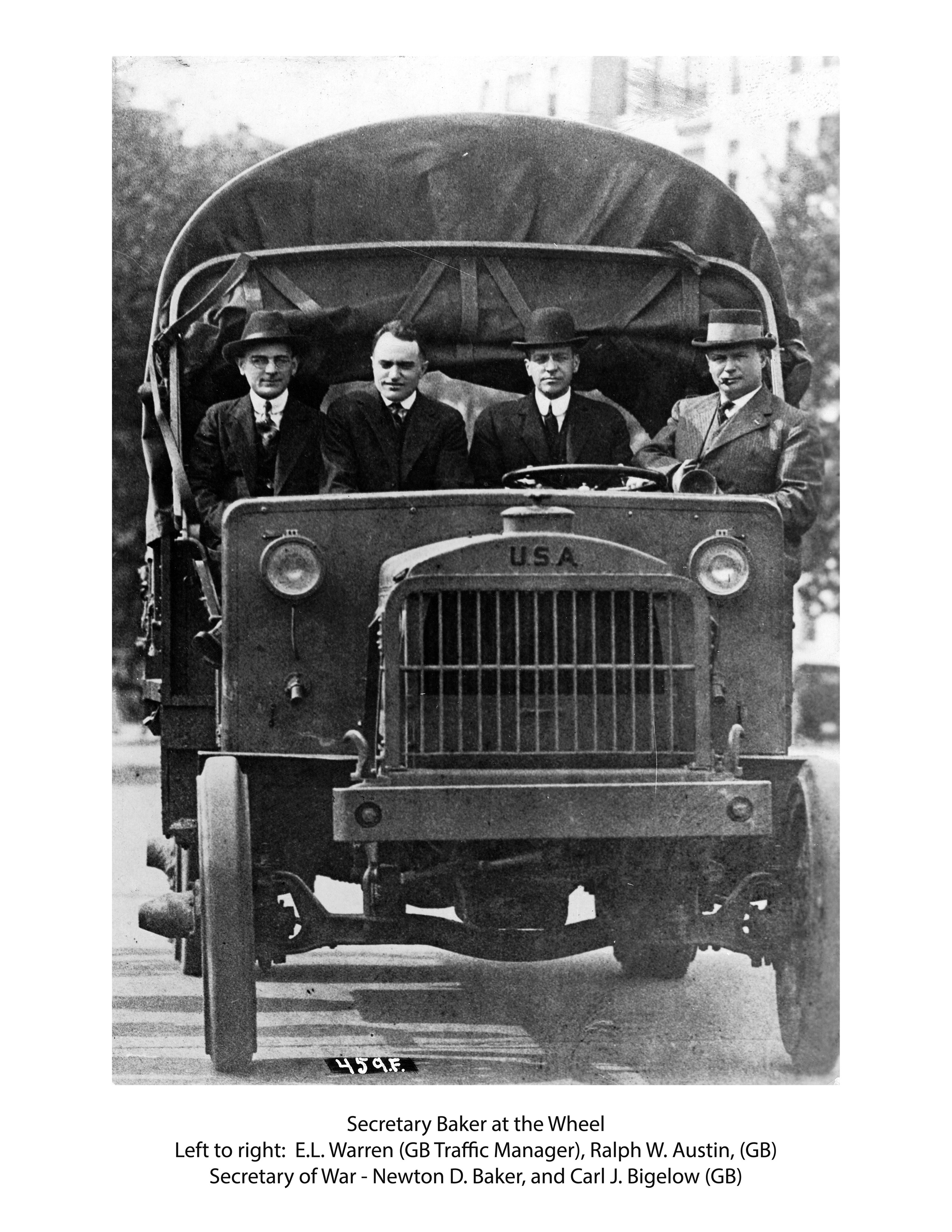
SAE expertise developed the famous Liberty Truck that pioneered standardized military vehicle design—and helped win WWI. Soon after World War I began in 1914, motorized vehicles slowly entered military service, supplementing horse-drawn cargo wagons. By the time the U.S. entered the war in spring 1917, the Allies were operating dozens of different motor trucks, from dozens of makers, on the Western Front. Little if any parts commonality existed among any of them. This situation created a service and logistics nightmare for the Allied armies. In Paris, an entire 12-story building with hundreds of clerks was dedicated to managing over 2 million component part numbers for the army motor vehicles then in use, according to Albert Mroz, author of American Military Vehicles of World War I, An Illustrated History (McFarland & Co., 2009). Taking a page from Henry Ford’s well-known playbook, U.S. Army Quartermaster Corps planners moved quickly to develop specifications for a standardized truck design that could be produced rapidly by industry. The call to action was amplified by the influential trade journal The Automobile and Automotive Industries which editorialized, “For every hour of delay, men will die sudden and horrible deaths.” Presumably the writer meant death on the battlefield rather than in the parts office in Paris. The young Society of Automobile Engineers played a major role in developing the standardized vehicle that soon became known as the Liberty Truck. A group of SAE members, mostly employed by truck makers and all ‘on loan’ from their companies, spearheaded the Liberty program. In August 1917, the 50-strong team began work to meet the Army’s specs. The aggressive production date was just six months away. Trucks of two primary payload ratings were developed. The 1½-ton (1360-kg) model was called the Standard A. There was far greater demand for the larger 3- to 5-ton (2722-kg to 4536-kg) Standard B model with 160- in (4064-mm) wheelbase; it became the Liberty. Meantime, 150 suppliers were engaged to produce the 7,500 parts in the bill of material. The Liberty’s powertrain featured a 4-cylinder, 424-in3 (6.9- L) gasoline engine, with cast aluminum crankcase and cast-iron cylinders and heads. Bore and stroke measured 4.75 x 6 in (121 x 152 mm). Supplied by engine makers Continental, Waukesha, and Wisconsin, the mammoth four generated 52 hp (39 kW). Spark was provided by two separate (magneto and battery type) ignition systems to ensure reliability. A 4-speed transmission and worm-drive rear axle completed the robust driveline. Testing showed the unladen Standard B Liberty to be capable of 15 mph (24 km/h). The Army selected 15 truck manufacturers, including famous marques Brockway, Diamond T, Packard and Pierce-Arrow, to produce the Standard B Liberty. Their factories began shipping the first of 7,500 Liberty Trucks to France in February 1918—about 11 weeks after development began. Other OEMs not included in the program developed their own models for military use. Mack, for example, delivered over 6,000 of its famous AC “Bulldog” model, beloved by British and U.S. forces. Developed with SAE expertise, the Liberty Truck helped win WWI and established U.S. military vehicle standardization. More than 9,300 examples were produced before the remaining 43,000-unit order was cancelled following the Armistice on November 11, 1918.