

































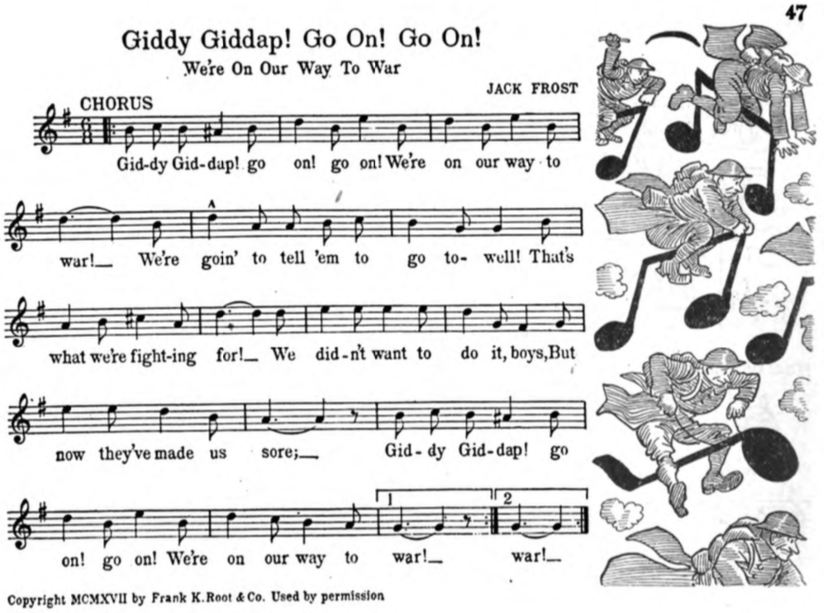
Giddy Giddap! go on! go on!
We’re on our way to war!
We’re goin’ to tell ‘em to go to well!
That’s what we’re fighting for!
We didn’t want to do it, boys,
But now they’ve made us sore;
Giddy Giddap! go on! go on!
We’re on our way to war!
Jack Frost composed this song in 1917 and was published the same year in Chicago by Frank K. Root and Co. The sheet music can be found at the Pritzker Military Museum & Library. There are no records how popular this song was during the war, but the lyrics are clear that this is a recruitment song. The title, rhythm, and the illustration on the side seem to target the cavalry division of the army.
When the U.S. entered the war in 1917, the country had already gained significant cavalry experience during the Pancho Villa Expedition from 1916 to 1917. In May 1917, a month after the US declaration of war, the National Defense Act of 1916 went into effect, that created the 18th through the 25th US Cavalry regiments. Later that month, twenty more cavalry regiments were created.
However, considering the challenges of trench warfare and modern weapons such as machine guns, cavalry warfare would have been impractical. Indeed, horses were used mainly for transporting ammunition and supplies to the front line. Thus, when the lyrics imitate the giddy-giddap of horses, they do not necessarily refer only to the cavalry division but to the entire military effort to support the soldiers. Further, this effort would have also functioned to convince the American public that “We’re on our way to war!”
For more information on horses in World War I, Brooke USA has written articles on American horses and mules that served in the war. https://www.worldwar1centennial.org/index.php/brookeusa-home-page.html

http://www.library.ucsb.edu/OBJID/Cylinder5602
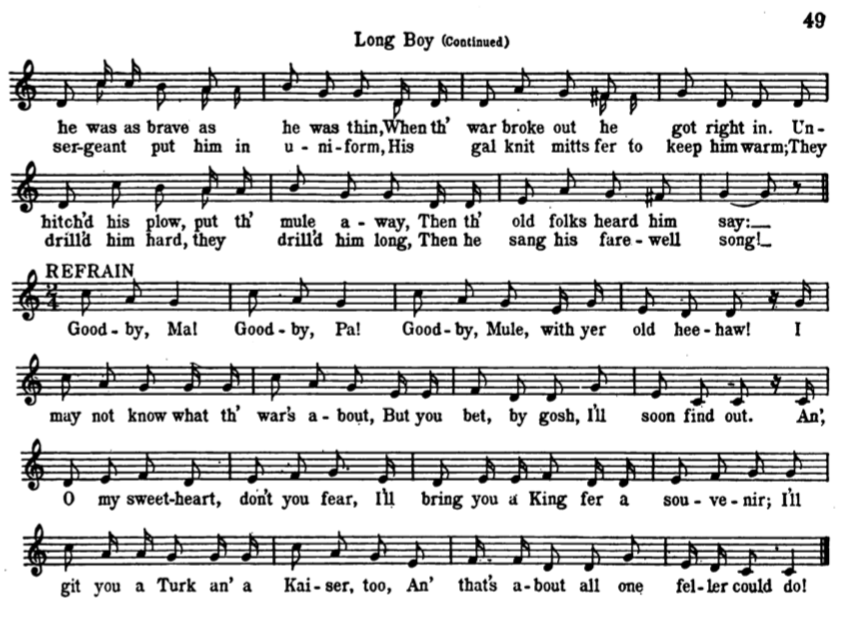
1. He was just a long, lean country gink
From ‘way out West where th’ hop toads wink;
He was six feet two in his stockin’ feet,
An’ kept gittin’ thinner th’ more he’d eat.
But he was as brave as he was thin,
When th’ war broke out he got right in.
Unhitch’d his plow, put th’ mule away,
Then th’ old folks heard him say:
(Refrain)
Good by, Ma!
Good by, Pa!
Good by, Mule with yer old hee haw!
I may not know what th’ war’s about,
But you bet, by gosh, I’ll soon find out.
An,’ O my sweetheart, don’t you fear,
I’ll bring you a King for a souvenir;
I’ll git you a Turk an’ a Kaiser, too,
An’ that’s about all one feller could do!
2. One pair of socks was his only load
When he stuck fer town by th’ old dirt road.
He went right down to th’ public square
An’ fell in line with th’ soldiers there.
Th’ sergeant put him in uniform,
His gal knit mitts fer to keep him warm;
They drill’d him hard, they drill’d him long,
Then he sang his farewell song!
(Refrain)
Also known as “Goodbye, Ma! Goodbye, Pa! Goodbye, Mule, with Yer Old Hee-Haw!, this song was written by Herschell and Walker in 1917. The lyrics tells, in a humorous tone, about the story of the very thin “country gink” who leaves his farm duties to join the army. The chorus is his farewell to his parents, “sweetheart,” and the family’s mule.
As with the previous songs that exhibited the rural qualities of the American midwest, the boy described in this song is a naive young fellow who is not interested in questioning the purpose of the war. Was this the ideal fellow the military was looking for? Indeed, the government would have had no trouble convincing and recruiting young men with this mindset. Thus, depicting the rural American midwest was an ideal picture for government propaganda. While naive fellows showed off their innocence in following government directives without question, depicting the untouched beauty of the rolling plains of the country farms and contrasting it to the ugly destruction of the Western Front convinced Americans that they had to protect their homeland to preserve its beauty.
Although the lyrics tell of a subject that “may not know what th’ war’s about,” by including the Turk, Kaiser, and King in the following lines, the subject is not at all alienated from what is really going on in Europe. To whom was this song intended for? Country folks or city people? Since Herschell wrote the lyrics during his time as the editor of the Indianapolis newspaper and the music was published in New York’s Tin Pan Alley by Shapiro, Bernstein & Co., perhaps Herschell used his background as a country folk to inspire city people of their unquestioning loyalty to the government’s agenda.
http://mediaschool.indiana.edu/ijhf/william-miller-herschell

https://www.youtube.com/watch?v=GznXltV1CBs
Keep your head down, Fritzie Boy!
Keep your head down, Fritzie Boy!
Late last night by the “star shell” light
We Saw You! We Saw You!
You were fixing your barbed wire,
When we opened rapid fire,
If you want to see your father in the Fatherland,
Keep your head down, Fritzie Boy!
Composed by Clarence Murphy and David Worton in 1918, this humorous song was based on older music hall favorites, “Hold Your Hand Out” and “Naughty Boy.” These songs were already popular with British troops. Lieutenant Gitz Rice, a Canadian gunnery officer who served in Ypres, Somme, and Vimy Ridge, popularized this song among Canadian and American troops. He sang and played the piano in concert parties held at the Front. Since Rice was under British command, he may have adapted this song after hearing it from the British troops. Rice is also credited for popularizing other wartime songs: “Dear Old Pal of Mine,” “On the Road That Leads to Home,” and “Fun In Flanders.”
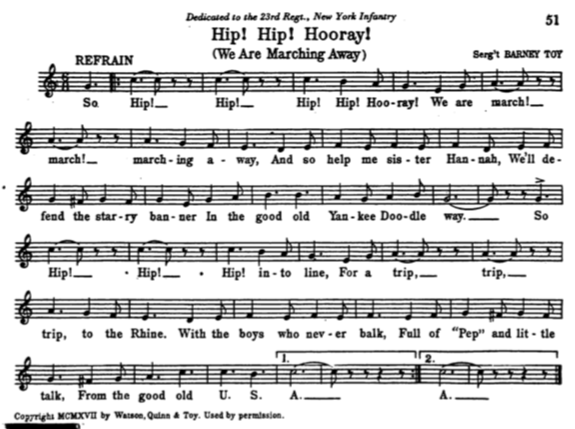
So Hip! Hip! Hip! Hip! Hooray!
We are march! march! marching away,
And so help me sister Hannah,
We’ll defend the starry banner
In the good old Yankee Doodle way.
So Hip! Hip! Hip! In to line,
For a trip, trip, trip, to the Rhine.
With the boys who never balk,
Fall of “Pep” and little talk,
From the good old U.S.A.
Written by Sergeant Barney Toy in 1917, this song is dedicated to his infantry division. Toy was known to head his men with music. In a telegram from the Chief of Staff of the 27th Division to the 106th Infantry dated June 28, 1918, it tells of how Sergeant Toy led his regiment.
Heavy firing far to the right told the positions of the guns; the roar of enemy planes, punctuated with blinding flashes indicated the locality of bursting aerial bombs dropped from the sky in an attempt to locate and destroy the gunners. And so the march was continued until dawn of the 4th of July when the goal was reached staggering under the weight of full packs and singing some favorite marching song, -- ending always with the battle cry “MINEOLA”! - MINEOLA” the plucky regiment went into billets; this was at Lederzeele in Flanders. In keeping with the spirit of the day, the band headed by the inimitable Barney Toy, marched and countermarched through the town, playing patriotic airs and popular medleys in a vain attempt to revive the weary troops but to no avail for by now the men were wrapped in slumber.
When Chas G. Woolsey visited Camp Wadsworth, he observed a battalion on its way to France. He wrote that when the battalion saw him, they immediately sang "Hip! Hip! Hooray!" and "We are March! March! Marching Away!" He further wrote that he could still hear them long after they had marched away. To Woolsey, this was an experience that made him appreciate the value of the singing program in the Army.
https://dmna.ny.gov/historic/reghist/wwi/infantry/106thInf/1999.0011_06_Chap06.pdf
National Committee on Army and Navy Camp Music, "Music in the Camps, No. 39," RG 287, National Archives, Washington, DC.
http://www.library.ucsb.edu/OBJID/Cylinder1065
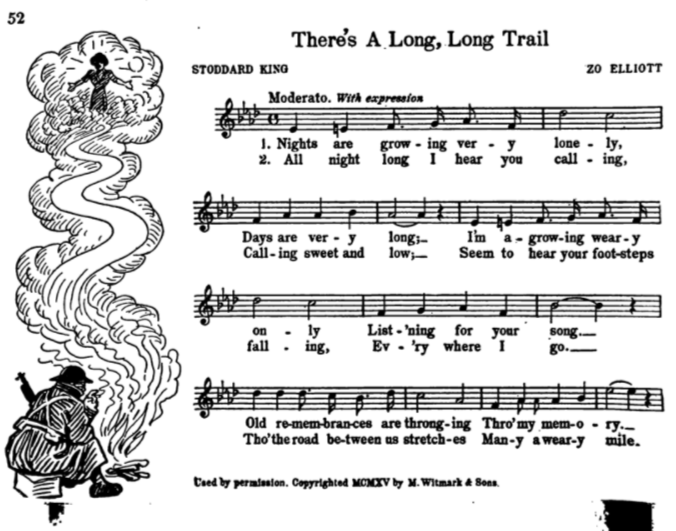
1. Nights are growing very lonely,
Days are very long;
I’m a growing weary only
List’ning for your song.
Old remembrances are thronging
Thro’ my memory.
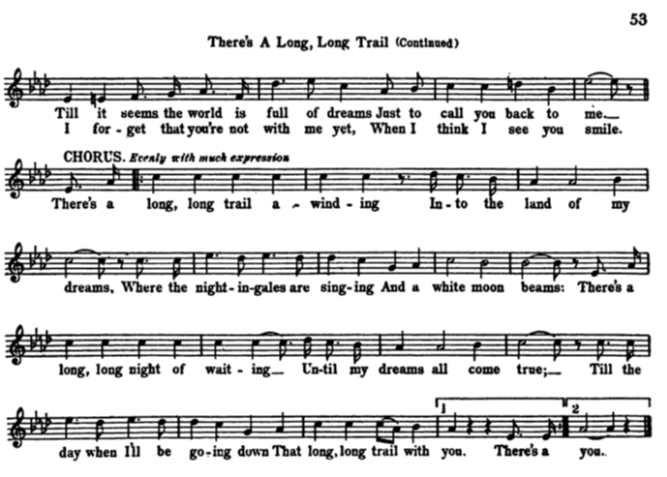
Till it seems the world is full of dreams
Just to call you back to me.
(Chorus)
There’s a long, long trail a winding
Into the land of my dreams,
Where the nightingales are singing
And a white moon beams:
There’s a long, long night of waiting
Until my dreams all come true;
Till the day when I’ll be going down
That long, long trail with you.
2. All night long I hear you calling,
Calling sweet and low,
Seem to hear your footsteps falling,
Ev’ry where I go.
Tho’ the road between us stretches
Many a weary mile.
I forget that you’re not with me yet,
When I think I see you smile.
Elliott and King, classmates at Yale College, wrote this song in 1913 that was published a year later. In a 1964 interview for the New Haven Register, Elliott discussed how the song came about. The article for this interview was later reprinted in the Yankee Magazine.
Elliott tells Marc Drogin how he created the music in his dorm room. When King entered the room, he liked the music and uttered the first line of the lyrics. Elliot followed up with the second line and the two alternated pitching in ideas to complete the song. They performed this song for a banquet in honor of their fraternity, the Zeta Psi, that evening. Later, Elliot tells how the song first attracted widespread attention when “a boatload of Canadian soldiers sang it coming down the Thames from a Sunday outing.” It was then picked up by the British Tommies and brought with them as they marched off to the trenches.
The song was used primarily as a recruiting tool and to garner support for the war effort. It was also used by the Canadian Highlanders when they came marching down Broadway in New York in July 1917, for wartime fundraising events led by Enrico Caruso and Alma Gluck, and in vaudeville shows and concerts before film showings.
Elliot remembers that his fellow Yale recruits also sang the song in the Officer Training Camp in Plattsburgh: “I remember the remarkable sensation of hearing my tune start with the big fellows up front, pass through my own squad, reach the end of the column, and then be taken up by the next company.”
https://web.library.yale.edu/.../gilmore-insights-iconic-world-war-i-song-theres-long-l..
page 103 of "The Best of Yankee Magazine"

http://www.library.ucsb.edu/OBJID/Cylinder8093
1. They were summoned from the hillside,
They were called in from the glen,
And the Country found them ready at the stirring call for men.
Let no tears add to their hardships,
As the soldiers pass along,
And although your heart is breaking,
Make it sing this cheery song.
(Refrain)
Keep the Home fires burning
While your hearts are yearning,
Through the dark cloud shining,
Turn the dark cloud inside out,
Till the boys come home.
2. Over seas there came a pleading,
“Help a nation in distress!”
And we gave our glorious ladies;
Honor bade us do no less.
For no gallant son of freedom
To a tyrant’s yoke should bend;
And a noble heart must answer
To the sacred call of “Friend.”
(Refrain)
“Keep the Home Fires Burning” is a British patriotic song composed for the war effort in 1914 by Ivor Novello. The lyrics were completed by the American poet, Lena Gilbert Ford who would die two years later in an air raid. The song became very popular alongside “It’s a Long Way to Tipperary.”
The song evokes a haunting effect and bridges the physical and emotional gap between the trenches and the home front. Although the melancholic melody may convey suffering, the title clearly tells the listener to have hope and “keep the home fires burning.” Someday, the “boys” will return home and will surely be welcomed in a nice warm house.
Novello has clear ideas how the piece should be performed. In a Home Notes magazine from December 1915, Novello guides the listener through the song’s shifts in tone. Beginning with a “bold attack,” the “growing crescendo corresponds to the lyrics as they tell the listener that “the country found them ready.” The song then falls back into a “sustained, soothing sound” on the word “yearning.” This is followed by a cheerful directive to “turn the dark cloud inside out.” In the article, he also warns that “Whatever happens, don’t overdo it.”
https://theconversation.com/the-story-behind-world-war-is-greatest-anthem-100-years-on-31601
http://www.library.ucsb.edu/OBJID/Cylinder4139
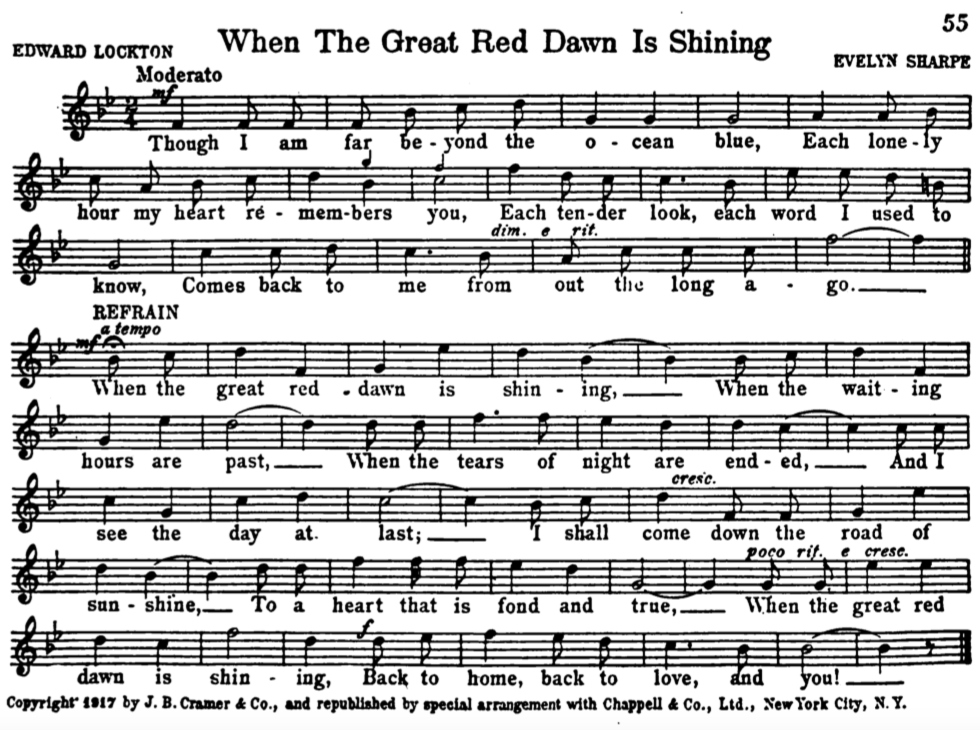
Though I am far beyond the ocean blue,
Each lonely hour my heart remembers you,
Each tender look, each word I used to know,
Come back to me from out the long ago.
(Refrain)
When the great red dawn is shining,
When the waiting hours are past,
When the tears of night are ended,
And I see the day at last;
I shall come down the road of sunshine,
To a heart that is food and true,
When the great red dawn is shining,
Back to home, back to love, and you!
“When the Great Red Dawn is Shining” is a song about a soldier’s experience of being away from home, a loved one, and his eventual return home. Popular in the Royal Canadian Newfoundland Regiment, the song was published in the U.S. in 1917.
The composer Evelyn Sharpe was born in 1884 and died in 1969. She composed songs, carols, church music and piano pieces for children.
https://www.awm.gov.au/articles/blog/recording-music-first-world-war-do-you-know-these-musicians
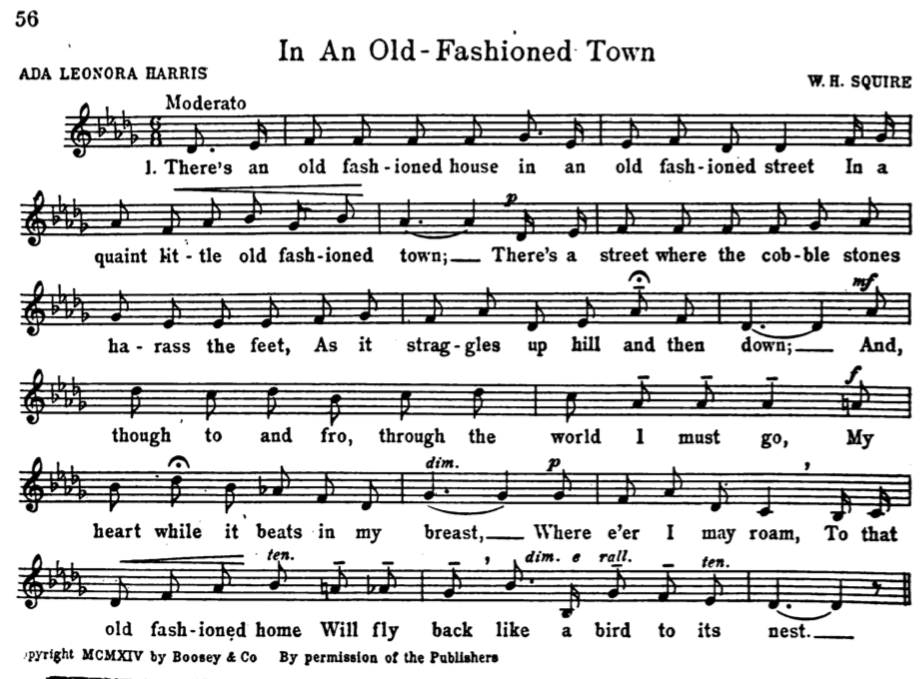
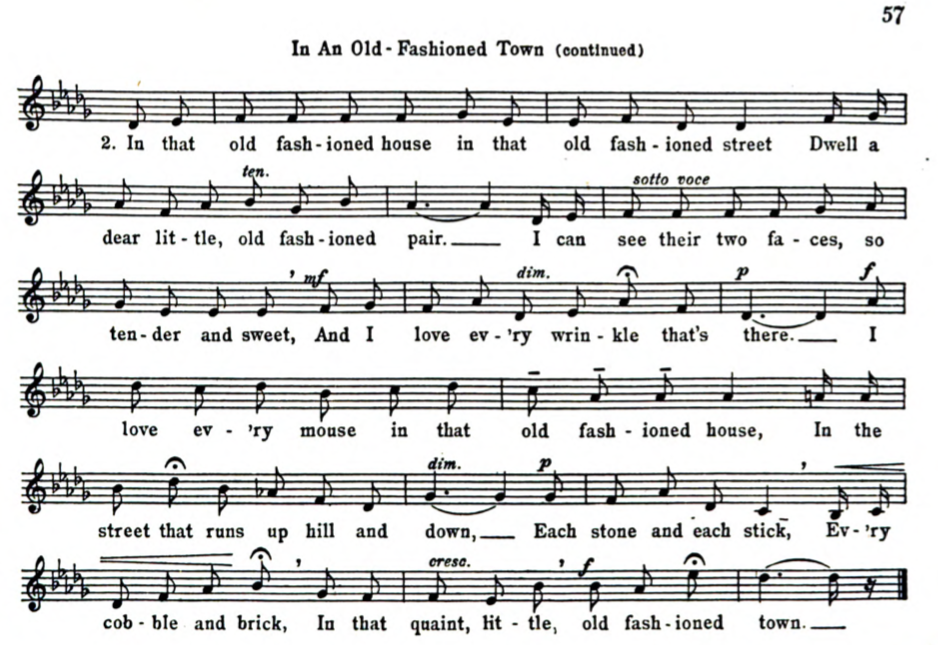
http://www.loc.gov/jukebox/recordings/detail/id/4849
1. There’s an old fashioned house in an old fashioned street
In a quaint kittle old fashioned town;
There’s a street where the cobble stones harass the feet,
As it straggles up hill and then down;
And, though to and fro, through the world I must go,
My heart while it beats in my breast,
Where e’er I may roam,
To that old fashioned home
Will fly back like a bird to its nest.
2. In that old fashioned house in that old fashioned street
Dwell a dear little, old fashioned pair.
I can see their two faces, so tender and sweet,
And I love ev’ry wrinkle that’s there.
I love ev’ry mouse in that old fashioned house,
In the street runs up hill and down,
Each stone and each stick,
Ev’ry cobble and brick,
In that quaint little, old fashioned town.
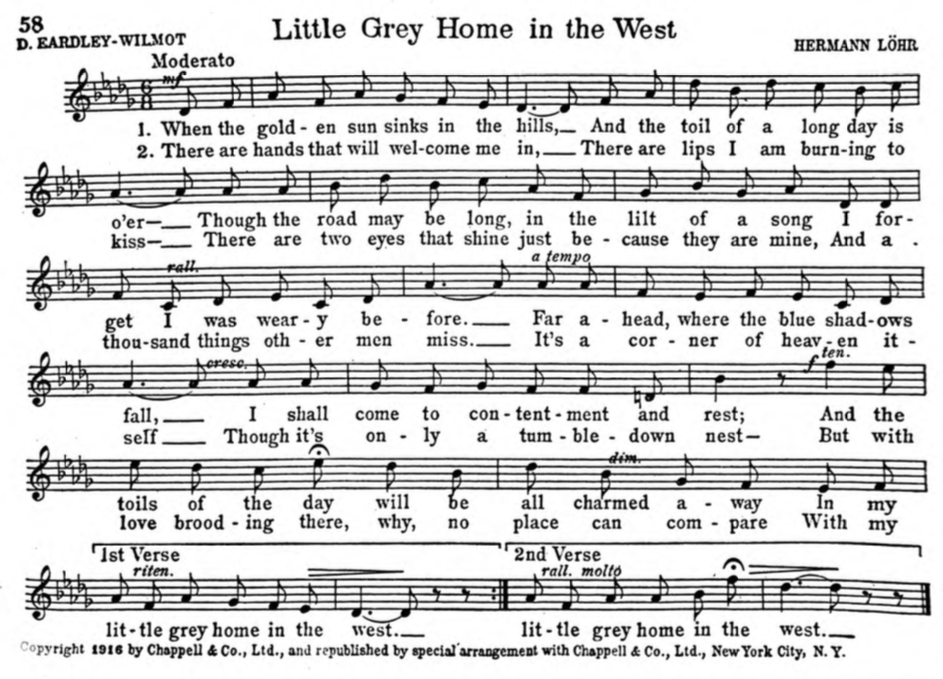
http://www.library.ucsb.edu/OBJID/Cylinder9335
1. When the golden sun sinks in the hills,
And the toil of a long day is o’er
Though the road may be long, in the lilt of a song
I forget I was weary before.
Far ahead, where the blue shadows fall,
I shall come to contentment and rest;
And the toils of the day will be all charmed away
In my little grey home in the west.
2. There are hands that will welcome me in,
There are lips I am burning to kiss
There are two eyes that shine just because they are mine,
And a thousand things other men miss.
It’s a corner of heaven itself
Though it’s only a tumble down nest
But with love brooding there, why, no place can compare
With my little grey home in the west.