






























Practice of Medicine
Rehabilitation
 Soldiers have forever been crippled by war. One of the great accomplishments of World War 1 medicine was to institute rehabilitation programs on a scale which had not previously been seen. Reconstruction and rehabilitation of injured soldiers assumed a much greater importance than after previous wars. Battlefield survival after injury was much higher. Once an injured soldier reached medical care, there was a 95% chance of surviving. The types of injuries were more likely to produce mutilating injuries. Two-thirds of casualties were from artillery, rather from rifle or machine gun bullets. Mortality following amputations was only 5%, compared with 50% or higher in earlier wars. Finally,society in general had come to see a much greater obligation to wounded soldiers. American policy was that no patient should be discharged until their wounds were completely healed, and they were provided adequate physical therapy and reconstruction.
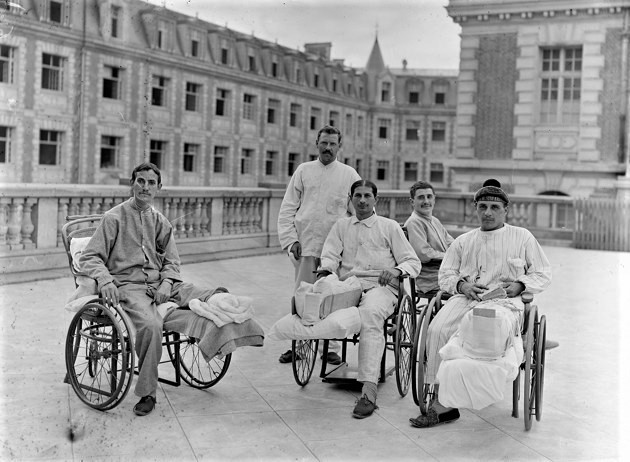 American Amputees in Convalescent Hospital
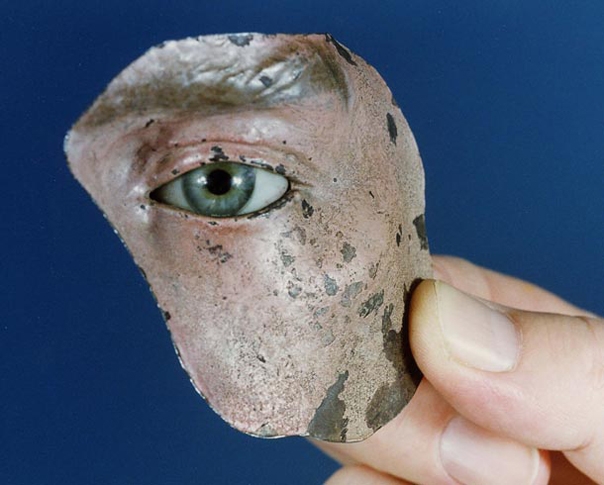
Facial ProsthesisSurgical reconstruction and physical therapy had advanced greatly over the last half of the 19th century. Orthopedic surgery had advanced the care of fractures and other extremity injuries far beyond that seen in earlier wars. Plastic and reconstructive surgery had emerged as a medical specialty. Its development was greatly accelerated by the large number of soldiers who could benefit from reconstruction. Facial wounds in particular were the subject for extensive reconstruction, to permit men with disfiguring injuries to have an acceptable appearance. Psychiatry and psychology were still struggling to deal with mental casualties such as “shell shock”, but their abilities to deal with these mental diseases were far better than earlier generations of physicians. In all of this, American military physicians were greatly assisted by their British and French counterparts, who had been caring for war casualties for the previous three years. Many American physicians had already traveled to Britain or France to help care for wounded soldiers and civilians.
Physical therapy, which is supervised exercise closely targeted on recovery from musculoskeletal injuries, was just emerging as a specialized medical field. It includes both physicians and non-physician therapists trained to help people recover to the extent of their abilities. But there was no such service in the Army before the Great War. Seeing a need, Surgeon General Gorgas established, on 22 August 1917, the Division of Special Hospitals and Physical Reconstruction. Finding few trained therapists, the Army set up 6 training schools across the country, from Boston to Oregon. While most stayed in the U.S., 80 were assigned to the AEF in France. Physical therapy was retained as a part of Army medicine after the war, and is now an important part of the Army Medical Specialist Corps today.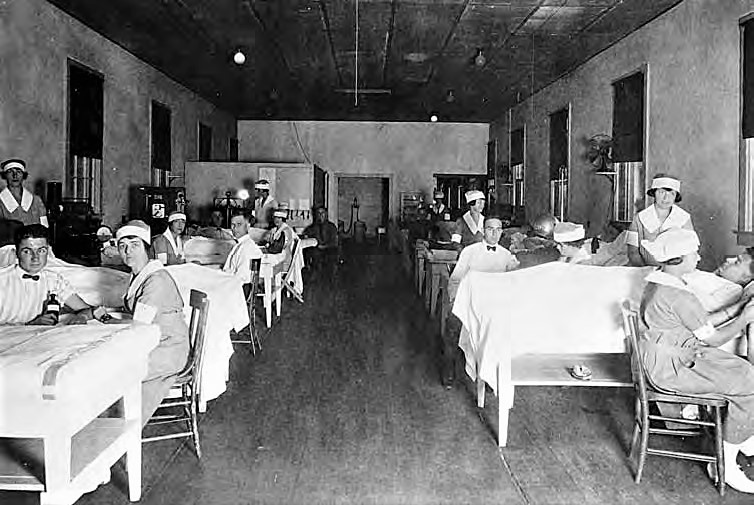 Physical Therapy Ward, Walter Reed Army Hospital, Washington, DC
Prosthetics for amputated limbs and other body parts was considerably advanced over previous centuries, when a “peg leg” was about as much as the victim could expect. In 1913, Charles Desoutter, an aeronautical engineer, made an artificial leg for his brother Marcel. He used duralumin, an aluminum alloy. Their prosthesis was half the weight of wooden prostheses. The British government contracted Desoutter Brothers (est. 1913), to make large numbers of these prostheses for war veterans. A U.S. Company, 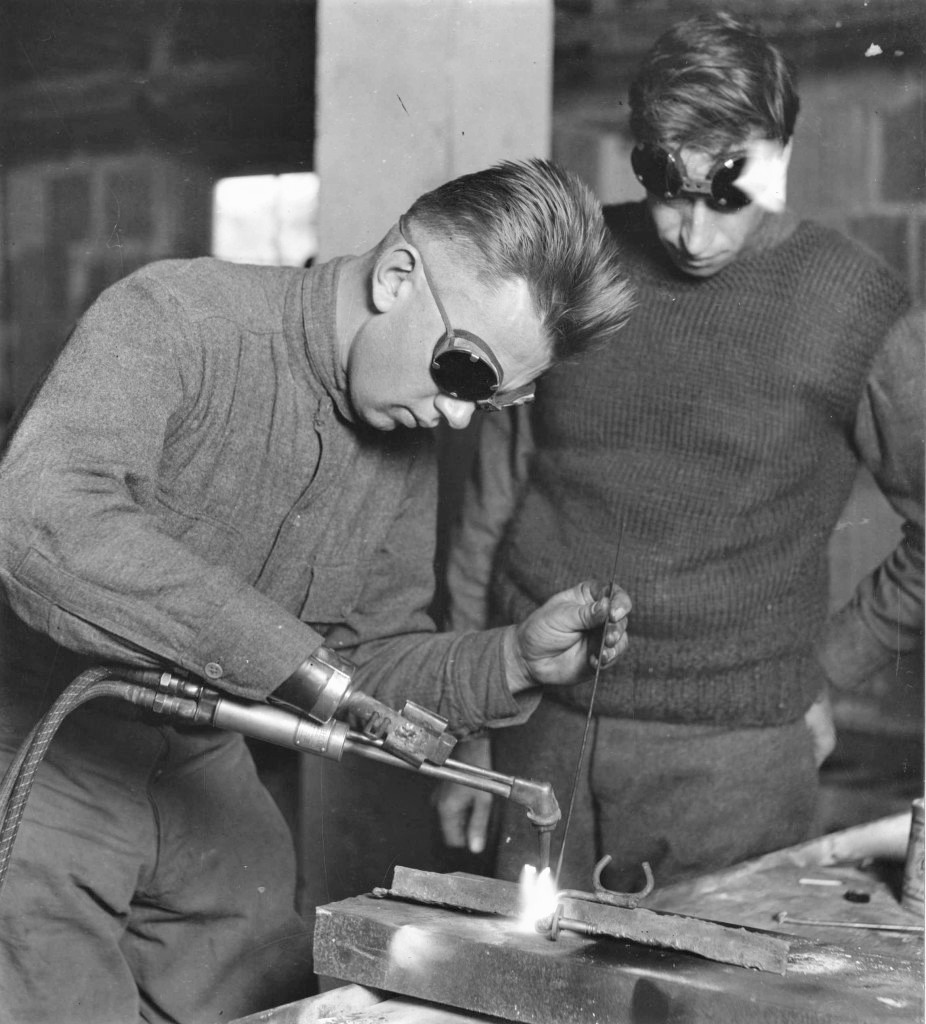 American Welder
J.E. Hanger, also made them for the British, and later for the United States. Upper extremity prostheses were also greatly improved. While some prostheses simply provided a lifelike hand, so theyprostheses were also greatly improved. While some prostheses simply provided a lifelike hand, so they could be used to conceal the loss of an arm, others increasingly were fashioned to accept functional attachments.
Surgeon General Gorgas also recognized the need for education, to prepare injured veterans to return to productive lives. The current term is vocational rehabilitation. An education branch was established, providing not only specialized vocational training but also general education in subjects such as English and mathematics. Training was begun while patients were still recovering from wounds, and then continued for the duration of their rehabilitation. Between 110,000 and 120,000 soldiers participated in the education program.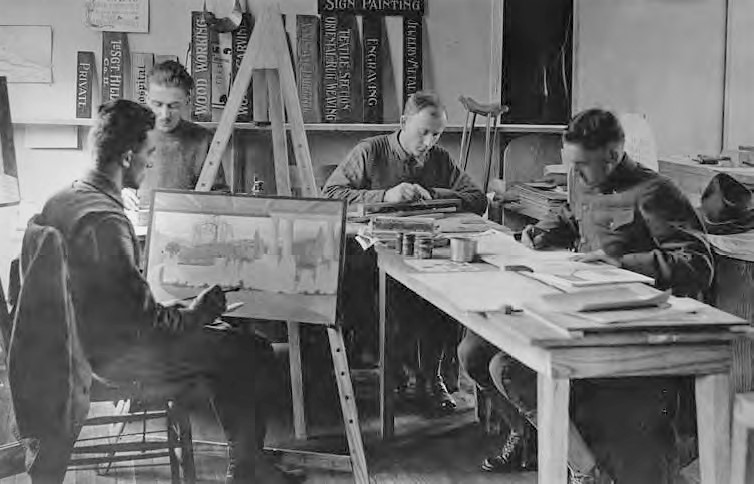 Workshop for Disabled, Walter Reed Army Hospital, Washington, DC
The Great War, with its large number of casualties, and its severe and disfiguring wounds, placed a great obligation on Army medicine not only to preserve life, but to repair injuries and to prepare injured veterans for their return to society and to productive lives. Doing this required that the Medical Department take on a number of new roles, and to become far more comprehensively involved with rehabilitation medicine than ever before. These new roles and responsibilities have become a part of military medicine today, to the great benefit of the American soldier.