




























Practice of Medicine
Public Health and Sanitation
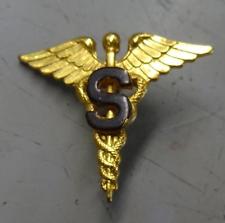 Sanitary Corps Insignia
Public health has always been important to armies. Wars have been decided by disease. For example, Napoleon’s invasion of Russia in 1812 failed as much because of typhus, a louse-borne disease, as because of the Russian army, or for that matter, the Russian “General Winter”. In the American Civil War, disease killed twice or more soldiers than enemy action. In the Spanish-American War, between 5 and 9 times as many soldiers died of disease as of wounds in battle. Public health includes things like clean food and water, sewage disposal, insect control, and the design and maintenance of encampments. Up until the Great War, all of this was the responsibility of the military commander, advised by military physicians. But as knowledge of diseases and their prevention grew, this simple approach became more and more inadequate. As the Army expanded in the Great War, Surgeon General Gorgas established the Sanitary Corps. Its purpose was to recruit officers who had "special skills in sanitation, sanitary engineering, in bacteriology, or other sciences related to sanitation and preventive medicine…” By the end of the war, it had expanded to 2900 officers, freeing medical officers to care for patients, and making specialized expertise available to commanders. The Sanitary Corps was the predecessor of today’s Medical Service Corps.
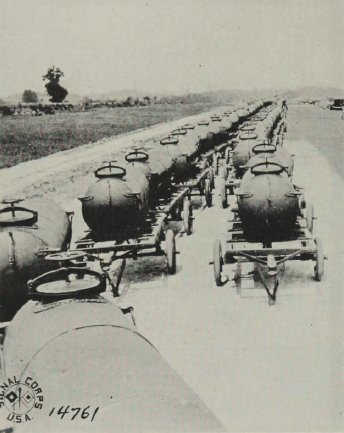
Consider the problems of maintaining an Army division in the field. As organized in World War 1, an American division included 27,000 men, plus another 10-12,000 support troops. Even at 12 men to a tent, that’s a lot of tents, spread out over a large area. Simply providing latrines is a major engineering effort, not to mention waste disposal. Add to that bringing in clean water every day, enough food for tens of thousands of soldiers, providing as many as 200 mess halls, and carrying out the resulting trash and garbage. Then consider the horses. Even in an Army which had little horse cavalry, the division still had a regiment of cavalry, plus enough other horses for officers. Horses require still more food and water, and the waste disposal was a chronic problem. Not to mention flies. Then, disease prevention, which includes keeping down mosquitoes, making sure troops are lice-free, setting up quarantine wards for soldiers with communicable diseases, and vaccinating for smallpox and typhoid, and yellow fever in tropical environments.
Before the American Army could be sent to France, it had to be gathered up, and trained. The goal was to send two million men to France. The first major job of the Army Medical Department, for which the Sanitary Corps was crucial, was to oversee inducting those men into the Army, help to set up a large number of training camps in the United States, and ensure that those camps were as disease-free as possible. Bringing young men in large groups into communal living, often in tents, was then and is now an invitation to epidemic disease. Some 40 camps were set up, with about half being in the states of the old Confederacy. Many were in former National Guard camps, others were new. In all cases, large numbers of barracks, classrooms, mess halls, laundries, dispensaries, hospitals, and other facilities had to be built. 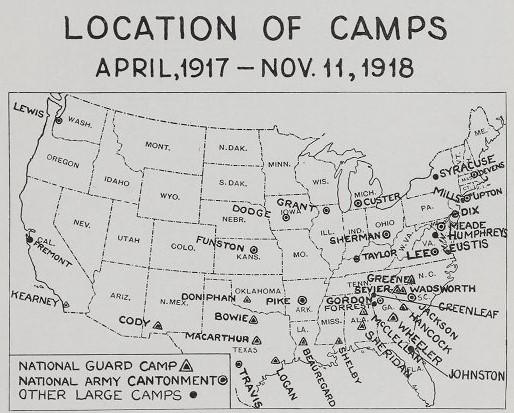
As units began to move over to France, more facilities were built to house and train the new American army. Before advancing to the front lines, soldiers typically underwent several weeks of training by French or British instructors on the new form of trench warfare. Again, the Medical Department was responsible for maintaining health, including inspecting the facilities, ensuring food and water supplies, and of course treating illnesses as they occurred. Just in the American Expeditionary Force, there were cases (and deaths!) from measles, mumps, meningitis, tuberculosis, typhoid fever, malaria, diphtheria, and smallpox. The largest problem was influenza and pneumonia. Influenza, when severe, would lead to pneumonia, and pneumonia carried a 40-50% death rate in this pre-antibiotic era.
Supervision of food preparation fell under the Sanitary Corps. While the Medical Department didn’t set up or operate kitchens and mess halls, save for its own troops, medical officers were responsible for inspecting eating facilities to ensure proper practices. Under field conditions, this could be difficult; but badly prepared food could put an entire battalion out of action.
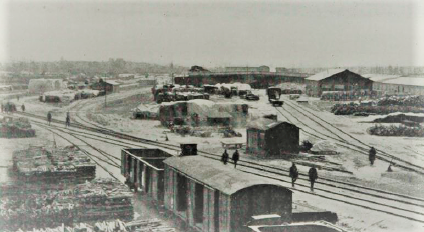
Medical Supply Depot, Is-sur-TillMedical facilities such as dispensaries, aid stations, and hospitals require an immense amount of supply. Separate supply depots were established in the United States and in France to collect the needed supplies in the United States, prepare them to be shipped overseas, and then collect and distribute them in France to some 30 to 40 hospitals and many smaller medical facilities.
In summary, the public health aspects of military medicine remained a continuing challenge. If the goal of forming the Sanitary Corps was to prevent disease, it was only partially successful. Taking the Army as a whole, more soldiers died of disease (57,460) than of battle injuries (50,280). Half of those disease deaths were from the world-wide influenza epidemic, which peaked in the fall and winter of 1918-19. But none of the armies of the Great War did very much better. Conditions of training camps across the world were much better than in the previous century, but they were still worse than would be seen today. The trench warfare of the Western Front, in particular, forced troops into a disease-ridden, anti-hygienic, hostile environment. Public health as a component of military medicine had been neglected for so long, and the concepts were so new, that all armies struggled with preventing disease. No army was more than partly successful in maintaining the health of their soldiers.