































_____ ♦ _____
Ralph N. DOERRES
Sgt., 332nd Inf., Co. "L"
Submitted by the children of Ralph N. Doerres

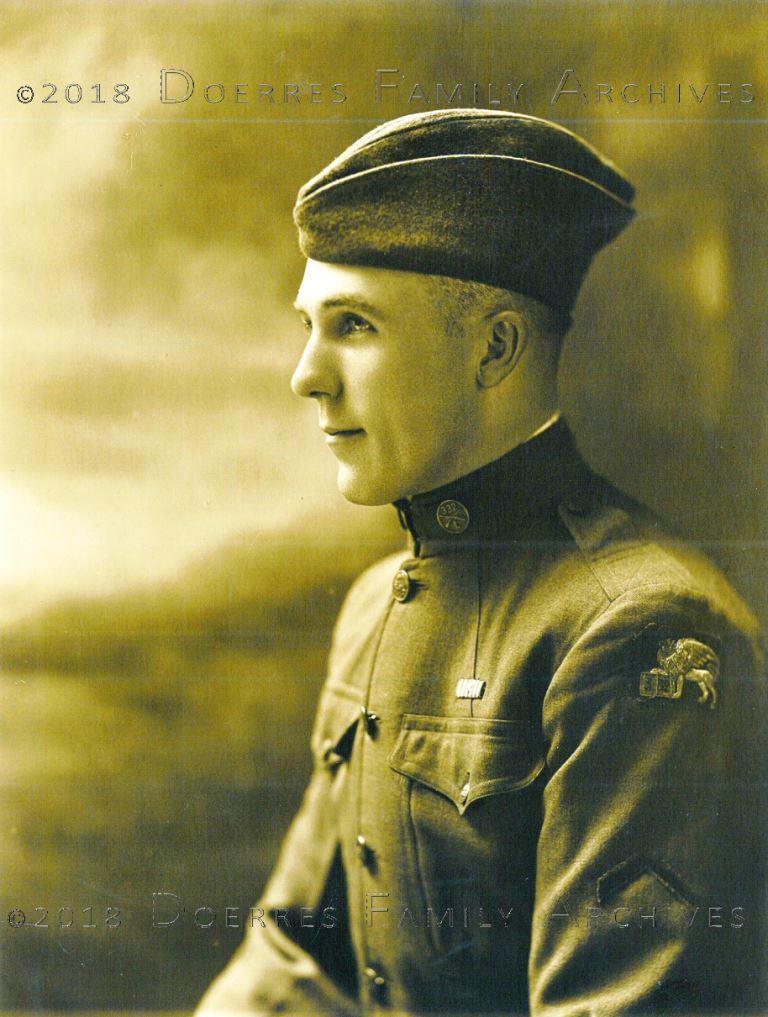 Ralph Norman DOERRES, our father ("Daddy" to us), was one of the few men to serve exclusively with the 332nd Infantry Regiment in WWI from when it was organized in the late summer, 1917 to when it was demobilized in May, 1919 — he took part in or witnessed just about every aspect of the adventures of "Wallace's Circus."
Born in Chillicothe, Ohio in 1892, the fourth of five children of Mary Dimity Doerres and John Doerres, Ralph was educated in Chillicothe's public schools (his father was a member of the school board). Shortly after finishing high school, he enlisted in Company "H", 4th Infantry, Ohio National Guard in July 1910 serving until 1915 and attaining the rank of Sergeant.
Ralph was working at Youngstown Sheet and Tube as an "efficiency engineer" when he registered for the draft in 1917. Once Chillicothe had been selected as the site of Camp Sherman and the first round of the draft was imminent, he returned to his hometown. He wrote to his draft board, Youngstown No. 1, requesting that he be " ... included in the first five percent of the quota ..." and for permission "... to report to Commanding Officer of Camp Sherman, Wednesday, September 5th. ..." and signed it "Yours for service." His letter was returned to him with the handwritten reply "... You will have to wait until your turn comes ..."
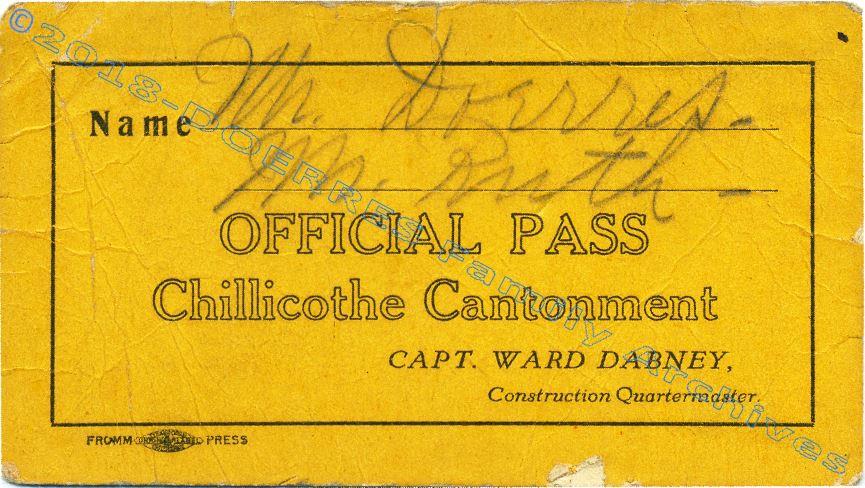 In the meantime, he secured a civilian job at Camp Sherman working for the general contractor responsible for building the new National Army cantonment, A. Bentley and Sons Company.
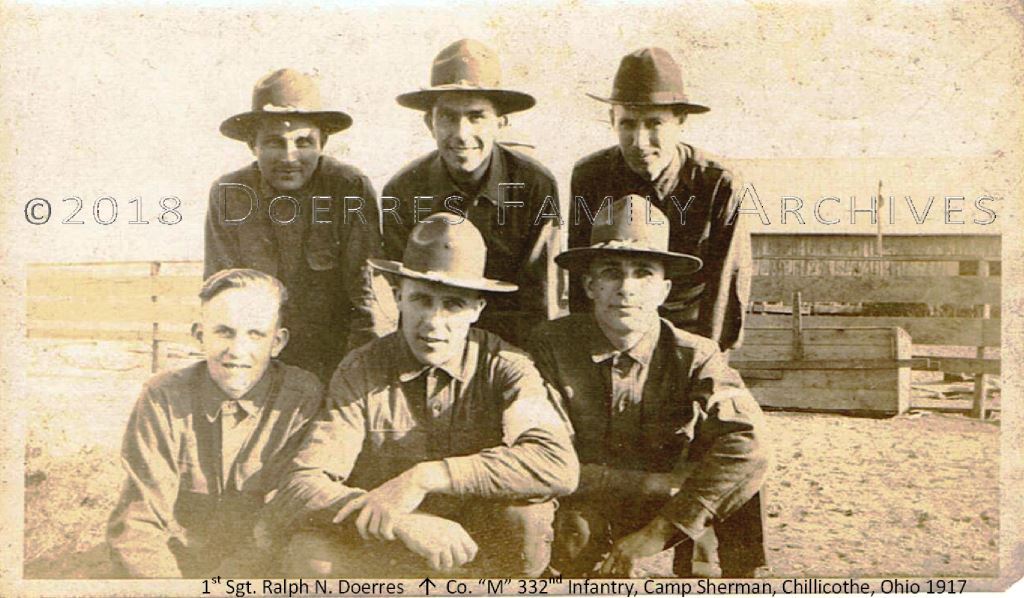
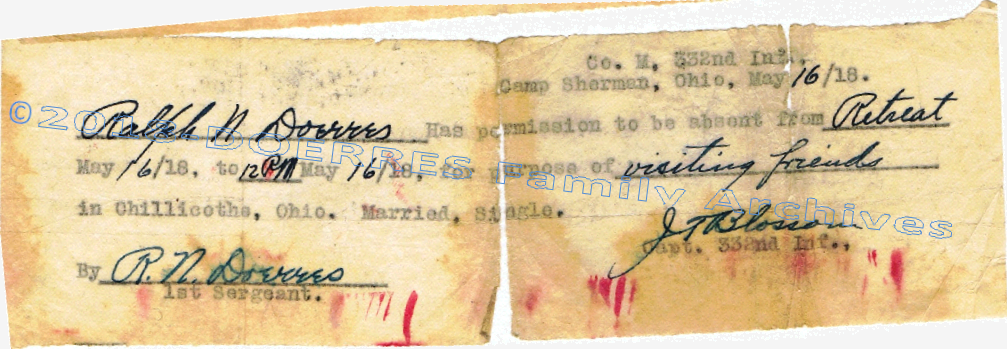
Ralph received official orders to report for duty at Camp Sherman in the middle of September. He was assigned directly to the 332nd Infantry's Company "M" and soon there after appointed 1st Sergeant.
* * *
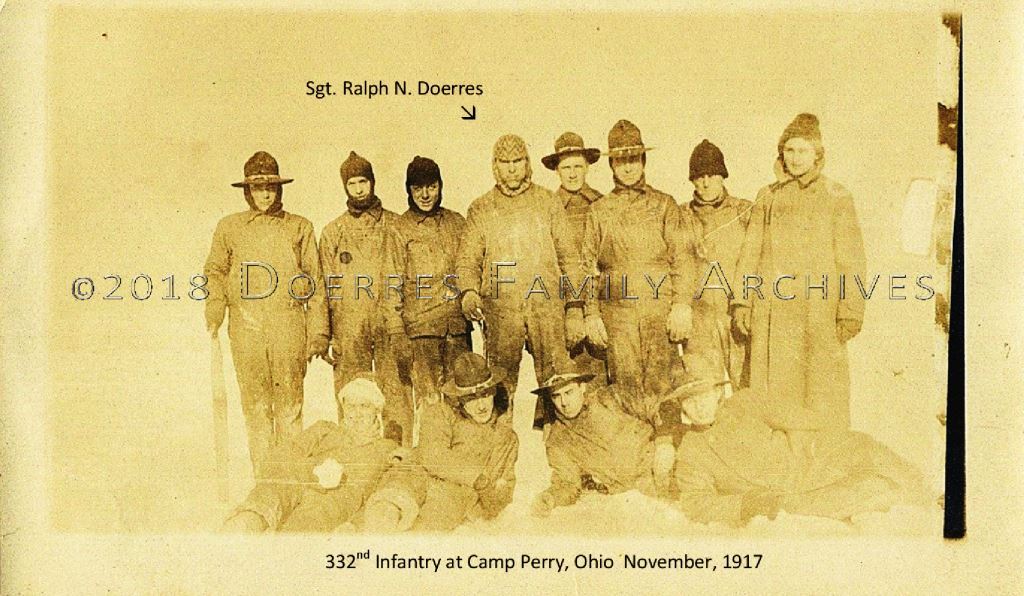
During the 332nd Infantry's rifle training excursion at Camp Perry, Ohio along the shores of Lake Erie, Ralph wrote to his sister in Chillicothe :
“11-23-17 Dear Sis: - Am having a grand time. Has been raining since we arrived yesterday AM. Is snowing now and the wind is blowing a gale and it is rather cold. We are living in tents with wooden floors + have small stoves in them. We manage to keep comparatively comfortable. Will write more later when I have more time. Give my regards to everyone. Write soon. As ever Ralph. We sure have a plenty of mud, in fact nothing but mud”
* * *
Normally, Ralph would have no reason to send a letter home since Chillicothe, the location of Camp Sherman, was his hometown. One evening in mid-December, however, he wrote this one to his sister who lived only about 4 miles away:
"Sunday Eve. Dec 16th 1917 Dear Sis : — I wouldn’t write this note if I didn’t have to. When I returned to camp last night I found that our company was quarantined. As yet we don’t know just what we are in for. We have one man in the hospital with the measles and another with pneumonia neither of them serious. Now don’t worry any about it for it es nothing serious and we will probably be loose in a few days.
As it is now, none of us can leave our barracks and no one but men of our Company can come in, of course, we go out to drill, etc. that is in the vicinity of the barracks.
Say, I can tell you what you can do if you will. Send me the paper out until we are released, as se can’t get any papers, stamps or anything else. ...
Another thing, such things as a little candy and cigars wouldn’t go bad for we can’t buy them at the exchange as we did before.
And say, if you get a chance tell Pop and any of the fellows about it, as I told them I would be in again Thursday night.
It sure was a quiet day as no one bothered me about a pass to go down town. Now, again don’t worry any. Will probably be able to get away in a few days.
As ever Ralph
Ralph was reassigned as 1st Sergeant of Company “L” when the 332nd Infantry reorganized in May, 1918 as it was infused with a slew of fairly new draftees necessary to fill out its ranks just before leaving Camp Sherman to join the A.E.F. in France.
* * *
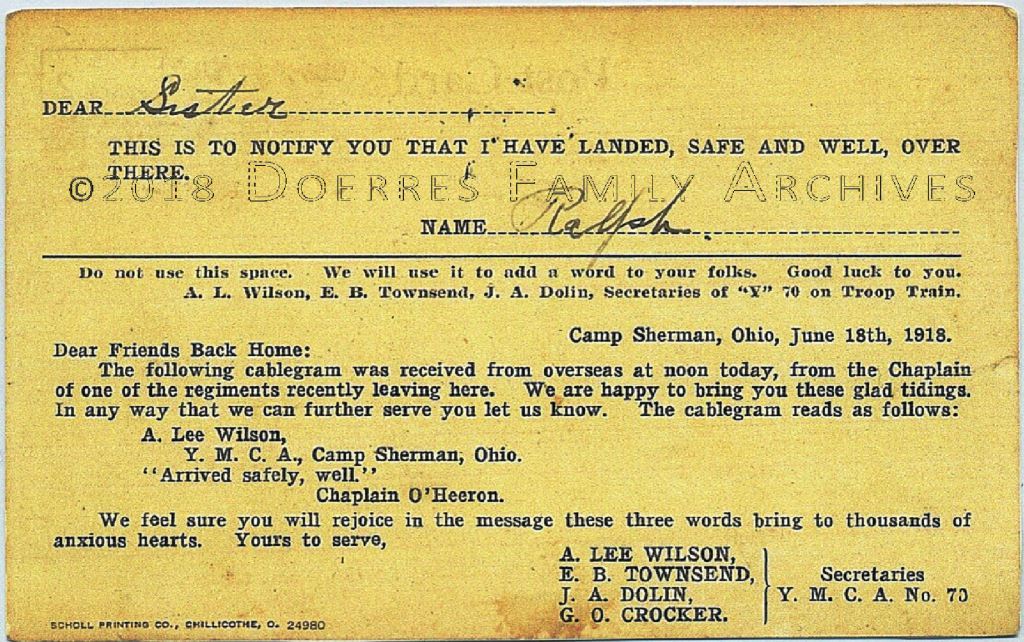
Only a few days after Co. “L” settled in at the French village of Essey les Eaux General Pershing and France’s Prime Minister Clemenceau came by to inspect the newly arrived troops of the 332nd Infantry prior to selecting Colonel Walllace's regiment as the sole U.S. combat unit to serve on the Italian Front. Ralph's own Co. "L" was one of the units Pershing and Clemenceau inspected that day. [ Click here to read the Article about the selection of the 332nd Infantry for duty on the Italian Front ]
* * *
Once all of the excitement of traveling to Italy and the ceremony upon arrival had died down and regular military life had resumed, the time in the new country for the men of the 332nd was fairly ordinary and uneventful. At least that's the way Ralph described in his letters. After the regiment had moved into camp at Valeggio, Ralph wrote:
“Italy 8-25 1918 Dear Sis, … I think I wrote you last just before we moved out of the town where we were quartered to this place where we are in a regular camp under canvas so I’ll not have a great deal to tell you.
“It has been almost two weeks since we moved out here and believe me it sure is a relief to get away from being cooped up in a stuffy old billet as most of them are. We have quite a camp here and by now things are fixed up pretty nice. We have the regular squad tents and as only six of us happened to be in this one, we have plenty of room and have it fixed up pretty nice. From the way they are fixing up everything it looks as if here is where we stay until it is all over. We have a Red Cross building and also a YMCA where they have almost everything a fellow wants [a small section at the end of this paragraph is blacked out with heavy pencil scribbling—it is not clear if Ralph did this or that his letter was censored].
“Nothing exciting has taken place since being here, about all we do is easy on with a regular drill schedule, with Sat afternoon and Sundays off. The drill is not at all hard, but the heat is something fierce. Such a thing as rain is unknown here and believe me winter an cold weather sure will be welcome. There is a river near here and a plunge in it certainly goes good. The water is great being quite warm and as clear as a crystal, one being able to see the bottom almost at any depth. …
“Now for a little more and then I’ll stop. As yet we are just as far from the front as ever, with no prospect of seeing it very soon. The whole bunch is much on the fence as to why we are down here and to what we are going to do in the future. Most likely the same as we have done in the past, that is nothing. …”
During the next couple of weeks the goings-on around “Camp Wallace” seemed to have become a bit less routine:
“Italy 9-8 1918 Dear Sis, Nothing much to write about this week. Made the trip to the trenches, as I told you, on schedule time. We had our evening mess enroute, arriving at destinations and relieved other battalion according to previous arrangements. We all had a most enjoyable time of it. We had just got located and comfortably settled to pass a quiet and pleasant night, but for some reason our plans failed for about the middle of the night it began to rain and with it the fun began. No attempt was made to keep dry, because we were all soaked to the skin right at the start and remained so until the next afternoon, when it stopped raining long enough for us to dry off, before being relieved. Many dropped on the ground where they stood and went to sleep, paying no attention to the rain whatever, others stood up against trees and a few pitched their pup tents. It sure was a great night and a fine looking bunch the next morning, but everyone was happy. Too many humorous incidents happened to mention, so I’ll say nothing about them except there were some dandies and to appreciate them, one had to be at the scene of action. We were relieved and arrive back in camp on time and I mean all were glad to get back to the squad tents and bunks. I guess that about finishes said trip, so I’ll go on with what happened during the rest of the past week. Nothing exciting happened at in fact we had a very quiet week.
“About all we did the whole week with the exception of yesterday and today was to go out to a place near here and practice grenade throwing from 7AM to 2PM and the day was done. Very easy schedule. Yesterday was devoted to equipment and quarters inspection in the AM and a ball game in the PM, the 2nd Batt coming out winners. This AM we had a regimental field meet, in which quite a number of close events were run off. Our battalion the 3rd took the lead by winning the 5 mile race and kept it up until the end coming out way ahead of the others. Nothing else doing to day. Had a good sleep right after mess and now we are enjoying a rain, snow, hail and wind storm. Thot the tent was going down and had to stop writing to help fix it up. Nothing new in the wind, lot of rumors going the rounds. Have no idea what we are going to do. …”
Ralph continued to play down the events he and the rest of the men had experienced even though there are records of much more that occurred while the 332nd Infantry was in camp at Valeggio — most likely, as "Top Sergeant" of Company "L," he was acting dutifully, intentionally being vague, appropriately omitting sensitive details and just writing about the routine and positive incidents:
“Italy 9-22 1918 Dearest Sis, Again it is time for me to write you, but what in the devil I’m going to write about I’m unable to say. So little has taken place during the las two weeks that it is hardly worth writing at all.
“During the early part of last week we paid another visit to the practice trenches but did not have near as much fun as the first time, as it didn’t rain. The latter part of the week was used up by training with the Italians. Very soft, more rest than work. As usual we had Sat and Sunday off, with the exception of attending a military funeral Sat P.M. [ he is referring to the funeral for the victims of the trench mortar training accident on September 13 – Right Click here to read about the accident ]
“The week just past amounted to almost nix in the way of news. We put in the week with the Italians again except Wednesday when we were on the rifle range.
“After all scores had been counted and averaged, we found our Company stood high in the regt and also our battalion. Friday was an Italian holiday so we had nothing to do. Many of the men visited various town nearby. Nothing doing yesterday and today.
“Nothing new doing. Plenty of rumors as to what we’re going to do, but as yet we are still here, with not prospects of moving soon. Most everyone is having a good time and enjoying good health and fair grub. The weather is the best ever and quite warm which makes swimming still good. …”
* * *
A few days after the Armistice of November 11th had gone into effect, Ralph wrote home about some of his experiences since the 332nd Infantry left its camp near Valeggio. This time his letter covered more events, was more descriptive and contained much more detail:
“Somewhere in Austria Nov. 15th, 1918 “Dearest Sis: - …. I’ll go back to the time l wrote last, also to the time we started in the fight and recount some of the most interesting events.
“I stopped writing about a week before we left Treviso account of doing much hiking and things being in a more or less unsettled condition as we were all expecting to have any time. It was just four weeks ago yesterday that we started hiking and I mean we sure did hike some too, and with a full pack on our backs. We hiked every day, with the exception of Sunday, until the next weds. No one could understand the reason for so much hiking as it seemed we were only taking a walk out in the country to eat dinner such as it was and then walk back to town. Nothing of special interest happened on these hikes only we put in two days of it in a steady downpour of rain everyone getting soaked to the skin.
“You remember I spoke in my other letter of not having gone thru an airraid. Well since then we have and I don’t think anyone of us will ever forget it. It happened on the night of Oct 22nd, right in the midst of our famous tour of the country around Treviso and just at the time when all needed rest badly. Most everyone was in bed and asleep enjoying good dreams, etc. when about 11:30P.M. it let loose and at intervals of an hour and a half, it kept up until daylight. The first sounds heard was some rifle shots, fired as a warning by the guard and then the siren let go and at the same time machine guns & anti-aircraft guns started to boom, all shooting at the hostile plane or planes, which ever it was. I only saw one myself, it being seen very easily, as they had it spotted with a searchlight of which there seemed to be hundreds. When I, as well as most everyone else, first woke up, we knew that it was an air raid and that the heavy shooting was from bombs being dropped from the planes and it seemed as if they were dropping all around us and most all expected the next one to hit the building but when we were fully awake and found out that it was anti-aircraft guns doing the shooting all jammed the windows and doors to see what was doing also to watch the searchlight work and the shells burst in the air all around.
“Believe me it sure was some night. The noise and excitement of the first raid would get quieted down and all back in bed again and about half asleep, when it would let loose again. As far as I know, no bombs were dropped at all hence no casualties.
“As I said before we continued our hikes until weds and on Thurs we packed our barracks bags etc. preparatory going to the front. We all expected to go most any time, as quite a number of British troops showed up at this time and it was strongly rumored that a big drive was to be pulled off, our outfit to take part in it. On Friday just three weeks ago, we made our packs up and hiked to a field where the rest of the regiment was formed everyone thinking we were on our way up there, but after standing around for about an hour, we were ordered back to our billets, to await the call, which was liable to come at any moment. Everyone was up on their toes and ready to do their part, also quite anxious to get to the front to see what it was like, but on Sat AM, our spirits dropped to almost zero, when we ordered out for another hike. Oh! Boy, most everyone was sore, but now, we know why we hiked so much and we have almost forgotten it. When we returned to our quarters that Sat eve it was rumored the big drive was to start that night and sure enough it did. At 11:30 PM the big show began in full swing. I nor none of the rest have ever been thru or seen an artillery barrage, but we were close enough to hear it and at that it seemed as if it was just outside.
“I can hardly describe it, as I have never heard anything like it before or since, except once, after we crossed the Piave river. The barrage was being put down by the Italians, while the English were building the pontoon bridge across the river. As I mentioned before it began at 11:30 Sat night and continued until 12:30 PM Sunday. Thirteen continuous hours of it, with out a let up. It sounded as if they had all be big guns in the world going, for it shook the building in which we were quartered and the windows rattled as if someone was shaking them. I bet the Austrians thot hell had broken loose that night.
“All day Sunday and Monday, we were all set and held in readiness to move up, on a minutes notice, but none came. Reports came back that they succeeded in crossing the river and was driving the enemy back. On Monday night 10-28-18 just after everyone had a good bed fixed and was prepared to get a good nights sleep, the call came. At 10:30 PM we were on our way up, most all thinking we would be in the thick of it by daylight. Well, we hiked all night and at daylight we were held up, at the river, where we remained until Thurs AM, account of the crossing being jammed with other troops and supplies going over. When we halted at the other side of the Piave, our troubles began. We bivouacked along the road and in fields nearby, everyone looking out for himself and flopping in the best place to be found, which was usually the hard, damp ground with a pile of straw or fodder, some times without. Just about at this time, we began to run short of rations and ever since then we have been in the same fix.
“On Thursday AM we started for the river and by the evening we were across and then we started in to chase the Hun. We hiked all day and to about 10 PM that night, having mess when we stopped. Again we flopped on the ground. Everyone turning in a soon as possible, to get all the sleep they could as all knew we had a lot of hard hiking ahead of us, as well as a lot of hardships.
“Contrary to our expectations, we didn’t move until the noon the next day and when we got started again, we all figured on an all night hike, but again we were fooled and before evening we pulled in a field for the night. Most everyone by this time was of the opinion that we were not trying to catch the enemy, but they all, as well as myself, changed our minds about 1130 AM Sat, when were called out and told to get ready to hike a 2:30 AM and also that we would go into the front line 3 PM the next afternoon. We got started on time and hiked to almost daylight hitting almost every kind of road. Just before daylight we came to another river where the bridge had been blown up and had to cross on a roughly constructed bridge made from the ruins of the other. We halted about daybreak and part of the outfit was sent out as an advance guard and flank patrols. About this time we heard heavy cannon, machine gun and rifle fire, just a short distance ahead and in the midst of it all two unusually loud explosions, which we found out later, was caused by the blowing up of two bridges across another river. The firing did not last long and in a short while we were on our way, after having a breakfast of corn-beef and hard tack, as we left our rolling kitchens at our last stop. We were delayed quite a while at the next River, which was the Meduna, as the crossing was rather difficult, for no bridge had been constructed and we had and we had to scramble across in single file on the timbers of the old bridge. After everyone was across, we again took up the march and didn’t stop until 4 PM that afternoon. You remember we were supposed to catch up with the Austrians at 3 PM, but when we reached the designated spot, the bird had flown. We stopped there for the night and believe me we were all glad of it, for most everyone was pretty well all in and hungry too. We got to sleep for 14 hours that night and I believe every single man went the limit.
“We continued our program on Sunday and by evening we reached the Tagliamento river, where the enemy was expected to make a stand. We stopped and had lunch of emergency rations, as our kitchens had not yet caught up with us. We could hear miscellaneous firing all along the river and we figured on crossing the river just after dark and having a little fight, but such did not happen. Some of the snipers and two platoons, waded across, as the bridge at this point, was a wooden structure and was burning, being set on fire by the enemy, but did not succeed in stirring up a fight. At daybreak our second battalion started across at the bridge, and was met with resistance from the enemy and quite a little firing took place, both by trench mortars, machine guns and rifled. The whole thing didn’t last long, as they succeeded in crossing the river and the enemy beat it on the run. Our battalion and the first started for the river shortly afterwards, but we were stopped just as we reached there, being informed that an armistice had been signed up and all fighting on this front stopped. As luck would have it, we stopped right by a fine field and went into camp there, our kitchens arriving at the same time and say, believe me there was some cheering done, mostly account of the kitchens coming up, as the last we seen of them was Sat morning and it was Monday afternoon then.
“No doubt you wonder what we all seen on our way thru the country where the enemy had just left. Eh? Well, we sure seen enough. All along the way we saw articles of all descriptions that had been thrown away, such as ammunition, helmets, guns, knives, bayonets etc. In some places trucks, wagons and big guns that had run off the road, the enemy not having time to stopped and take them along. At various places where fights had taken place we saw most everything, dead horses and soldiers, mostly Austrians lying around. In some places we saw where horses had been killed by the Huns and their meat used for food. From the looks of things and the prisoners taken the enemy was pretty hard up for everything but guns and ammunitions. There is a good deal more to tell, but I haven’t the time as it would take too long, right now, but perhaps it won’t be many more moons before I’ll be able to tell my whole story from start to finish.
“I’ll now account for things we have done since the fighting has stopped down here. The day after the armistice was signed we moved back to Valvasone a town nearby and went into billets expecting to move back to Treviso, but the next day we got orders to go forward, crossing the Tagliamento river in the afternoon and hiking all night until 4 AM last Thurs. 17 hours hike in all. We stopped and rested until 10 AM the next day and again went on hiking to late that afternoon reaching a town named Louvaria. We billeted there that night and continued our hike Friday crossing the Tower river and went into camp on this or the eastern side. We did not expect to stay there long, but it was Tuesday AM this week before we moved. Sat afternoon we all marched down to the river and took a bath. Can you imagine taking a bath in an river on the 9th of Nov? The water was quite chilly but everyone stood it OK. I only washed me feet, head and hands as I took a bath in an irrigation ditch on the Thurs before. We pulled stakes Tuesday noon and pushed on crossing into Austria that afternoon and reaching the town of Cormons by evening, where we camped for the night. Day before yesterday we moved to this place, formerly an Austrian hospital about two miles from Cormons and her we have been since. There is no telling where we go from here but according to rumors we may go most anywhere, but home, even at that I don’t think it will be such a long time and we will be on our way. We have had things pretty hard during the last few weeks, but such was to be expected when in the field, but the outlook seems to be brighter, at least we all hope so.
“Well I guess I said enough for this time, perhaps too much, but that the chance I have stood it pretty well and am feeling good, except for a cold, which most all have. Am pretty well located here, four of us have a room with a stove in it, also iron cots with a lot of hay to sleep on, which is a luxury right now. Our feed is pretty good, but we all could stand more of it. Give my best to all and write soon. Will be glad to hear from you all and also to get those papers you are sending. Goodbye. Love Ralph”

* * *
A few weeks after the 332nd Infantry's 3rd Battalion arrived for duty in Adriatic port city of Fiume, Ralph wrote a brief letter home:
"Fiume – Austria Dec 7th 1918 Dear Sis: — ... This city is sure some place, being quite American like. Good buildings, well paved streets and all. The people are quite up to date and dress fine. There are loads of good looking girls, but so far haven’t fallen for any. Everyone treats us fine and we all are having a pretty good time. Very little drill, only two hours a day.
"They are having their winter time now. Sure is fine weather, almost like our spring. ... No such thing as snow, ice or such.
"Am in good health and sailing along OK as well as most everyone else.
"Don’t be surprised at the shortness of this letter for this will be the last one I’ll write from this side and will soon be there to tell you all about it. ..."
* * *
As political events grew more complicated in Fiume, everyday life became more frustrating and difficult for the men 3rd Battalion. In another letter home, Ralph took the opportunity to vent some of his exasperation:
"Fiume-Hungary Jan 1st, 1919 Dear Sis: - I might as well tell you right now, one of my New Years resolutions, was to write to everyone I know. Some job. Eh! Well, I don’t mean exactly everyone, but only some of the family and a few? others. If I remember right I told you all, in my last note, that I wouldn’t be writing anymore from this side. At that time, the dope was that we were going to leave soon and it would be our last mail out. Well, we all were wrong and the worst of it is, that it looks as if we may be here for the next six months to come unless things change here or someone over there raises cane about it.
"I can’t remember very well if I told you anything about this place or not, anyway I’m going to assume that I didn’t and go back to the time of our arrival here, and give you the dope concerning the city, “what’s what” and “who’s who” and the most important events of the season.
"Our arrival was a matter of small importance only a usual occurrence as far as the people were concerned.
"We marched downtown to a large school building where we have been quartered ever since. It sure is a good looking building from the outside and pretty decent on the inside, but that has nothing to do with us or our beds? I believe the boards are getting softer tho, for the men have only been sleeping on the floor for six weeks now, with only three blankets to make a bed with. Pretty nice? I guess not! That’s only one item
"Nothing what one would call real exciting has happened at all. We have had it pretty nice as far as any drill is concerned, all we do in that line is to take a two hour hike each morning and that’s all. Nothing doing on Sundays or holidays, nor on days when it rains.
"Since being here, several sub-chasers, destroyers and a cruiser, which is still here has been in port. Made a visit to them all, in hope I might find someone I know or get something to eat. I had no luck at all in finding anyone I know, but I did get one or two meals of some real food and plenty of it, as long as the boats were in port. When the cruiser leaves I don’t know what we’ll do. You understand we have been on Italian rations since being down here and if you knew what they were I’m sure you all would be a little surprised.
"I’ll drop that subject and go on with something more pleasant. Week before last, some of the bunch or rather battalion put on a minstrel show at one of the theaters, by the way, quite a regular one, just like in the States. The show was pretty fair considering the source and talent. The following night, the “YMCA” came down off their perch a little and went as far as to have a musical entertainment for us. Free for all, something quite unusual, as they never give anything to anyone unless you have the jack to pay for it and then usually cost about twice as much as it is worth. That has nothing to do with the show tho, it was really good and songs fine & up to date.
"Next on the program was another show produced by the British troops that are located here. Nuf-ced, as entertainers, singers or comedians they were good plumbers. When I tell you that that is all that has happened here, up to Xmas, you can easily see what a lazy, useless life we are living, when, for no reason on earth, we could ____ ____ doing some real good for ourselves and everyone else. Oh Hell! What’s the use to talk about it, were in the ____ army and only enlisted men, so what’s the use.
"Last week or Xmas week was just the same as any other, as far as we were concerned, nothing at all doing to make it seem like Xmas except we had a fairly decent dinner and some of the men got their boxes. I received the one you sent, yesterday and was rather surprised to get is as I didn’t send any slip and didn’t expect to get any. Many thanx! The cake and chocolate sure went good and the other things will come in handy. Thanks again.
"Today is New Years, but no one around here seems to realize it. To express it in plain words, It is a dam rotten day, has been raining all day.
"Last Monday, the sailors from the Birmingham put on a minstrel show and it sure was good, will enclose their program and you can judge for yourself.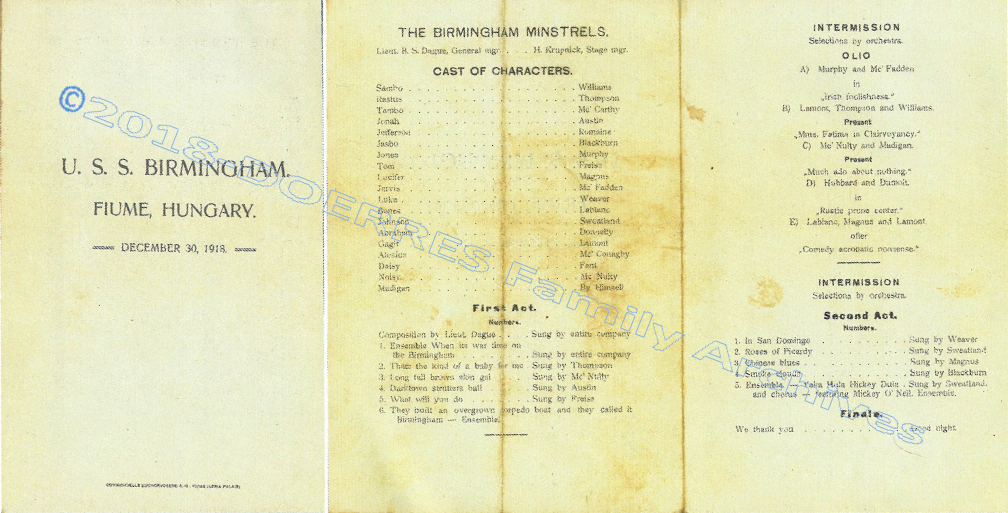
"Well Sis, I guess that is about all I can think of at this writing and there is now use for me to say much about the city, you can draw your own conclusions from the cards I sent.
"I sure would like to go ahead and tell you some honest to God, real down-right truth, but I dare not for it may get me in bad and then to. If I was to start such, I would get to raving about it and say more than I am allowed to. It’s bad enough to think about some of the things that are done or that have happened let alone talk about them, so I’ll say no more about, except things are not or never have been a bed of roses for this outfit and take this little hint from me, don’t believe all the dope you read in the papers, but instead read between the lines and take just the opposite meaning of what is said in them.
"Now don’t get all excited and go tell Anne or Dad what all I’ve said for no doubt they will worry themselves sick about it or don’t worry yourself. Just take it from me I’m all OK and in good health and will get by with the rest of them. I sure hope for the day of our liberation and freedom when we all can get back in civilian clothes again.
"Well I guess I had better stop before I get to raving. Give my best to all and remember don’t any of you do any worrying about me, but instead do a lot of wishing and hoping that we all get away for this soon and come home. Write soon.
"As ever Ralph
"P.S: - don’t forget the fact to be prepared of one awful earful for I sure have one to tell and more too, and another thing, when you get the word I am coming home prepare a lot of real food for if things keep up I’ll need it. Ralph"
* * *
As a follow-up, Ralph soon wrote home again to express his regret about sending his earlier letter and to attempt to explain his discontent :
"Fiume – Europe Jan. 5th 1919 "Dear Sis: - . . . Now for a little bit of explaining. You all or rather Leona will get a letter from me which I mailed the other day and now I wish I hadn’t done so.
"For to speak in plain English it was a hell of a letter. You will find said letter rather disconnected and won’t be able to make head from tail out of it as it was mostly devoted to raving about this and that. I shouldn’t have written it at all for at that time I was doing a good deal of crabbing about everything in general and it seemed I couldn’t tell about anything unless I got off the track and went to raving. Now don’t misunderstand me, there is nothing that letter that isn’t the truth, in fact it is not exactly true to facts as they are and have been here. I could have said a whole lot more, and not exaggerating things one bit, but then you know, if the fellows all wrote home and told the truth it would only cause their folks to do a whole lot of unnecessary worrying, when it is much easier for us to swallow things and to grin and bear the hardships and then tell about them when we get home.
"While I’m on said subject just remember that I’m capable of taking care of “Yours truly” and will get by OK and for none of you to do any worrying about me. Also remember and prepare yourselves to hear one big earful when I do get home. I’ll assure you, right now, it will be quite different from what you might expect or have read or heard about. Don’t let anyone tell you different.
"Next, I wish to thank you all for the Xmas box. Rec’d it last Monday all OK. Sure was glad to get it, especially the cake, which was more than good, having not tasted anything like it for seven months, also the chocolate, which has it all over the stuff we get here. Sure would like to get more, but take it from me, don’t try that stunt of ordering anything from concerns thru their Paris branch for they sure sting you. Several of the fellows got things that way and I mean they got stung good and proper. Everything else came in mighty handy. Have the tie on and one the handkerchiefs in my pocket now and use the gloves every time I go out. Again I say thanks and many of them. . . .
"Well I guess there isn’t a whole lot more to tell. We are carrying on, in the same old way, a two hour hike each day and that’s all, inspection on Sats & nothing doing on Sundays. Sure a fine way to spend ones life. I guess not. Everyone is getting pretty well fed up on it and want to be on the move again. Preferably Home.
"A couple of weeks ago, some of our fellows put on a show, also the “Y” and the French & British troops too. All of which were only fair. Last week some of the sailors from the U.S. Cruiser Birmingham put on a show and I mean it was a show too. Will enclose the program & you can judge for yourself. [ see image of program above ] . . .
"Nothing unusual going on here during the holidays to make it seem any different from any other time. We had a pretty food dinner Xmas, but nothing special New Years day. Xmas, we had turkey, dressing, mashed spuds, gravy, slaw, stewed figs, “wop” bread, tea and wine. Pretty good! Eh? It was the first time since I left the States that I had a real good stomach full.
"Speaking of the weather, we haven’t had any to brag or kick about. It is similar to the fall or spring in the States that is about half way or fifty-fifty hot & cold with a plenty of rain and wind mixed in, but never both at the same time. Snow never falls here in the city, altho, one can see it on the mountain tops nearby.
"There is sure some beautiful scenery around here but no chance to see it at a close up view, as we are not allowed out of the city.
"Just to cite the kind of weather we have here can you imagine sitting in a room with the window open and no coat on and being comfortable on the 5th of Jan. That is the case today. . . ."
* * *

 Day-to-day life became better for Ralph and the other men of the 332nd when the regiment was reunited at Genova in February, 1919. He was billeted in the Hotel Miramare along with most of the regiment, was granted a few days leave along the Riviera, he received his beautiful Lion of St Mark shoulder patches and was one of about a hundred of the 332nd Infantry’s men who were awarded with St. George medals by the Genovese.
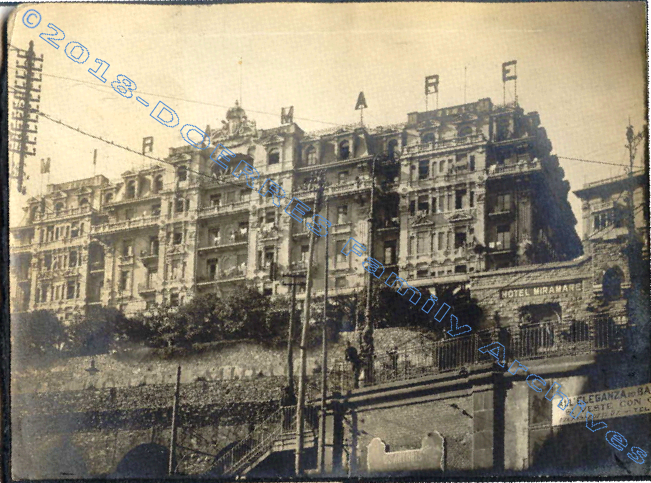
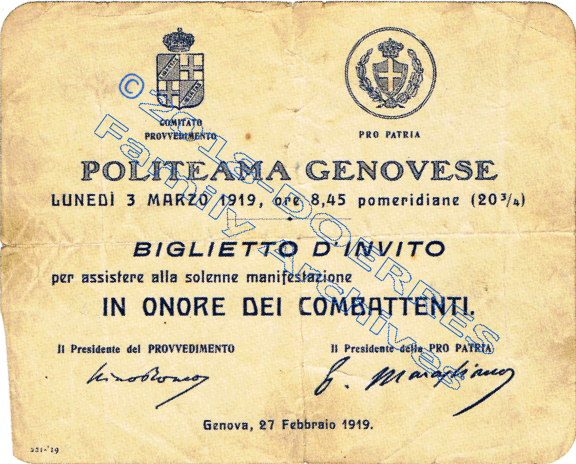
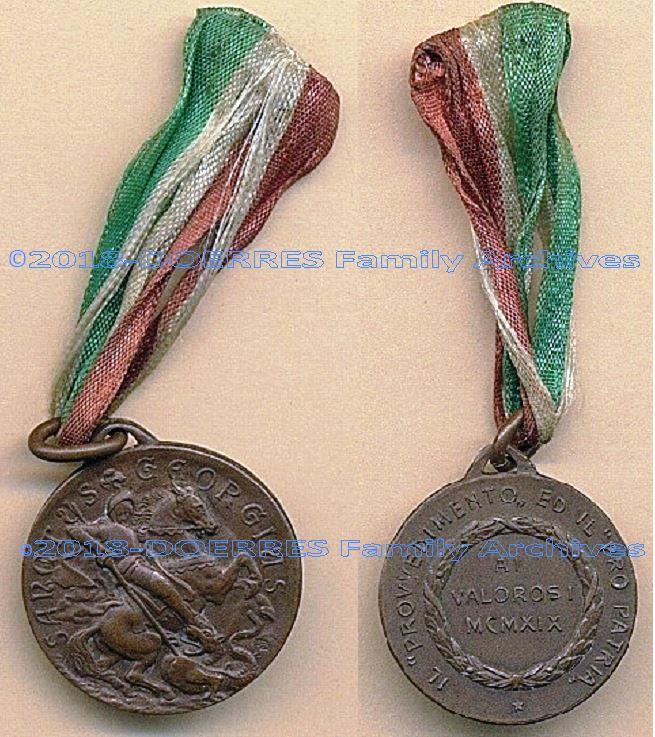
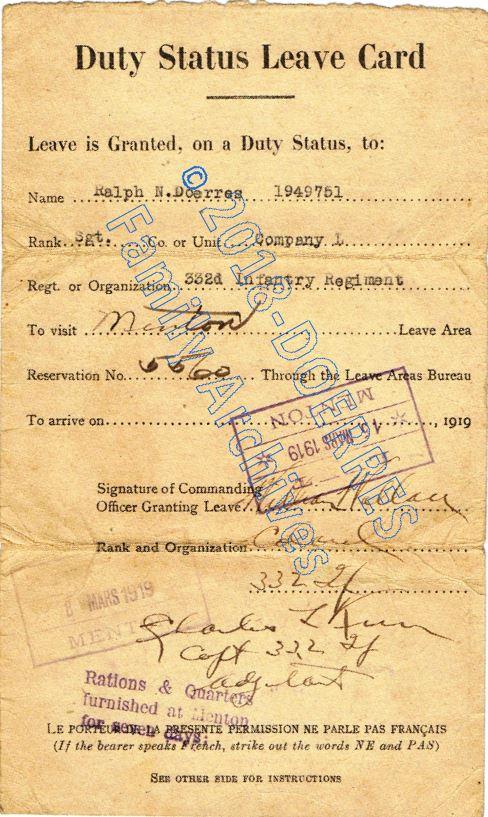 While on leave in Menton, France, he sent a brief note to his father on a postcard:
“3-11-19 Dear Father Am here on leave. Reg’t now at Genoa waiting to leave for the States. Am having a great time here. Perhaps we may leave later part of the month. Regards to all, Ralph”
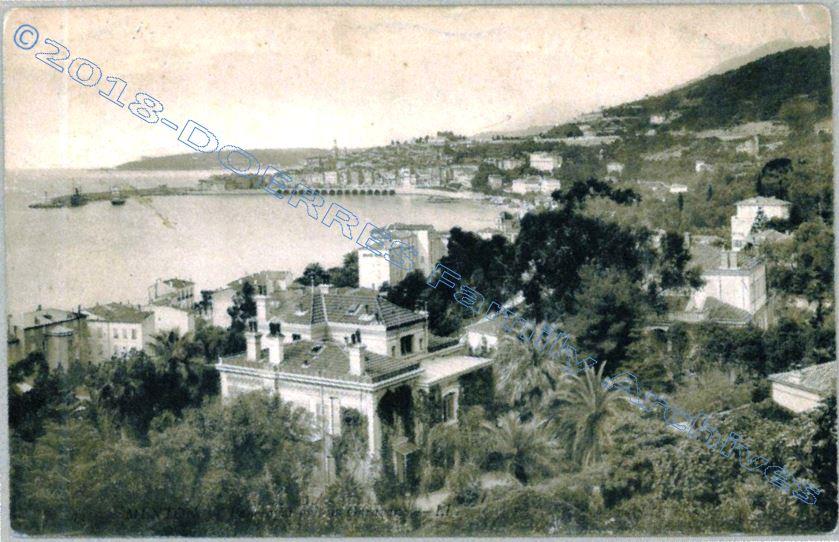
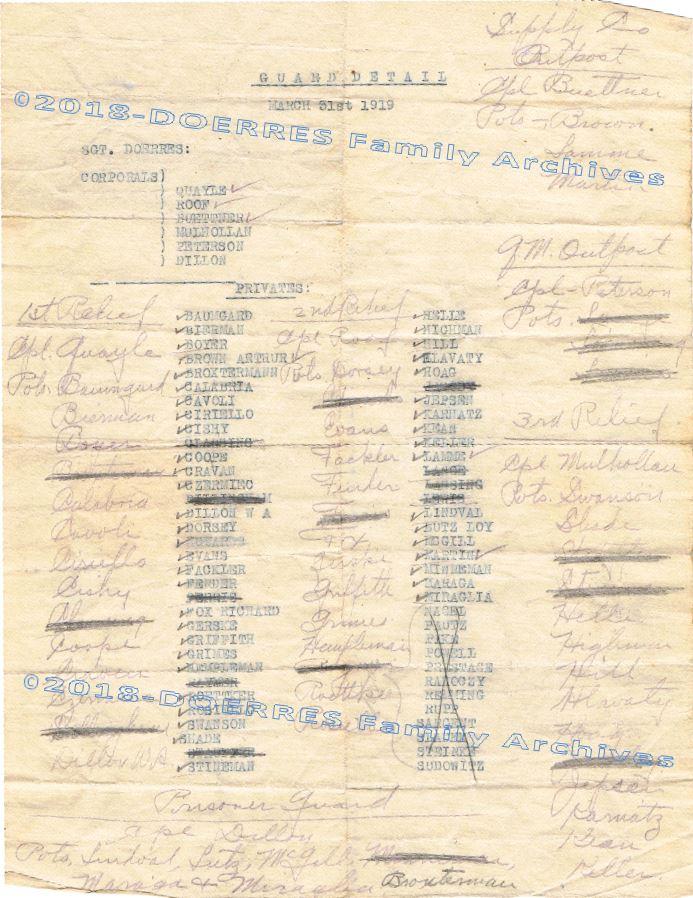
Most of the 332nd Infantry did, in fact, sail for the States at the end of March, 1919 but Company “L” remained in Genoa for a few more days to wrap up business and pick up men returning from leave.
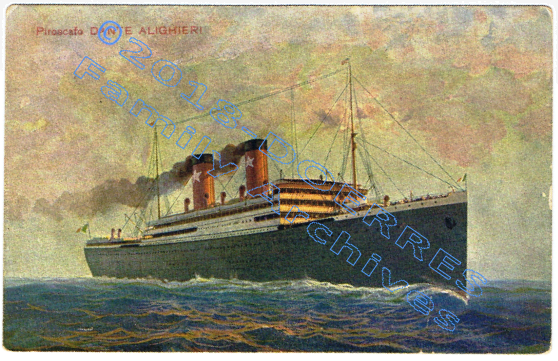 At last, in the afternoon of Thursday, April 3, 1919 Ralph set sail from Genoa aboard the steamship Dante Alighieri and arrived in New York harbor in the morning of Friday, the 18th of April—nearly a year after he and the 332nd Infantry left Camp Sherman.
Ralph paraded up 5th Ave. in NYC and along Euclid Ave. in Cleveland with his 332nd Infanty comrades. Back at Camp Sherman received his final pay, $60.00 bonus, travel pay and honorable discharge on May 5, 1919.
* * *
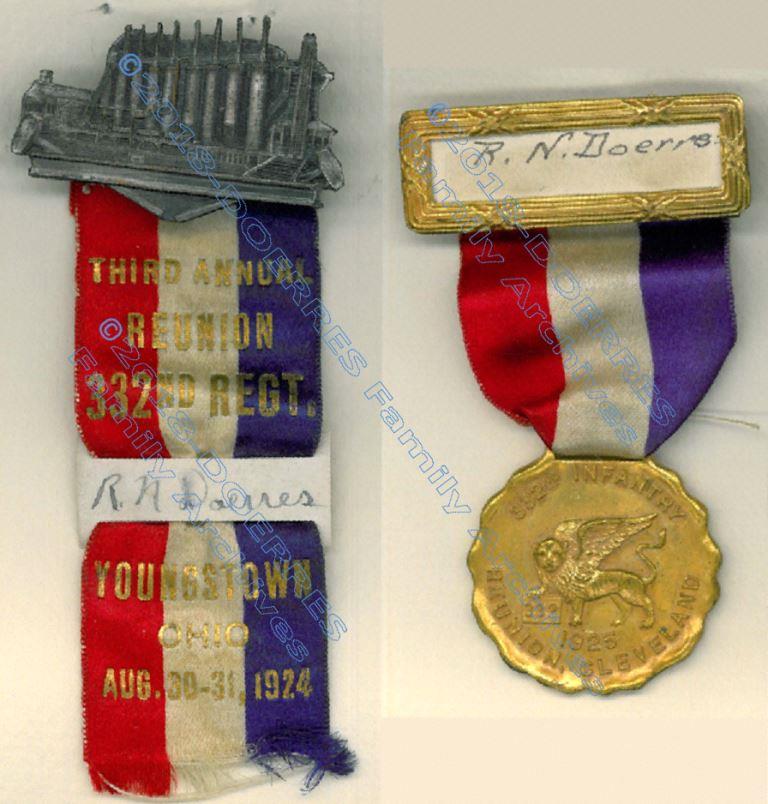 Upon returning to civilian life in Chillicothe, he kept busy in the decade following the war by: obtaining a patent for an anti-skid tire-chain system he designed; running for a Councilman-at-Large seat; quarterbacking a regional professional football team; attending 332nd Infantry reunions; working for a local construction company; becoming a partner in a retail paint, glass and wallpaper store; etc. In the early 1930s Ralph and our mother, Mabel, were married and began the task of raising our family. Ralph, along with his new title, responsibilities and duties as Daddy, became the owner of the paint store and continued being active community affairs serving as an officer in the local Elks and American Legion, a neighborhood Civil Defense air-raid warden during WWII, a precinct election official and a Deacon of the 1st Presbyterian Church.
Over the years, he would often talk with his friends Austin Story and Colonel Wallace, both residents of Chillicothe, and, among other topics, reminisce about their experiences in Italy in WWI. When Mr. Story took a trip to Europe in the mid-1950s he sent our father postcards from Villafranca and Rijeka (formerly Fiume).


"Sept 12 – Dear Ralph – Remember this old tower? And the trench mortar accident across the river Mincio? Have seen it all today – including our camp site in the mulberry trees. Have enjoyed it. The memory of old times & old friends. Austin"
——
Rijeka — Fiume Sept 1[?] Dear Ralph – Does this landscape look familiar? This AM saw your old school house barracks and the palace – Have been thru Treviso – over the Piave & Tagliamento for the second time — Very interesting trip – A. P. Story
* * *
At home, though, Daddy seldom spoke much about his army life with the 332nd Infantry but we fondly remember a few of his stories about his time with “Wallace’s Circus”:
A situation at Camp Sherman when they had to take the pistols away from some of the young, new officers who were “playing cowboy” – hiding behind desks and tables pretending to shoot at each other with their side arms.
The outdoor public toilet stalls (pissoirs) in France and/or Italy where one could see the man’s hat and shoes but everything in between was hidden.
While he was out on one of the long training/propaganda hikes in the country near Treviso [ before the offensive drive against the Austrians ] they came upon a Scotch soldier, who happened to be on a white horse, who remarked something to the effect that “…you should have seen the bunch of Americans that came through here yesterday! ” – in fact, it was the very same 332nd Infantry soldiers, but in a different uniform combination — [ members of the Allied forces were fooled as well as the enemy ]
There was a lot of mud and the going was difficult
Being so far ahead of their food supplies that they didn’t have enough to eat – they had to forage for food and could only find cabbage [during the advance against the Austrians: Battle of Vittorio-Veneto] – he didn’t like cooked cabbage for many years afterwards.
Taking a row boat out to a ship in a harbor [Fiume] to get “beans” because they were hungry [November, 1918—February, 1919]
* * *
Not long after retiring from the paint store at the age of 66, he died of a heart attack while attending a holiday dance at the Elks Club in December, 1958.
_____ ♦ _____
Return to "332nd Inf. Soldier Profiles" main page